
Global Reformed University Theological Seminary
A History of the Early Church
From Jerusalem to Chalcedon
Steve Jun
Publication Information
Title A History of the Early Church: From Jerusalem to Chalcedon Author Steve Jun Institution Global Reformed University Theological Seminary (GRUTS) Manuscript year 2026 Language Easy English. A Korean edition is also available. Subjects Early Christianity, church history, historical sources, Reformed theology and ministry Format Student textbook with companion appendices and a facilitator manual Publication record Publisher, place of publication, edition, rights holder and ISBN are pending confirmation. | Description This course follows the early church from the first Christian communities in Jerusalem to the Council of Chalcedon in AD 451. Sixteen lessons cover the spread of the gospel, worship and care, persecution, the reading of Scripture, imperial power and the church’s confessions about God and Christ. The lessons bring letters, laws, creeds, buildings and inscriptions into conversation with Scripture and the life of local churches. Readers can follow the evidence using the timeline, maps and source readings in the companion appendices. Availability The course materials consist of the student textbook, the appendices and the facilitator manual. The student textbook and its companions are available in English and Korean. About the Author Steve Jun is a missionary and theological educator. His teaching and writing integrate Scripture, Reformed theology, church history, and training for local church leaders, alongside strategic mission development and tech-enhanced ministry through MissioTech and GRUTS. He also authored A History of Christianity in the Philippines. |
For Academic Use
The book serves seminarians, pastors, church workers and theology students who read in English as an additional language. Its sixteen lessons support a four day intensive, regular classes, small groups and independent study. Each lesson joins historical teaching with a source activity, a ministry case, discussion, reflection and prayer.
Recommended Manuscript Citation Jun, S. (2026). A history of the early church: From Jerusalem to Chalcedon [Course textbook manuscript]. Global Reformed University Theological Seminary. Copyright and Edition Edition and copyright details for the textbook are pending confirmation. Credits and stated use terms for third party materials appear with the relevant sources and figures. Scripture Quotations Lesson 2 draws its two short Scripture quotations from the New English Translation (NET, Biblical Studies Press, 2017). It refers to the NRSV Updated Edition for comparison at Acts 11:20. Appendix D, Lesson 2, uses the Nestle–Aland Greek New Testament, 28th edition, with direct translations. Visual and Source Credits Figure captions and references identify the sources and use terms of historical images and maps. Appendix E identifies the Metropolitan Museum of Art facsimile and the Yale University Art Gallery excavation photograph. Lesson references give the editions and translations of ancient texts. |
Cover Illustration Disclaimer
The cover is an AI-generated conceptual illustration inspired by early Christian symbols and Late Antique church architecture. It does not depict a specific historical monument, archaeological site, or reconstructed city. Its architectural features, mosaic, and landscape are artistic representations intended to evoke the historical and theological development of the Early Church.
Acknowledgements
Gratitude for the Gospel and for Those Who Teach It
“Not to us, LORD, not to us but to your name be the glory,
because of your love and faithfulness.”
Psalms 115:1 (NIV)
I give thanks first to the triune God. In his providence, the good news of Jesus Christ was heard in Jerusalem, carried across languages and taught in places the first believers could scarcely have imagined. As we read about their courage and weakness, I pray that the glory for the church’s life and witness will go to God.
I thank the faculty, leaders and supporters of Global Reformed University Theological Seminary for their service to theological education. Studying the early church in a seminary belongs alongside the patient work of teaching Scripture in congregations, forming leaders and helping people take responsibility for one another.
I give thanks for Missionary JS Kim and Missionary JS Kang, whose service to the Filipino church I acknowledged in A History of Christianity in the Philippines. Their long work of prayer, teaching and church planting puts familiar faces beside the questions raised by this book. Who carries the message to the next household? Who teaches people who are new to the faith? Who remains to care for them?
I am grateful for the pastors, elders, deacons, teachers, local workers and families of Tuguegarao, Cagayan and the Lagum area. A classroom can learn from the experience of a worker who visits households or from a teacher who listens as students explain a passage in their own language. Their questions help us see what faithful teaching and care require in a particular place.
I thank the librarians, archivists, archaeologists, editors and translators whose work allows students to examine the old records. A catalogue entry, a careful translation or a photograph of a manuscript page makes it possible to return to the evidence and reconsider what we first thought it showed.
I thank my wife, Gloria, for her prayer, patience and companionship in the work of teaching and writing. I also give thanks for the quiet service of people who prepare a classroom, welcome a visiting student or make time for a tired ministry worker to rest.
To the students and church workers who will open this book, thank you for bringing your questions and your experience. May the Lord give us ears to hear, humility to revise a judgment and patience to teach and care for the people he has placed among us.
Steve Jun
Preface
Reading Early Church History through Providence, Confession and Mission
Why This Book Exists
When a church prepares an anniversary booklet, one family may remember the first Bible study in a home. Another person may remember the preacher at the first public service. Both memories matter. Each points to a different event that helped form the church. In Lesson 1, a fictional church near Lagum faces this question. So do readers of an ancient letter from Rome to Corinth. The letter tells us what the Roman church said about a dispute over leaders. What would we need to hear from Corinth to understand the dispute more fully?
This book helps seminarians, pastors and church workers in Cagayan, Lagum and beyond study the early church with that kind of care. We confess Jesus Christ as Lord of history and head of the church. We want to learn how believers taught the faith, welcomed people, dealt with disputes and cared for their neighbors. We also want to ask how Scripture guides our judgments about their choices. Each lesson gives the reader a place to practice. You can work through it in a class, in a church group or on your own.
Four Ways to Read This History
Keep providence, confession, mission and the life of local churches in view as you read. Consider the Christian gathering Justin describes. Its people hear readings, share the Lord’s Supper and give to help people in need. Ask how God cares for people through ordinary acts, what the church confesses in worship, how its practices become visible to outsiders and who carries out the work. Each question helps you notice a different part of the same gathering (First Apology 65–67).
Lens | Question to carry into the lessons | Example in the book |
|---|---|---|
Providence | How does God’s care call us to gratitude and responsible action? | The elders in a Cagayan case can listen and give practical help to a family under pressure (Lesson 5). |
Confession | What does the church say about God, and how does it reason from Scripture? | Read John 1:1–3 beside the confession about the Son at Nicaea (Lesson 10). |
Mission | Who carries the gospel, and what does it change in the places where people hear it? | Trace the people who spoke about Jesus in Syrian Antioch (Acts 11:19–26, Lesson 2). |
Local churches | Who teaches, makes decisions, receives care or helps others take part? | Look at what deacons did for believers who were absent (First Apology 65, Lesson 4). |
A Reformed Method for Reading History
Begin with the evidence. Place it in its setting. Then weigh what people did in light of Scripture and ask what your church can learn. A careful reader may thank God for faithful witness and still need records to explain a governor’s decision. Scripture is the final authority for faith and life. The Westminster Confession helps readers state their theological reasoning clearly and calls them to test judgments by Scripture (Westminster Confession of Faith 1.10 and 5.1–3).
Step | What to ask | What to do |
|---|---|---|
1. Evidence | Who speaks? What does the source say? When and where? | Mark one line in Trajan’s reply. Write the letter number and a claim the line supports (Letters 10.97). |
2. Context | Who is the audience? What problem is the writer addressing? | Read the governor’s question beside the reply. Compare that exchange with what the church of Smyrna hoped readers would remember (Letters 10.96–97. Martyrdom of Polycarp 17–18). |
3. Reformed assessment | What does Scripture say about the choice or practice? | Read 1 Peter 4:14–19 and Matthew 10:23. Explain how a believer can keep trusting Christ and seek safety. |
4. Ministry application | What can a church do in its own setting? How can it check whether that helps? | In the Cagayan case, choose one person to hear the family privately and agree with the family on one kind of help (Lesson 5). |
How the Book Is Organized
The sixteen lessons follow four parts. A four-day course covers one part each day. In weekly study, take one lesson at a time and use the first few minutes to recall the previous source. Keep your written answers and revised case decisions. In Lesson 16, they will help you build and review a thirty-day ministry plan.
Part | Historical focus | Question for discernment |
|---|---|---|
1 · Lessons 1–4 | Jerusalem and Antioch, the Apostolic Fathers, leadership, worship and baptism. | How did communities teach the faith and make room for people to belong? |
2 · Lessons 5–8 | Roman pressure, accounts of martyrs, public defenses, Scripture and everyday care. | How can believers speak truthfully and serve others when their faith is questioned? |
3 · Lessons 9–12 | Imperial policy, Nicaea, the Holy Spirit and the Trinity, and the confession of Christ at Chalcedon. | How do we read a ruler’s decision and a church’s confession according to what each document does? |
4 · Lessons 13–16 | Christian communities across regions, Augustine, grace and unity, formation and care. | What can churches today learn from communities that faced different needs in different places? |
Global Church Context
Follow the people as well as the dates. Acts names several places connected with the growth of the church in Antioch. An Egyptian papyrus preserves the words of one person and two witnesses. A building in Dura-Europos gives evidence from a community on Rome’s eastern frontier. The Aksum inscription gives a ruler’s public words. Keep a map open when you read. Ask what kind of movement or connection the source actually shows. The Council of Chalcedon in AD 451 gives the course its closing point. The histories of these communities continue beyond it.
Period | Places or settings | Why they matter here |
|---|---|---|
First century | Jerusalem and Syrian Antioch | Acts and Galatians show how the gospel spread and how shared life raised questions about belonging (Lesson 2). |
Second and third centuries | Bithynia-Pontus, Smyrna, Carthage and Theadelpheia | Compare officials’ records with Christian accounts. Each gives evidence about people in a particular place (Lesson 5). |
Fourth and fifth centuries | Nicaea, Constantinople, Ephesus and Chalcedon | Read how councils stated what churches confessed about God and Christ. Check the wording and date of each text (Lessons 9–12). |
Across the course | Dura-Europos, Armenia, Persia and Aksum | Read a building, a dialogue, a later account and an inscription on their own terms. Their evidence differs (Lesson 13). |
How to Use Each Lesson
Keep the Appendices beside the Student Book. Use A–C to locate events, places and unfamiliar terms. Use D to find the ancient reading and its edition, E to look closely at Greek texts or objects, and F to compare two sources in writing. A grade tells you how the wording on the page relates to an ancient text or witness. A historian still asks whose voice that text preserves and what question it can answer. Teachers and group leaders can use the separate Facilitator Manual for a ninety-minute session.
Practice | What to do in a lesson |
|---|---|
Read | Start with the Bible passages and the overview. Follow the main historical question through the narrative. |
Mark | Underline a place, person or date that matters. Record a chapter, verse, section or object number that you can find again. |
Discern | Write one sentence about the source and one about how Scripture helps you evaluate the practice. Give the reason for each. |
Apply | Write your answer to the case before checking the example. Compare it with a partner or revise it on your own. Name a person, an action and a way to check the result. |
Pray | Use the lesson’s prayer points. Thank God for what you have learned and ask for help with one action you can take. |
Charity, Critique and Limits
Give historical people a fair hearing. When a writer describes an opponent’s belief, name the writer and the purpose of the account. Read the opponent’s own words when they survive. When you read Augustine’s letters on church unity, identify each recipient and request before comparing his choices. When you study a creed, explain what it confesses in its own words before judging how people used it. Keep track of dates that are estimates and questions for which the sources give only one voice. In a ministry discussion, ask what the people affected would say about the proposed action.
A Reading Covenant
Before Lesson 1, read these commitments privately or with your group. Return to them when a source is difficult or a case brings out strong disagreement.
• I will read before the Lord with gratitude for the faith handed down to the church.
• I will examine theological claims in light of Scripture and use the Reformed confessions to explain my reasoning.
• I will name my evidence, identify whose words I am reading and say when a question remains open.
• I will listen fairly, describe disagreements accurately and correct my own claims when I find better evidence.
• I will ask what this history teaches us about worship, discipleship, leadership, mercy and mission in our own setting.
• I will pray that Christ will strengthen the Filipino church and churches across the world to serve their neighbors faithfully.
References for the Preface
A History of Christianity in the Philippines, introduction. See also the Student Book, Lessons 1, 2, 5, 10, 12, 13 and 16, and the Appendices, especially D and E. For the confessional references, read the Westminster Confession of Faith 1.10 and 5.1–3.
Table of Contents
A History of the Early Church 2
Day 1 The Church Takes Shape 16
Reading Early Church History 17
From Jerusalem to Many Peoples 28
Worship Baptism and Christian Life 50
Defending and Explaining the Gospel 69
Scripture and the Rule of Faith 78
Everyday Christians and Mission 86
Day 3 Empire and Christian Confession 94
The Church and Imperial Power 95
The Holy Spirit and the Trinity 112
Day 4 Churches across Cultures 128
Augustine Grace and Church Unity 138
Formation Learning and Care 146
Learning from the Early Church 154
Appendix B Maps and Places 168
Appendix C People and Terms 171
Appendix D Ancient Sources for Lessons 1–16 173
Course Syllabus
A History of the Early Church | From Jerusalem to Chalcedon
Item | Course Information |
|---|---|
Course format | Four days, 16 lessons, four per day. Each lesson lasts 90 minutes. Total instruction is 24 hours, excluding breaks. |
Audience | GRUTS seminary students, church leaders, ministry educators, and English-language learners. |
Course level | Seminary-level introduction with Reformed theology and ministry practice. |
Course leader | Designated by the seminary or training host. |
Primary coursework | Reading notes, source comparisons, daily reflections, case responses, and the Lesson 16 ministry plan. |
Course Description
Follow the early church from Jerusalem to the Council of Chalcedon in AD 451. Study worship, mission across cultures, the reception of Scripture, responses to empire, and debates about the Trinity, Christ, grace, and unity.
Read ancient texts and objects in context. Apply Scripture and Reformed confession to ministry cases set in places such as Cagayan and Lagum. Both language editions support classes, groups, and independent study.
Course Learning Outcomes
• Locate major people, places, and events on course maps and the timeline.
• Support a historical claim with an exact passage or object number and explain its limits.
• Explain how worship, mission, and care took shape in different settings.
• Use Scripture to explain early confessions about the Trinity and Christ and to assess questions about grace and church life.
• Design a 30-day ministry response using two ancient sources and a biblical reason.
Course Arc
Day | Theme | Lessons | Integrative Outcome |
|---|---|---|---|
Day 1 | The Church Takes Shape | 1–4 · Evidence, mission, leadership, and worship | Use a letter, Scripture, and early church instructions to explain how local churches took shape. |
Day 2 | Witness and Mission | 5–8 · Persecution, defense, Scripture, and daily life | Read records from different viewpoints and connect Christian witness with practical care. |
Day 3 | Empire and Christian Confession | 9–12 · Imperial power, Nicaea, the Trinity, and Chalcedon | Distinguish imperial action, council confession, and local reception. Explain core teaching from Scripture. |
Day 4 | Churches across Cultures | 13–16 · Mission across regions, Augustine, formation, and application | Compare sources across cultures and use the evidence to plan one local ministry response. |
Recommended Daily Rhythm
Time | Activity | Purpose |
|---|---|---|
08:30–10:00 | Session 1 | Open the day’s theme in Scripture and place the first lesson in context. |
10:00–10:15 | Break | Rest before the second session. |
10:15–11:45 | Session 2 | Practice locating and explaining evidence. |
11:45–13:00 | Lunch | Rest and informal conversation. |
13:00–14:30 | Session 3 | Connect the lesson’s sources with biblical and Reformed assessment. |
14:30–14:45 | Break | Rest before the final session. |
14:45–16:15 | Session 4 | Complete the last case and record one insight for the day. |
Each 90-minute session has six parts. Opening 10 minutes, context 15, source reading 20, case work 20, discussion 18, and closing check and prayer 7.
Detailed Four-Day Schedule
Day / Session | Lesson Focus | Core Activity |
|---|---|---|
Day 1 / S1 | 1. Reading Early Church History | Write a Lagum anniversary caption with a source and verification step. |
Day 1 / S2 | 2. From Jerusalem to Many Peoples | Compare Acts 15 and Galatians 2. Plan how to welcome newcomers. |
Day 1 / S3 | 3. The Apostolic Fathers | Compare leaders’ roles. Plan a first conversation with a Bible group leader. |
Day 1 / S4 | 4. Worship Baptism and Christian Life | Read Justin on worship. Plan four weeks of teaching and care. |
Day 2 / S1 | 5. Persecution and Martyrdom | Compare the governor’s letters and martyrdom account. Respond to a threatened family. |
Day 2 / S2 | 6. Defending and Explaining the Gospel | Compare Irenaeus’s statements about faith and Marcion. Write a respectful reply. |
Day 2 / S3 | 7. Scripture and the Rule of Faith | Compare the book lists and check the video’s claim about Nicaea. |
Day 2 / S4 | 8. Everyday Christians and Mission | Identify two voices in Origen. Plan fair food relief and voluntary Bible study. |
Day 3 / S1 | 9. The Church and Imperial Power | Compare the three imperial measures. Draft one literacy room agreement term. |
Day 3 / S2 | 10. Nicaea and the Son of God | Compare Arius’s letter and the creed. Explain John 1:1–3 to a new believer. |
Day 3 / S3 | 11. The Holy Spirit and the Trinity | Compare the Spirit clauses. Explain the Trinity in three sentences. |
Day 3 / S4 | 12. One Christ in Two Natures | Compare Cyril and Chalcedon. Explain Jesus’s full deity and humanity. |
Day 4 / S1 | 13. Beyond the Roman Empire | Compare the Bardaisan dialogue and Dura’s building. Test a sentence in two languages or two plain versions. |
Day 4 / S2 | 14. Augustine Grace and Church Unity | Read Augustine on grace and authority. Rewrite a volunteer invitation. |
Day 4 / S3 | 15. Formation Learning and Care | Compare Basil and Gregory. Make a four-week teaching and care rota. |
Day 4 / S4 | 16. Learning from the Early Church | Use two ancient sources and Scripture to prepare a 30-day ministry plan. |
Possible Assignments and Assessment
Adapt these suggested assignments to the group. Use the right column to guide feedback.
Assessment | What to review |
|---|---|
Preparation and reading notes | One located detail, one question, and one possible ministry implication. |
Participation and source work | A cited claim, a fair limit, and a useful response to a partner’s reading. An independent learner can write the response. |
Daily reflection and case response | A clear connection between the evidence, a biblical reason, and a practical action. |
Short church-memory exercise | A caption and verification step from Lesson 1, with two relevant pieces of evidence where available. |
Final integrative plan | A realistic first action and a way to review one observable result within 30 days. |
Assignment Details*
• Before each day, read the Bible passages and assigned lessons. Note a historical observation, a biblical question, and a ministry implication.
• Use Appendix F to compare two sources. Cite each, state its purpose, and name evidence that could answer a remaining question. Appendix grades identify the form of the text.
• Save one reflection and case answer each day. Revise one sentence after using the sample or receiving feedback.
• Use Lesson 1’s Lagum case to write a caption. Name a record or witness that could help verify it.
Final Integrative Assignment*
Use the Lesson 16 worksheet. Describe one local ministry question and the people affected by role. Cite two ancient sources and one claim each supports. Give a biblical reason and two differences between the ancient and present settings.
Name the first action, responsible person, date, and needed support or consent. Choose one observable result to check by day 30 and whom to ask. Revise before submitting.
Course Expectations*
• Bring a Bible, the Student Book and Appendices, and writing materials. Read the source before viewing model answers.
• Represent others fairly. Check dates, names, places, and quotations against the sources.
• Use historical evidence for claims about the past and Scripture to support theological judgments.
• Check digital or AI-assisted quotations against the named edition before citing them.
• Use role names in case work. Ask permission before sharing private church information.
For a missed session, complete the corresponding source and case activities and check your answers.
* may be changed during the course
Required and Recommended Readings
Category | Reading |
|---|---|
Core reading | Student Book Lessons 1–16 and their key Bible passages. |
Ancient sources and tools | Appendix D readings. A–C supply context, E presents texts and objects, and F supports comparison. |
Confessional reading | Nicene Creed (325), Chalcedonian Definition, and Westminster Confession of Faith 1.10, 2.3, and 8.2. |
Further reading | Editions and passages cited in the Student Book. |
Core Theological Commitments
• Scripture has final authority for faith and practice. Reformed confessions help us express and test our judgments.
• God’s providence leads us to remember the past with gratitude and humility. Evidence helps us tell it truthfully.
• Christ gathers his church around the Word, sacraments, and prayer. Leadership, discipline, mercy, and mission belong to its shared life.
• Grace in Christ gives rise to good works. Study the past to discern how to serve faithfully today.
Recommended Reading List
Begin with the lesson passages. Use these reading paths for deeper study.
• Early church. Read 1 Clement 44, Didache 7 and 15, and Justin’s First Apology 65–67. See Everett Ferguson, Church History, Volume One (2005), chapters 3 and 6, for context.
• Councils and creeds. Compare the 325 creed, the creed associated with Constantinople, and the Chalcedonian Definition in Lessons 10–12 and Appendix D.
• Grace and ministry. Compare Augustine’s On Nature and Grace 1–3 and Basil’s Letter 94 using Appendix F.
Day 1 The Church Takes Shape
Before Lesson 1 · Background Guide
The World of Jesus and the First Churches
Historical political and social background
A preparation guide for
A History of the Early Church
From Jerusalem to Chalcedon
Global Reformed University Theological Seminary
2026
Why we begin here
Dates help us find our place in history. But dates alone do not show what people faced. This guide helps us ask how rulers, languages, worship, work and social relationships shaped the world of Jesus and the first believers. It prepares us to read the course textbook, not to replace it.
We first examine the ancient evidence. Then we ask how Scripture guides Christian judgment. Finally, we compare a carefully defined issue with church life today. An ancient situation and a present situation may share a question without being the same situation.
1 How to use this guide
The main story runs from the world before Jesus to the first decades after his ascension. A short look ahead to AD 70 explains a later turning point. The wider course continues to Chalcedon in AD 451. Read this guide before Lesson 1, or use selected pages before Lesson 2.
For a 45 minute opening session: spend 10 minutes on the timeline, 15 on one background topic, 10 reading one source, and 10 on a local application question. Longer classes can use the cases near the end. Students may discuss in a language they understand well before giving a short English answer.
Three different kinds of statement
- Evidence What does this passage or object actually say?
- Historical interpretation What explanation fits the evidence, and what remains uncertain?
- Christian application What should we consider in our setting, in the light of Scripture?
Christian confession: We confess that Christ is Lord and the Holy Spirit empowers witness. Historical study investigates human events and conditions; it does not turn God’s work into a formula for church growth.
Read and check: Acts 1:6–11; course textbook, Preface, pp. 5–8, and Course Syllabus, pp. 11–12. All page numbers refer to the 193 page English PDF.
2 A timeline before the first churches
BC means before Christ. AD is the traditional Christian era label. There is no year zero in this system. “About” marks an estimate, not an exact date.
Date |
Change |
|---|---|
539 BC |
Persia takes Babylon; a new imperial setting for Jewish return. |
515 BC |
The rebuilt Jerusalem temple is completed. |
334–323 BC |
Alexander conquers the Persian Empire; he dies in 323. |
After 323 BC |
Successor kingdoms compete; Judea lies between major powers. |
167–164 BC |
Religious coercion, revolt and temple rededication. |
63 BC |
Pompey takes Jerusalem; Roman dominance deepens. |
37–4 BC |
Herod the Great rules as a Roman client king. |
Early AD 1st century |
Judea comes under direct Roman administration. |
During Jesus’ ministry |
Pontius Pilate governs Judea; Antipas rules Galilee. |
Read and check: Ezra 6:13–18; Hemingway and Hemingway [S2]; Martin, Lecture 4 [S3]; 1 Maccabees 1 and 4 [S4]; Josephus, Antiquities 14.4 and 18.1–3 [S5–6]. See also [S23–24] for Babylon and the Second Temple. Chronological labels are conventional historical reconstructions; they are not all dates printed in those ancient texts.
3 Before the New Testament
“Between the Testaments” is a Christian teaching label. It must not mean that Jewish life stopped or that God was absent. “Second Temple period” is a wider historical term: it includes the era of the rebuilt Jerusalem temple until its destruction in AD 70.
Ezra describes rebuilding under Persian rule. Worship, Scripture and community identity mattered, even when the people did not have an independent kingdom. Many Jews also lived outside Judea. The world of Jesus therefore had both a homeland and communities abroad.
This background helps us hear questions about restoration and belonging. When the disciples ask about restoring the kingdom to Israel, their question belongs to a long story. Acts 1 then directs their attention to the Spirit and witness. We must read that answer before turning the background into a political programme.
Think together
What can a people preserve when political control belongs to someone else? Which answer comes from the source, and which is your inference?
Read and check: Ezra 6:13–22; Acts 1:6–11; Acts 2:5–11. The term “Second Temple period” extends beyond the narrower Christian label “intertestamental”.
4 Greek language and cultural pressure
Alexander’s conquests changed political power across a large region. After his death, successor kingdoms competed for territory. Greek language and forms of city life spread, but local languages and traditions did not disappear. Hellenization means this uneven process of Greek cultural influence, not everyone becoming the same.
Judea came under rulers connected with Egypt and Syria. Some Jewish leaders welcomed Greek institutions; others resisted changes they saw as threats to covenant faithfulness. Language learning and forced religious conformity were not the same thing.
Greek later helped communication across some communities. It did not remove the need to explain the gospel. Acts 2 emphasizes people hearing in their own languages. A shared language can connect people while also excluding those who do not know it.
Think together
When is learning a shared language helpful? When can church language become a barrier? Do not assume the language needs of every Cagayan congregation are identical.
Read and check: Hemingway and Hemingway [S2]; Martin, Lecture 3, opening historical sections [S9]; 1 Maccabees 1:11–15 [S4]; Acts 2:5–11.
5 Resistance memory and hope
In the second century BC, Antiochus IV tried to impose religious changes in Judea. First Maccabees describes interference with worship and Jewish practices, a revolt, and the rededication of the temple under Judas Maccabeus in 164 BC. The Hasmonean family later held political power. These events joined questions of worship, identity and rule.
The book supports the resistance. It is evidence from a particular viewpoint, not a neutral camera recording every person. In this Reformed course we use First Maccabees as an ancient historical source, not as a replacement for canonical Scripture.
Memories of foreign domination help explain why freedom and restoration mattered. They do not prove that every Jew expected the same Messiah or supported armed revolt. Avoid describing the whole population through the actions of one party.
Think together
Name one action reported in the source and one judgment made by its writer. How would another participant’s testimony help?
Read and check: 1 Maccabees 1:41–64; 4:36–59 [S4]; Martin, Lecture 4, chapters 1–2 [S3].
6 Roman power was not one simple system
Pompey captured Jerusalem in 63 BC during a struggle involving rival local rulers. Roman power then worked through changing arrangements, including client kings and direct governors. A client king ruled with Rome’s support; he was not simply an independent national king.
In Jesus’ adult life, Judea and Galilee did not have the same immediate ruler. Luke 3 names Pilate in Judea and Herod Antipas in Galilee, alongside the emperor and priestly leaders. Political and religious authority overlapped but were not identical.
Taxation and foreign rule could provoke resistance. Yet responses varied. Some negotiated, some resisted, and many tried to maintain daily life. The expression “Roman peace” must not make us forget conquest and coercion. Rome provided some conditions for travel, but it also used violence. Jesus’ crucifixion took place under Roman authority.
Think together
How might different kinds of authority affect one family? In a modern case, identify the actual decision maker rather than saying only “the government”.
Read and check: Josephus, Antiquities 14.3–4 and 18.1.1 [S5–6]; Luke 3:1–2; Mark 15:1–27.
7 Jewish life was diverse
Jesus and his first followers were Jewish. Israel’s Scriptures, the temple, festivals, Sabbath and local gatherings formed their world. Christianity did not begin as a foreign movement with no connection to Jewish life.
Josephus describes Pharisees, Sadducees and Essenes, with different teachings and practices. His categories are useful but do not describe every ordinary person. A Pharisee is not simply a word for a hypocrite, and a Jew is not simply an opponent of Jesus. Acts 15 even speaks of Pharisees who believed.
Synagogues provided settings for Scripture reading and communal life. Their forms varied. Scholars debate their origins; do not give one confident founding date for all synagogues. The Jerusalem temple and local synagogue gatherings were not interchangeable institutions. Understanding these distinctions helps us read disputes about teaching, purity and belonging more fairly.
Think together
Which group or person is speaking in a passage? What evidence would be needed before applying that description to all Jews?
Read and check: Josephus, Antiquities 18.1.2–5 [S6]; Acts 15:5; Runesson, “The Nature and Origins of the 1st-Century Synagogue” [S13].
8 Work households and unequal power
The first churches were not only public speeches and famous leaders. People needed food, work, housing and care. Acts 18 places Paul, Priscilla and Aquila in a shared trade. Romans 16 names people who helped, worked and hosted a church. Such evidence shows concrete relationships through which Christian communities lived.
A meeting in a home could provide hospitality. It could also expose differences in wealth and influence. Paul criticizes a gathering where some eat well while others go hungry. Shared Christian identity did not automatically remove unequal treatment.
Ancient households could include dependents and enslaved people, not only a modern nuclear family. We should not romanticize them. Ask whose voice survives, who owns resources, and who may find it difficult to disagree. These are questions for examining evidence, not permission to invent the private thoughts of silent people.
Think together
Read 1 Corinthians 11:17–22. What unequal treatment does Paul actually describe? What details about its cause remain unstated?
Read and check: Acts 18:1–4; Romans 16:1–16; 1 Corinthians 11:17–22; Martin, Lecture 3, household discussion [S9].
9 Jesus in this world
The Gospels place Jesus within Jewish life under Roman power. They present his message and actions in relation to God’s kingdom, Scripture, worship and human need. Read the particular Gospel passage before explaining how its setting matters. Background should clarify the text, not replace it.
Mark 15 brings several kinds of power together: priestly accusation, Pilate’s judgment, a crowd and Roman soldiers. The royal accusation above the cross shows that the execution had a political dimension. It does not make Jesus merely another political rebel. Nor does the narrative justify blaming all Jews, then or now.
Christians confess Jesus’ death and resurrection as saving events. Historical background helps us understand the setting in which these claims were proclaimed. It does not by itself prove or disprove every theological claim. Keep an account of an event, its Christian meaning, and a modern application distinct.
Think together
Who can order an action in Mark 15, and who cannot? What would be lost if we described the scene only as “a religious disagreement”?
Read and check: Luke 3:1–2; Mark 15:1–27. Read the Gospel as theological testimony with historical claims, not as a modern court transcript.
10 After the ascension
Acts 1 presents the risen Jesus sending his followers as witnesses through the power of the Holy Spirit. Acts 2 describes Pentecost, the proclamation of Jesus, and a community marked by teaching, prayer, meals and care. This is the narrative’s theological explanation of the church’s mission, not a claim that transport or language created faith.
Growth also brought practical problems. Acts 6 reports a complaint that Greek-speaking widows were neglected in daily provision. The community did not solve this merely by repeating that everyone belonged. It appointed people to take responsibility.
This episode shows that language and social relationships could affect care inside the church. The text reports the complaint and the response; it does not supply a modern statistical survey or prove deliberate hostility by every Hebrew-speaking believer. Read carefully before diagnosing motives.
Think together
What did the church hear, decide and change? How could a leader today check whether a care system misses some people without accusing them before investigation?
Read and check: Acts 1:6–11; 2:1–11, 22–47; 6:1–7.
11 The gospel crossed boundaries
Acts 11 connects the movement of scattered believers with witness in new places. Acts 18 connects migration, work and teaching. Roads, sea travel and shared languages could support contact. They also carried risks. Paul recalls hunger, violence and shipwreck; Acts 27 describes a dangerous voyage. Better connections did not guarantee safety or faith.
As Gentiles joined, questions of belonging became urgent. Acts 15 reports a public discussion and a decision. Galatians 2 gives Paul’s account of conflict over eating together. A decision about inclusion did not make daily fellowship automatic. The exact relationship between the visits described in Acts and Galatians is debated; this guide does not force them into one certain sequence.
In AD 70 Roman forces destroyed Jerusalem’s temple. This was a major later disruption, not an event immediately after the ascension. It should not be treated as a single date when every Jewish and Christian community separated.
Read and check: Acts 11:19–26; 18:1–4; 27:1–20; 2 Corinthians 11:23–28; Acts 15; Galatians 2:1–14; Josephus, Jewish War 6.4.5–7 [S22]. Course textbook, pp. 29–33, preserves the Acts 11:20 “Greeks/Hellenists” textual caution; do not erase it.
12 Local discussion cases
These are invented teaching cases, not reports about actual churches in Tuguegarao, Lagum or Cagayan. Ask local participants which details fit their setting.
Case A A language at the table
A church welcomes students from several places. The familiar language works for long-standing members, but two newcomers stay silent. A leader calls them uninterested.
Read Acts 6:1–7. What is similar, and what is different? What should you ask the newcomers before judging them? Plan one small change and one way to check its effect.
Case B A generous host
A respected family offers a room and meals for a Bible group. People begin to avoid questions that might upset the host. The gift is useful, but discussion becomes narrow.
Read Romans 16:3–5 and 1 Corinthians 11:17–22. Do not assume every host abuses power. How can the group thank the host while protecting fair participation? Name a transparent procedure, not an accusation.
Case C A useful connection
A church can share lessons online, but some members cannot join easily. Does a larger audience prove deeper discipleship? What evidence would you collect? Compare the opportunity and danger of ancient travel without equating a Roman road with the internet.
13 From background to the course
You are now ready to ask more precise questions in the course. Lesson 1 teaches us to read evidence. Lesson 2 examines mission and belonging. Lesson 3 introduces the Apostolic Fathers. Later lessons consider worship, persecution, confession and churches across cultures. The background is a starting point, not a complete explanation of every later event.
For each lesson, write four short statements: what happened, what a source supports, what remains uncertain, and one possible response in your church. Keep the local response open to correction by Scripture, better evidence and the people affected.
A short learning check
1. Put Persian rule, Alexander, Pompey and Pentecost in order.
2. Explain one opportunity and one danger created by connected travel.
3. Why is “all Jews thought the same” a weak historical claim?
4. Use Acts 6 to state a source based observation, then a separate modern application.
Facilitator checkpoints
Expected order: Persian rule → Alexander → Pompey → Pentecost. Look for specific evidence, not slogans. A good answer may remain cautious. Do not grade a student only by agreement with the teacher’s proposed local solution.
14 Words to remember
Second Temple period
The era of the rebuilt Jerusalem temple until AD 70.
Hellenization
The spread and local adaptation of Greek cultural forms.
Diaspora
People living outside their ancestral homeland; here especially Jewish communities abroad.
Client king
A king whose position depends on a stronger imperial power.
Synagogue
A Jewish local assembly and, in some cases, its meeting place.
Gentile
A person outside the Jewish people in this historical discussion.
Household
People attached to a home, sometimes including dependents and enslaved people.
Primary source
A text or object from the world being studied; it still needs critical reading.
Inference
An explanation drawn from evidence, not directly stated by it.
Application
A reasoned response in a present setting, not a claim that past and present are identical.
15 Sources and reading notes
References below identify material actually consulted for this guide. Bible passages are summarized in our own words, not presented as verbatim quotations. Bible passages were checked using the World English Bible. Korean summaries are explanatory renderings, not an official Bible translation.
Ancient sources have perspectives. Josephus’s English text is William Whiston’s older translation, hosted by the University of Chicago. Its bracketed dates and notes are editorial, not words written by Josephus. First Maccabees is consulted as historical testimony; its canonical status differs between Christian traditions. Modern lectures and articles are scholarly aids, not the doctrinal authority of this course.
[S2] Hemingway, Colette, and Seán Hemingway. 2004. The Rise of Macedon and the Conquests of Alexander the Great. Metropolitan Museum of Art. Alexander and successor kingdoms.
https://www.metmuseum.org/essays/the-rise-of-macedonia-and-the-conquests-of-alexander-the-great
[S3] Martin, Dale B. Introduction to the New Testament History and Literature, Lecture 4, Judaism in the First Century. Open Yale Courses. Chapters 1–2 and 4. Historical sequence; not blanket adoption of all interpretations.
https://oyc.yale.edu/religious-studies/rlst-152/lecture-4
[S4] 1 Maccabees 1:11–15, 41–64; 4:36–59. USCCB online text. Religious coercion and temple rededication.
https://bible.usccb.org/bible/1maccabees/1
https://bible.usccb.org/bible/1maccabees/4
[S5] Josephus. Antiquities of the Jews 14.3–4, especially 14.4.1–4. William Whiston translation. Rival rulers and Pompey’s capture.
https://penelope.uchicago.edu/josephus/ant-14.html
[S6] Josephus. Antiquities 18.1.1–6; 18.3.1–2. William Whiston translation. Census, groups and Pilate’s actions. Avoid the disputed Jesus passage at 18.3.3 as an unqualified proof text.
https://penelope.uchicago.edu/josephus/ant-18.html
16 Evidence limits and course connection
[S9] Martin, Dale B. Introduction to the New Testament History and Literature, Lecture 3, The Greco-Roman World. Open Yale Courses. Greek cultural influence and household structures.
https://oyc.yale.edu/religious-studies/rlst-152/lecture-3
[S13] Runesson, Anders. 2004. The Nature and Origins of the 1st-Century Synagogue. The Bible and Interpretation, July. An argument in an ongoing scholarly debate, not a settled single-origin account.
https://bibleinterp.arizona.edu/articles/2004/07/run288001
[S22] Josephus. Jewish War 6.4.5–7. William Whiston translation. Temple fire; the account’s explanation of Titus’s intentions requires critical assessment.
https://penelope.uchicago.edu/josephus/war-6.html
Course connection
Jun, Steve. 2026. A History of the Early Church: From Jerusalem to Chalcedon. GRUTS course textbook manuscript. English PDF, 193 pages. Preface pp. 5–8; syllabus pp. 11–12; Lesson 2 pp. 28–33. This guide supplies earlier background and does not renumber or rewrite the sixteen lessons.
What this guide does not claim
- A single agreed date for Jesus’ death or the ascension is not needed here. The first Christian decades are kept broad rather than assigned invented exact dates.
- A shared language, roads or social networks alone do not explain conversion.
- The three local cases are teaching constructions, not findings about real congregations.
- Only the listed portions of the course and external sources were checked for this supplement. This is not a claim that every statement in the full course has been independently verified.
Source access checked 17 November 2026 in Asia Manila time.
17 Chronology source notes
[S23] British Museum. Cyrus cylinder. Collection record on Google Arts & Culture. The museum description dates the conquest of Babylon to 539 BC. This object does not itself name a return of Jewish exiles. Read Ezra for the biblical account of return and rebuilding.
https://artsandculture.google.com/asset/cyrus-cylinder/4wHjbQnYhZgzVQ?hl=en
[S24] Second Temple Judaism. Oxford Bibliographies in Biblical Studies. Published 11 January 2012. Public introductory abstract, not the subscription-only bibliography. Its opening paragraph places return and temple rebuilding in 538–515 BC and temple destruction in AD 70.
https://academic.oup.com/reference/62341/reference-article-abstract/554095221
The timeline gives Herod’s rule from 37 to 4 BC following Martin, Lecture 4 [S3], the discussion of Roman rule. This is not the date of his earlier appointment in Rome. For Pilate and Antipas, Luke 3:1–2 identifies different areas of rule; the table deliberately does not require exact reign dates.
Chronology is a guide to sequence, not a substitute for explaining people’s experiences. When a date matters to an argument, check the ancient passage and the modern reconstruction separately.
Lesson 1
Reading Early Church History
First Clement and the Memory of the Local Church
Key Bible Passages
Passage | Historical Focus | Ministry Use |
|---|---|---|
Luke 1:1–4 | Luke follows earlier accounts and testimony carefully as he writes for Theophilus. | Ask who saw an event and how their account reached you. |
Acts 17:10–12 | The Bereans listen to Paul and Silas and examine the Scriptures. | Listen carefully to what people teach and test it by Scripture. |
Psalm 78:4–7 | God’s people tell the next generation about his works. | Tell the church’s story with gratitude and care. |
1 Thessalonians 5:21–22 | Paul tells the congregation to test what it hears. Read verses 19–20 for the setting. | Examine what you hear and hold on to what is good. |
Lesson Overview
What can Rome’s letter tell us about a leadership dispute in Corinth? In this opening lesson, you will read First Clement, or 1 Clement. The church in Rome wrote this letter to the church in Corinth. The writers say that some leaders lost their place and argue that they had served well. You will read for what the letter says, what it helps us explain and what we still need to learn.
The same skills will help you write part of an anniversary booklet for a fictional church near Lagum. You can study with a teacher, work with a group or read on your own. Write your own answers before checking the examples in the Activity section.
How to Study This Lesson
Read the Bible passages and the history first. Look at the visuals and complete the source questions in writing. Then read the assessment and work through the case and activity. Compare your work with the sample answers before writing your reflection and praying.
Learning Objectives
Area | Objective |
|---|---|
Historical Knowledge | Locate Rome and Corinth and put the letter and its later witnesses in order. |
Source Discernment | Use 1 Clement 1 and 44 to make a claim and state what needs further evidence. |
Theological Method | Explain how Scripture guides the way we judge past decisions. |
Ministry Practice | Write two sentences for a church booklet and plan one way to check them. |
Key Terms
Term | Simple Definition |
|---|---|
Primary source | Evidence from the time or people we study. |
Context | The setting in which something happened. |
Inference | A conclusion we draw from evidence. |
Providence | God’s wise care and rule over creation. |
Facsimile | A copy that shows what a document or page looks like. |
A Letter Between Churches
1. Open a Letter from Rome
Imagine sitting in a gathering in Corinth near the end of the first century. A visitor begins reading a letter aloud. The opening names the church in Rome and the church in Corinth. It asks for grace and peace through Jesus Christ. Within a few lines, the writers tell their readers that a conflict in Corinth has reached Rome. They also say that troubles of their own delayed their response. Those are the first details the letter gives. It leaves the nature of the Roman troubles and the date of the letter unstated. The scene of a listener helps us picture the distance the letter traveled, while the text itself gives the names of the two communities. (1 Clement 1)
The opening also remembers the Corinthians for hospitality, faith and respect for their elders. This memory is part of the appeal. The writers want their readers to recover a way of living together that they say the church once displayed. Notice what we have learned so far. We can identify the sender and recipients from the greeting. We can identify how the Roman church describes the trouble and what kind of community it wants Corinth to become. A record from Corinth would help us find out how the people receiving the letter told their own story. (1 Clement 1)
2. Ask What Happened to the Leaders
Chapter 44 gives the disagreement a human shape. According to the writers, some leaders who had served the church well were removed from their ministry. The writers remember their humility and peaceable conduct. They recall the apostles appointing leaders and making arrangements for others to continue the work. The chapter speaks of approval by the whole church in its account of later appointments. Rome appeals to both the way leaders received their work and the way they carried it out. Good appointment and faithful service are the reasons Rome gives for judging the removals unjust. (1 Clement 42–44)
Keep the different kinds of statement together as you read. The words about people being removed report an event. The words about their character give Rome’s description of the people affected. The judgment about whether the removal was just expresses Rome’s argument. These details come from one letter. If we found a statement by a person in Corinth who supported the removals, we would learn what reason that person offered. A dated record of an assembly might help identify who decided and what the church heard before deciding. The kind of question determines the kind of evidence we need. (1 Clement 44)
3. Follow the Appeal from Words to People
By the end of the letter, the writers ask their readers to pursue peace. They also ask Corinth to send back the people who carried the message. Chapter 65 names Claudius Ephebus, Valerius Bito and Fortunatus. The Roman church wants to hear how the Corinthians respond. The names add a small but important detail. We can see people helping to keep contact between the churches. We can also trace a movement from the greeting to the final request. Rome hears about a division, puts its reasons in writing and looks for news of peace. A Corinthian reply would help us see what happened next. (1 Clement 63, 65)
This letter shows two congregations taking an interest in one another’s life across the sea. From this case, we can say that Rome believed it could appeal to Corinth about the treatment of its leaders. To make a wider claim about authority over churches in this period, we would need other letters and evidence of how the churches understood their relationships. Notice how the scale of a claim changes the scale of the evidence required. One letter gives a close view of one relationship and one dispute.
4. Ask Why the Letter Is Called First Clement
The title First Clement gives us another historical question. The greeting names a church as the sender. In a later letter to Rome, Dionysius of Corinth refers to an earlier letter that came through Clement. Eusebius quotes Dionysius in his fourth-century Church History. That testimony helps explain why the letter has long been connected with Clement. It also tells us that the letter was still valued in Corinth in the second century. The connection with Clement comes through later testimony. The public words of the greeting remain those of a church speaking to another church. (1 Clement 1. Eusebius, Church History 4.23.11. Ferguson, ch. 3, II.A.)
Pause to distinguish the events. First, Rome sent its appeal. Later, Dionysius mentioned the earlier letter as something the Corinthians could still read for guidance. Later again, Eusebius preserved those words in a history. Each writer gives evidence for a different moment. The later reading is good evidence for the memory and use of the letter. Whether the leaders regained their places soon after Rome wrote is still an open question. A source can answer an important question while leaving another question for further study.
5. Follow the Letter into a Manuscript and a Photograph
The picture of the pages you will study comes from a photograph made by Roger Fenton in 1856. Fenton photographed pages from the Codex Alexandrinus. A codex is a book made of pages joined along one side. This one is a fifth-century manuscript and contains a copy of the letter. First came the writing to Corinth, then the copying of the text in that manuscript, then the photographing of the manuscript. Think of the three dates as dates of different actions. If you study the image, you can see the layout of the copy. To describe the dispute, you read the words that the copy preserves. The catalogue records help you identify the manuscript and the photograph. (British Library, Royal MS 1 D VIII. The Metropolitan Museum of Art, object 2009.18.)
6. Write a Historical Sentence You Can Explain
Suppose a student writes that all the members of the Corinthian church rejected their leaders. Ask the student to find the words that name all the members. Chapter 44 names people who were removed and gives Rome’s judgment of their service. A more precise sentence says that the church in Rome reported that some leaders in Corinth had been removed and regarded their removal as unjust. The phrase “the church in Rome reported” gives the reader the point of view. “Some leaders” gives the extent of the claim. The reference shows the reader where to check it. (1 Clement 44)
Use the same care as you read the other lessons. Ask who speaks, to whom and why. Put the evidence in time and place. Give the reason for your inference, which is a conclusion you draw from details you can point to. Name a source that could help with a question still open. Luke’s opening describes the care he took in writing to Theophilus. Acts describes the Bereans examining Scripture after hearing a message. These passages train us to listen, check and give reasons. Those habits also serve a church that wants to hand on its memory truthfully. (Luke 1:1–4. Acts 17:10–12. Psalm 78:4–7.)
Source Spotlight
Read First Clement
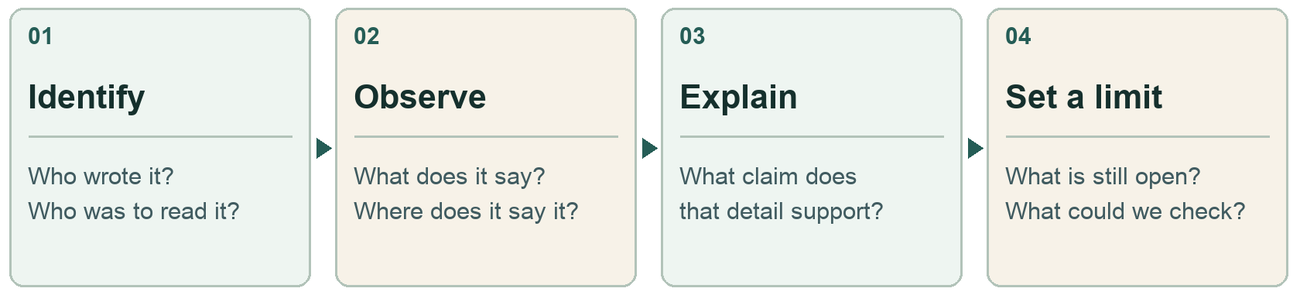
Both cards come from one letter. The short quotations are from John Keith’s 1896 translation. Each paragraph below a quotation restates the source in easier English.
Card A The Greeting and Division
“The church of God which sojourns at Rome, to the church of God sojourning at Corinth” (1 Clement 1).
Sojourns means lives or stays. In the rest of the chapter, the Roman writers say their troubles delayed their response. They describe a serious division. They remember the Corinthians for their earlier faith, hospitality and respect for elders.
Card B The Treatment of Leaders
“cannot be justly dismissed from the ministry” (1 Clement 44).
The writers say that leaders who were properly appointed and served faithfully should keep their work. They tell Corinth that some leaders had been removed. Rome describes those leaders as people who had served well.
1. Identify and observe · In A, mark the sender and reader. In B, mark the action the writers report. Add the chapter number.
2. Compare · Mark R by a report of an event and J by a judgment. With a partner, compare one mark. On your own, explain one mark to yourself in writing.
3. Write · Make a claim using the letter. Name one detail you would still need and a source that could help.
My claim and chapter number
A question that remains and a source I could check
4. Revise · Check whose view your claim gives and where the reader can find it. Change one phrase if needed. Would a second translation give a second witness to the events? Explain briefly.
Historical Visuals
Find the Two Churches
Jesus’ first followers lived in a Jewish setting under Roman rule. By the time of this letter, churches existed in Rome and Corinth. Rome was on the Italian peninsula. Corinth stood near the narrow strip of land that joins the Peloponnese to the Greek mainland. People in the two churches could exchange messages across a wide area.
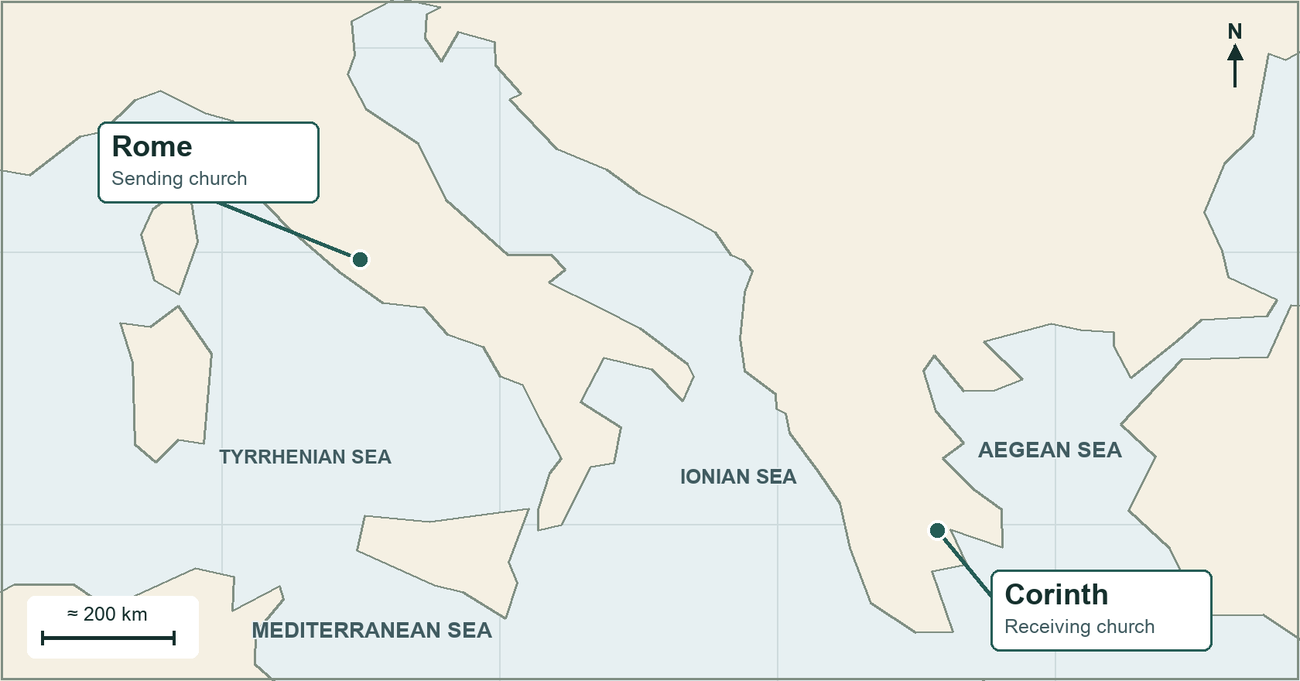
Place the Letter in Time

Historians commonly place the letter near the end of the first century, often around AD 96. The exact year is uncertain. AD 451 marks the end of our course because the Council of Chalcedon issued a statement about Jesus Christ that later lessons will study.
1. Point to Rome and Corinth. Which city is farther east? Which church sent the letter?
2. Find Dionysius and Eusebius on the timeline. Which one wrote closer to the time of the letter?
A Letter Can Survive in Copies
Handwritten copies help old texts reach later readers. The Codex Alexandrinus is a large handwritten book from the fifth century. It preserves text from the letters associated with Clement. In 1856, Roger Fenton photographed pages from it. A facsimile is a copy that shows what a page looks like.
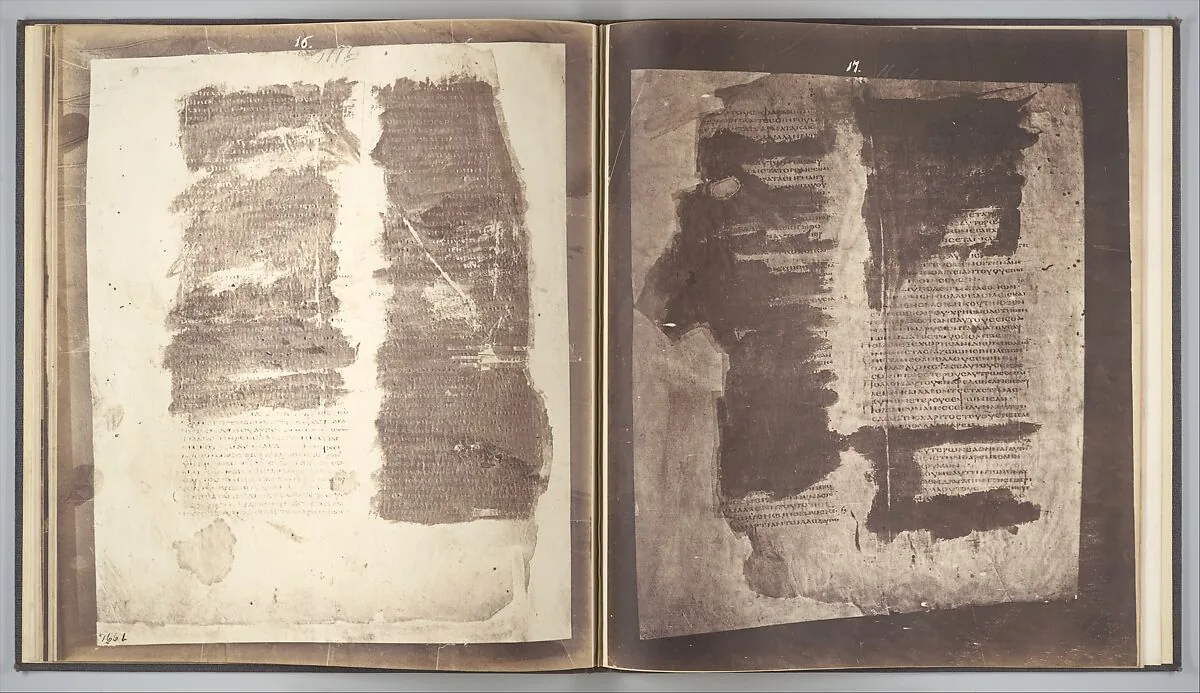
Look Closely
1. Name one detail you can see. Then name one fact about the date or object that comes from the caption.
2. Put these in order: Rome’s letter, the handwritten book, Fenton’s photograph. Which can the photograph show you directly?
Match the Question to the Evidence
Write the best letter next to each number. A is a written church rule. B is a dated record of a meeting. C is a later copy of a letter.
3. ___ What did one church expect its leaders to do?
4. ___ What decision was recorded at one meeting?
5. ___ What words were preserved from an older text?
With others, compare one reason for a match. On your own, write one reason. Check the sample answers after the activity.
Global Church Context
Era | Global Church History | Why It Matters Here |
|---|---|---|
Late first century | Rome’s congregation writes to Corinth about leadership. | The letter shows contact between two churches in different cities. |
Second to fourth centuries | Dionysius recalls reading the earlier letter in Corinth. Eusebius later quotes him. | Churches read and passed on letters after the events that first prompted them. |
Source note. 1 Clement 1 and 44. Eusebius, Church History 4.23.11.
Reformed Assessment
Luke tells Theophilus why he wrote and describes the care he took with what had been passed down. In Acts 17, the Bereans listen to the message about Jesus and examine the Scriptures. These passages teach habits of listening closely and giving reasons for what we believe. As Reformed Christians, we receive Scripture as the final authority for faith and life. We read letters like 1 Clement to learn about early churches and weigh their judgments under Scripture. (Luke 1:1–4; Acts 17:10–12; Westminster Confession of Faith 1.4, 1.10)
Psalm 78 calls God’s people to tell the next generation about his works. In 1 Thessalonians 5, Paul tells a congregation how to respond to prophecy. He calls for careful testing and holding on to what is good. We can practice the same care when we receive a story about our church. (Psalm 78:4–7; 1 Thessalonians 5:19–22)
Providence means God’s wise care and rule over creation. The Westminster Confession teaches that God works through ordinary means and that people are responsible for their actions. We can thank God for his care while we examine people’s choices. To ask why leaders were removed in Corinth, we look for evidence about that decision. To ask how a church should treat its leaders, we reason from Scripture. (Westminster Confession of Faith 5.1–4)
Thank God and Listen Carefully
Psalm 78 asks God’s people to tell the next generation what God has done so that they will hope in him. The Westminster Confession says that God ordinarily works through means. A household that opens its home and a visitor who teaches can both take part in what God does through ordinary people. To name their part accurately, we still need evidence. Luke explains what he received and why he investigated it before writing. We can follow that example when several people remember a church’s beginning differently. Listen to each person, identify the event they mean and compare it with a record when one is available. A careful account gives the next generation more reason to trust the story it receives. (Psalm 78:4–7. Luke 1:1–4. Westminster Confession of Faith 5.2–3.)
Case Study
An Anniversary Booklet in Lagum
Fictional teaching case
A church near Lagum is preparing an anniversary booklet. One member remembers a visiting preacher and says that he started the church. Another member remembers regular Bible meetings in a home before the visit. The committee recognizes a gathering in an old photograph. The photo has no date or caption.
In both Corinth and this case, people tell the story from their own point of view. In Lagum, the committee can still ask people what they remember and seek permission to consult records. First decide what you mean by the church’s beginning. A first Bible meeting at home, a first public service and the formal start of a congregation can fall on different dates.
Historical Evidence | Reformed Interpretation | Ministry Application |
|---|---|---|
Two members remember different beginnings. The photograph shows a gathering. | God calls us to tell the truth and listen to the people involved. | Say whose memory you are using. Look for a dated record tied to the event. |
Work Through the Anniversary Question
Begin with what the two church members actually say. One puts the beginning at the visiting preacher’s service. The other remembers earlier meetings in a home. Both memories might be true if each person means a different kind of beginning. The photograph shows people gathered. Ask whether anyone can identify a person, house or event in it, and give the person credit only with permission. If a dated entry in the host family’s notebook mentions a meeting, compare the names and place with what people remember. A date on a paper helps when you can connect it to the same event.
You can write a caption before the question is settled. For example, “Members remember home Bible meetings before the visiting preacher came. This photograph shows a gathering whose date we are still checking.” The first sentence identifies the testimony. The second states what the committee can see and what it still needs to learn. Psalm 78:4–7 calls God’s people to pass on his works. Luke 1:1–4 gives an example of care in receiving and telling an account. An assigned committee member can ask for one dated record this week. At the next meeting, the committee can check whether that record identifies the same gathering and revise the caption if it does.
Ministry Lessons for Today
• Listen to the people who remember the event. Ask permission before recording or sharing their memories.
• Be clear about what began. A home Bible meeting and the formal start of a congregation are different events.
• Give thanks for God’s care. Check names and dates with people and records before you publish the story.
Activity
A Church Memory Check
Discuss in a language you share if helpful. Write your final evidence sentences in short English.
Write for the Anniversary Booklet
1. List what each member remembers and what the case tells you about the photo. Choose which beginning your caption will describe.
2. Write two sentences for the booklet. Say what people remember and what needs checking.
3. Review your wording. Underline any date or claim about who started the church. Ask what supports it. With others, swap drafts and ask that question of a partner. On your own, read your draft aloud or silently and mark one phrase to revise.
4. Revise one phrase. Then fill in the four parts of your plan.
Part of the plan | My answer |
|---|---|
Person responsible | |
Who or what to consult and whose permission is needed | |
Date for the first check | |
What to review by day 30 |
Check Your Work
Read these examples after writing your own answers.
• Rome is west of Corinth and was the sender. Dionysius wrote closer to the time of the letter than Eusebius did.
• Figure 4 shows Greek writing in columns. First came Rome’s letter, then the fifth-century handwritten book, then Fenton’s photograph. The matches in the visuals are 3–A, 4–B and 5–C.
• Chapter 1 names the churches. Chapter 44 reports removals and gives Rome’s judgment of the leaders. A Corinthian reply or another record could help explain why people acted as they did. A second translation gives another way to read the same letter.
• Sample booklet text. “One member remembers the preacher’s visit as the beginning of the church. Another remembers home Bible meetings before the visit, and the date of the earliest meeting still needs checking.” A recorder could ask to see a dated notebook with the host family’s permission. On day 30 the committee could review any entry tied to those meetings.
Discussion Questions
1. What does 1 Clement 44 report? What question about the dispute does it leave open?
2. The writers wanted peace in Corinth. What source might help you find out whether peace returned? How could you check when it was written?
3. What does Psalm 78:4–7 ask God’s people to pass on? How can a church remember God’s works and tell the truth when memories differ?
4. What dated source might help the Lagum committee identify the gathering in the photo? How would you connect that source to the same event?
In a group, give everyone time to answer before you discuss. On your own, write short answers to two questions. Use a chapter number or a detail from the case.
Reflection Prompt
Begin with the response below. In your notebook, develop it into a reflection of about 200–250 words. Give an exact source location, a biblical reason and one practical step.
Think of a story about your church or one you know. Name what you heard, the evidence you have and one question you could ask. End with one action you can take to preserve that memory with care.
Prayer Points
• Thank God for the people who have handed on the good news and served the church in ordinary ways.
• Confess the times we have repeated a story before checking it or overlooked the people who were affected.
• Ask for patience to listen when accounts differ and courage to correct a story we have told.
• Pray for peace and fair treatment when churches face disagreements.
Readings
• Read Luke 1:1–4, Acts 17:10–12, Psalm 78:4–7 and 1 Thessalonians 5:19–22.
• Read 1 Clement 1 and 44 for the activity. For further study, read chapters 63 and 65.
• Read Eusebius, Church History 4.23.11 for the later testimony and the Westminster Confession of Faith 1.4, 1.10 and 5.1–4 for theological study.
References
Core Texts
Clement of Rome (traditional attribution). (1896). Letter to the Corinthians (J. Keith, Trans.). In A. Menzies (Ed.), Ante-Nicene Fathers (Vol. 9). Christian Literature Publishing. Cards use 1 and 44. The story also uses 63 and 65. John Keith translation
Eusebius. (1890). Church History (A. C. McGiffert, Trans.). In P. Schaff & H. Wace (Eds.), Nicene and Post-Nicene Fathers (2nd series, Vol. 1). Christian Literature Publishing. Read 4.23.11 for the second-century testimony. Church History Book IV
Ferguson, E. (2005). Church history, volume one: From Christ to Pre-Reformation. Zondervan. Read ch. 3, II.A, “The Apostolic Fathers,” entry on 1 Clement, for the date and traditional attribution. Google Drive copy
Biblical Studies Press. (2017). New English Translation (NET). Bible notes in this lesson are paraphrases. Read the listed passages in a translation you understand. Luke 1:1–4
Westminster Assembly. (n.d.). Westminster Confession of Faith, 1.4, 1.10 and 5.1–4. Orthodox Presbyterian Church edition
Image and Map Credits
Figure 2. Map drawn for this lesson. Base geography is Natural Earth 1:110m land data, released into the public domain. The scale is approximate near 41°N. Natural Earth terms
Ancient city points are based on the Digital Atlas of the Roman Empire. Roma
The Corinth dot marks the ancient city near Acrocorinth. Corinthus
Figure 4. Fenton, R. (1856). Photographic Facsimiles of the Remains of the Epistles of Clement of Rome, plates 16 and 17 [Salted paper prints from glass negatives]. The Metropolitan Museum of Art, Purchase, Alfred Stieglitz Society Gifts, 2009, object 2009.18 (1–22). Public Domain. The Met collection record
The fifth-century manuscript photographed by Fenton is held by the British Library. Codex Alexandrinus, Royal MS 1 D VIII
Figures 1 and 3 were drawn for this lesson. Figure 3 follows 1 Clement 1, Eusebius 4.23.11 and the GRUTS course sequence. Figure 1 is a teaching aid for the source workshop.
Lesson 2
From Jerusalem to Many Peoples
The Gospel and Belonging in the First Churches
Key Bible Passages
Passage | Historical Focus | Ministry Use |
|---|---|---|
Acts 2:42–47 | Believers in Jerusalem learn, pray, eat together and share with those in need. | Notice how teaching and care shape a church’s common life. |
Acts 11:19–26 | Believers who have scattered carry the message about Jesus to Antioch. | Recognize what local and unnamed workers contribute. |
Acts 15:7–11 | Peter points to God’s work among the Gentiles and to the grace of Jesus. | Ask what a church can rightly require of new believers. |
Galatians 2:11–14 | Paul challenges Peter when he stops eating with Gentiles in Antioch. | Examine how the church’s everyday habits affect who can take part. |
Lesson Overview
How did the growth of Gentile churches change what early believers had to decide about belonging? Jesus’ first followers lived within Israel’s story. As people carried the message about Jesus beyond Jerusalem, Gentiles came to faith. Churches had to decide whether Gentile believers needed circumcision to belong. They also had to learn to eat and live together.
You will follow the story from Jerusalem to Antioch, then compare a meeting in Acts with a dispute described in Paul’s letter. The lesson ends with a fictional case from Cagayan about how a Bible group chooses its meeting language.
How to Study This Lesson
Read the Bible passages and the history first. Look at the visuals and complete the source questions in writing. Then read the assessment and work through the case and activity. Compare your work with the sample answers before writing your reflection and praying.
Learning Objectives
Area | Objective |
|---|---|
Historical Knowledge | Explain the Jewish roots of the first churches and locate Jerusalem and Antioch. |
Source Discernment | Use Acts 15 and Galatians 2 to write a claim with two verse references and one limit. |
Theological Method | Explain why salvation by grace mattered for Gentile believers. |
Ministry Practice | Propose one way to help people take part in a Bible group and say how you would check it. |
Key Terms
Term | Simple Definition |
|---|---|
Apostle | A person sent with authority. Here, a witness commissioned by Christ. |
Gentile | A person outside the Jewish people. |
Diaspora | People living outside their ancestral land. Here, especially Jews living outside Judea and Galilee. |
Circumcision | A bodily sign of God’s covenant with Abraham’s family (Genesis 17:9–14). |
Fellowship | Shared life and participation in Christ. |
Household | People linked to a home. In antiquity this could include family, dependents and enslaved people. |
The Gospel Travels Across Communities
1. Many Languages in Jerusalem
The story begins in Jerusalem among people who knew Israel’s Scriptures. Acts describes Jews and converts to Judaism who had come from many places for Pentecost. They hear the message in their own languages. Peter speaks of Jesus’ death and resurrection and draws on Israel’s Scriptures to explain what God has done. A visitor could be far from home and still recognize the stories and promises Peter uses. The event gives us an early example of the message being heard across languages. (Acts 2:5–11, 22–36)
The people who receive the message learn together after that day. Acts describes them hearing the apostles’ teaching, praying, breaking bread and helping people in need. It places their gatherings in the temple courts and in homes. Picture the different things these settings make possible. A gathering in a public space can bring people together. A home can give people a place to eat, speak and share what they have. Acts gives a summary of what marked the Jerusalem community. Records from other places would help us see how believers met and cared for people in their own settings. (Acts 2:42–47)
2. Scattered Believers Carry the Message
The movement reaches other places through the actions of people whose names we often do not know. After the trouble connected with Stephen, Acts names Phoenicia, Cyprus and Antioch as places reached by believers who had scattered. Some people from Cyprus and Cyrene spoke about Jesus in Antioch. On the map, find Cyprus, an island, and Cyrene, a city in North Africa. These are places of origin for some of the people who spoke. Antioch is where Acts places their work. The text gives no route for an individual journey. This is one reason a map of the places can help us more than a line drawn as though we know where every traveler went. (Acts 11:19–21)
Look closely at who heard the message in Acts 11:20. The NET uses “Greeks.” The NRSVUE uses “Hellenists” and notes that some ancient witnesses read “Greeks.” The difference matters when the question is exactly who the listeners were. Both versions name the same places of origin and describe people speaking about the Lord Jesus in Antioch. Later in the lesson, Acts 15:7–11 and Galatians 2:12 speak directly of Gentile believers. A claim about them can start with these clearer references. (Acts 11:20, NET and NRSVUE)
3. Antioch Receives Help and Sends Workers
News of Antioch reaches Jerusalem. The Jerusalem church sends Barnabas, who sees evidence of God’s grace and encourages the people to remain faithful. He goes to Tarsus to find Saul and brings him back to Antioch. Acts says the two spend a year teaching a large number of people and that disciples first received the name Christians in Antioch. Watch the sequence in the account. Unnamed believers speak, a church sends someone to see what is happening, and two people give time to teaching. The movement depends on these different acts of service. (Acts 11:22–26)
Later Acts describes prophets and teachers in Antioch. The community worships and fasts, the Holy Spirit sets apart Barnabas and Saul for work, and they are sent out after prayer. The church that received support from Jerusalem now sends people itself. A Roman coin made in Antioch during the reign of Claudius offers another kind of evidence about the city. The portrait on the coin shows imperial rule expressed in public life. Acts gives the evidence about the church and the work its people did. Set the coin beside the text and ask what each allows you to say. (Acts 13:1–3. University of Münster Archaeological Museum, M 1443.)
4. Jerusalem Hears a Dispute About Circumcision
The growth of Gentile communities brought a question into the open. Acts says that some people insisted that Gentiles had to be circumcised to be saved. Circumcision was the covenant sign given to Abraham’s household. In Jerusalem, the apostles and elders meet to consider the matter. Peter recalls that God gave the Holy Spirit to Gentiles and made their hearts clean by faith. Barnabas and Paul report what God did among the Gentiles. James draws on the prophets and gives his judgment. Notice how the narrative places testimony and Scripture alongside one another. (Genesis 17:9–14. Acts 15:1–21.)
The meeting leads to a letter for Gentile believers in Antioch, Syria and Cilicia. The instructions address food offered to idols, blood, meat from strangled animals and sexual immorality. Peter’s words help us read the decision. He says that Jewish and Gentile believers are saved through the grace of the Lord Jesus. The practical instructions address the life believers will share after they receive that grace. Read verses 7–11 for the ground of salvation and verses 22–29 for what the letter asks the churches to do. (Acts 15:7–11, 22–29)
5. Paul Remembers a Meal in Antioch
Paul writes to the churches of Galatia. He recalls going to Jerusalem with Barnabas and Titus. He names Titus as a Greek and says that Titus was under no compulsion to be circumcised. He also describes an encounter in Antioch. Peter, whom Paul calls Cephas, had been eating with Gentile believers. When people came from James, Peter withdrew. According to Paul, Peter acted out of fear of the group that favored circumcision. Others followed, including Barnabas. Paul challenged Peter in front of them because he believed that the conduct departed from the truth of the gospel. The letter lets us hear the challenge from Paul’s point of view. (Galatians 2:1–14)
Take a moment to compare the accounts. Acts identifies a disputed requirement and records the reason Peter gave for welcoming Gentiles. Galatians shows how someone’s place at a shared meal could change because of group pressure. We can put these concerns side by side and see why grace mattered in both salvation and fellowship. Dating the Antioch incident in relation to the meeting in Acts 15 would require more evidence. So would an account of how Peter and the Gentile believers understood their own actions and experience. (Acts 15:7–11. Galatians 2:11–14.)
6. Notice Who Made the Gatherings Possible
Paul’s greetings to believers in Rome give another view of the people who sustained these churches. He commends Phoebe and greets Prisca and Aquila, his fellow workers, and the church that gathers in their home. People provided places to meet, carried messages and worked alongside traveling teachers. Romans 16 names some of them. Acts 11 lets us see others through their places of origin. When you tell the story of this movement, start with one named person and one group whose names are unknown. Give a verse that shows what each did. A larger history comes into view as we learn to notice these particular people. (Romans 16:1–16. Acts 11:19–26.)
In AD 70, Roman forces destroyed Jerusalem’s temple. Josephus describes the burning in his account of the Jewish war. The destruction changed the setting in which Jewish communities, including Jewish followers of Jesus, lived and remembered Jerusalem. Relationships between Jewish communities and Christians developed at different times and in different ways across the Mediterranean. The date of the temple’s destruction anchors one event. The lives of particular communities still have to be traced through their own evidence. (Josephus, Jewish War 6.4.5–7. Lieu, 2004.)
Source Spotlight
Two Sources on Belonging
Read Acts 15:1–29 and Galatians 2:1–14 in your Bible if you have it. The short quotations are from the New English Translation. The cards restate the surrounding passages in easy English.
Card A A Meeting and a Letter
“we are saved through the grace of the Lord Jesus” (Acts 15:11).
Acts tells the story of a meeting in Jerusalem. Some people require circumcision for salvation (15:1, 5). Peter says that God gave the Holy Spirit to Gentile believers and made their hearts clean by faith (15:7–11). The apostles and elders send their decision to Gentile believers. Their letter asks them to keep away from food offered to idols, blood, meat from strangled animals and sexual immorality (15:22–29).
Card B A Dispute at the Table
“he had been eating with the Gentiles” (Galatians 2:12).
Paul writes to the churches of Galatia about his ministry and the gospel. He says that Peter, also called Cephas, used to eat with Gentile believers in Antioch. Peter withdrew when people came from James. Paul says Peter was afraid of the group that insisted on circumcision. Other Jews, including Barnabas, followed Peter’s example. Paul challenged him in front of them (2:11–14).
1. Mark · In Card A, mark the condition that some people tried to require. In Card B, mark the change in Peter’s behavior.
2. Compare · name the kind of writing and what it helps you see. On your own, write one difference between a public decision and a letter that tells one person’s side of a dispute.
3. Write · Use one verse from each source to answer this question. What did Gentile belonging have to do with both salvation and shared meals?
My claim and two verse references
One question the passages leave open
4. Revise · Check that your sentence names the places correctly and says when Paul is the person giving the explanation.
Historical Visuals
Jerusalem and Antioch in the Eastern Mediterranean
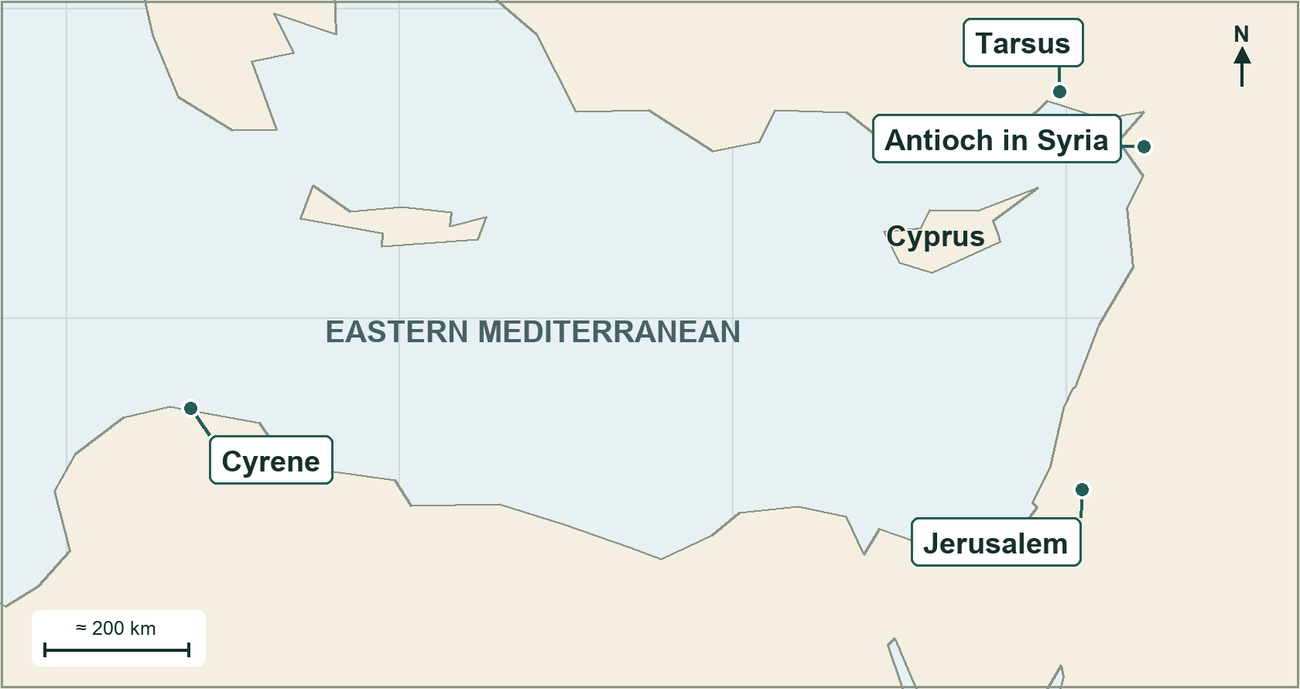
Place | What Acts Says |
|---|---|
Jerusalem | The first community learns and shares there. Later, Jerusalem sends Barnabas to Antioch and hosts the meeting about Gentile believers (Acts 2:42–47; 11:22; 15:2). |
Cyprus and Cyrene | Some of the people who speak about Jesus in Antioch come from these places. Cyprus is an island. Cyrene is a city in North Africa (Acts 11:19–20). |
Tarsus | Barnabas goes here to find Saul and brings him to Antioch (Acts 11:25–26). |
Antioch in Syria | Barnabas and Saul teach here. This Antioch sends them out in Acts 13:1–3. |
1. Which city on the map is south of Antioch? Which place on the map is an island?
2. Find Cyrene and Cyprus. What do we know about the people from those places? What travel detail is still open?
Two Settings for a Question About Belonging
Question | Acts 15 Jerusalem | Galatians 2 Paul’s Account |
|---|---|---|
What kind of source? | A narrative about a dispute, a meeting and a letter. | Paul’s letter describing a visit and his challenge to Peter. |
What is at stake? | Some demand circumcision as a condition for salvation (15:1, 5). | Peter withdraws from meals with Gentiles. Others follow him (2:11–13). |
What does the source emphasize? | Peter points to grace and the Spirit. A letter gives the churches a decision and instructions (15:7–11, 22–29). | Paul challenges conduct that fails to fit the truth of the gospel (2:14). |
What needs more evidence? | How churches used the letter over time. | How Peter and the Gentile believers understood the dispute. |
Table 1. Read across each row. The columns compare different settings. They give no order for the two incidents.
Translation note. The NET prints “Greeks” in Acts 11:20. The NRSVUE prints “Hellenists” and notes the other reading. Both report that people from Cyprus and Cyrene spoke about Jesus in Antioch. Acts 15:7–11 and Galatians 2:12 name Gentiles directly.
Global Church Context
Setting | Opportunity | Question for the Churches |
|---|---|---|
Jerusalem and Judea | Israel’s Scriptures give a shared story and promises. | How do the promises include the nations? |
Antioch and the eastern Mediterranean | People move among cities, islands and regions. Some carry the message of Jesus with them. | What should churches ask of people from different backgrounds? |
Households such as those in Romans 16 | Homes provide a place to gather. People in different roles help sustain the church. | Who takes part, and what do the surviving sources let us see? |
Shelley (2013), chapter 3, uses Acts 11:20 to illustrate the part played by people from Cyrene. This passage names their origin and their work in Antioch. The founding of a church in Cyrene would need its own evidence.
An Object From Roman Antioch


Look at the portrait and letters. The coin gives evidence of Roman public life in Antioch. Which source would you turn to for evidence about a meal between Jewish and Gentile believers?
What the Sources Can Tell Us
Claim | Location and limit |
|---|---|
People and places in Syrian Antioch | Acts 11:19–26 names people from Cyprus and Cyrene, Barnabas, Saul and Tarsus. The exact routes remain open. |
The Jerusalem meeting and the Antioch meal | Acts 15:1–29 records a meeting and a letter. Galatians 2:11–14 gives Paul’s account of the meal. The relative order of the episodes needs more evidence. |
The date and mint of the bronze coin | The museum catalogs M 1443 as a coin of AD 41–54 minted at Antioch. It gives evidence of the city’s public life. |
Reformed Assessment
Grace and the Life We Share
Peter says that Jewish and Gentile believers are saved through the grace of the Lord Jesus. God gave Gentiles the Holy Spirit and made their hearts clean by faith. The Westminster Confession teaches that God accepts sinners for Christ’s sake and that faith receives Christ and his righteousness. This is what Reformed churches call justification. At Jerusalem, the church’s letter gave instructions for holy conduct and common life. Peter’s words give the ground of salvation in Christ. (Acts 15:7–11, 22–29. Westminster Confession of Faith 11.1–2.)
In Antioch, eating together gave people a visible place in the group. When Peter withdrew, others did the same. Paul judged the action by the gospel. A church today can examine its habits in the same way. Andrew Walls reads Acts 15 as showing that the gospel can take root among different peoples and can call every culture to change. A church can make its teaching easier to hear while keeping the words and meaning of Scripture clear. (Galatians 2:11–14. Walls, 1996, pp. 7–9.)
Which Expectations Belong to the Gospel?
A church rule can sound reasonable until we ask what it is meant to accomplish. Consider the two requirements discussed in Acts 15. Some teachers said that a Gentile must receive circumcision to be saved. The church’s letter later asked Gentile believers to keep away from food offered to idols and from sexual immorality. Read Peter’s speech before you put those requirements in the same category. In Reformed teaching, faith receives Christ and his righteousness. The church can call believers to obedience on the basis of the grace they have received. Its own habits also need review. At Antioch, withdrawing from a meal put pressure on Gentiles even without a new rule being announced. (Acts 15:1, 7–11, 28–29. Galatians 2:11–14. Westminster Confession of Faith 11.1–2.)
Case Study
A Bible Group in Cagayan
Fictional teaching case
A Bible group in Cagayan includes people who speak different languages at home. A visiting leader uses his own preferred language at every meeting. Several older adults nod during the lesson and rarely speak. The leader takes their nods as a sign that they understand. A local worker asks the group to try a different way of hearing and responding to the lesson.
In Antioch the dispute concerned Jewish and Gentile fellowship at meals. In Cagayan the question is how people can understand and join a Bible discussion. In both cases a group’s habits affect who takes part. The present group can ask its members what helps them hear and respond.
Historical Evidence | Reformed Interpretation | Ministry Application |
|---|---|---|
Acts records Peter’s appeal to grace. Paul describes how a shared meal changed at Antioch. | Christ receives believers by grace. A church can examine whether its habits express that welcome. | Ask members what they understand. Try a short summary in a language they say helps them. |
Find Out Who Can Take Part
In the Cagayan group the leader saw people nod and heard little from some of them. He concluded that they understood. The local worker can ask those people privately what they heard, which words were hard and which language helps them explain the passage. One person may understand the main idea and feel shy about speaking. Another may be able to repeat a familiar word while missing the sentence it belongs to. Listening gives the group better evidence for its decision.
Read Acts 15:7–11 before choosing a change. God receives Jewish and Gentile believers by grace. Read Galatians 2:11–14 and notice how a shared practice changed when Peter withdrew. The Bible group can ask how its shared practice affects participation. One member could read the passage in the usual language while another gives a short summary in a language the participants choose. Invite willing learners to explain the main idea or ask a question in their own words. The local worker can note what ideas people express and which words still need explanation, with their consent. After two meetings the group can look at those observations and decide whether to keep or adjust the practice. The same passage remains at the center while more people have a way to respond.
Ministry Lessons for Today
• Ask which language helps members understand and speak. Give people a private way to answer if they prefer.
• Keep the Bible passage and its meaning at the center. Let people help choose how to hear and discuss it.
• Invite anyone who wishes to retell one main idea or ask a question. Use their feedback to improve the next meeting.
Activity
A Welcome That People Can Take Part In
Discuss in a language you share if helpful. Write your final evidence and plan in short English.
1. Observe. Which details did the visitor see or hear? Which claim about understanding did he infer?
2. Name one thing the Bible group should keep and one practice it could change. Give a reason from Acts 15 or Galatians 2. Say how the modern situation differs.
3. Draft a plan to try one change. In a pair, ask what the proposed check can tell you. On your own, underline the part of your plan that depends on hearing from the group.
Part of the Plan | My Answer |
|---|---|
Person who will ask what helps | |
One change to try and the first date | |
One way people can respond by choice | |
What we will review by day 30 |
4. Revise one phrase after feedback. Collect only the feedback needed to make the next meeting easier to understand.
Check Your Work
Write your answers first. Then use these examples to revise one sentence.
• Map. Jerusalem is south of Antioch. Cyprus is an island. Acts identifies some speakers as coming from Cyprus and Cyrene. The account leaves their exact route open.
• Source claim. Peter says Jewish and Gentile believers alike are saved through Jesus’ grace (Acts 15:11). Paul sees Peter’s withdrawal from shared meals as a problem for the gospel (Galatians 2:12–14). The passages leave open how the visits fit together and whether James directed anyone to withdraw.
• Coin and letter. The coin shows what Antioch’s mint put on a public object. Galatians gives Paul’s account of the meal.
• Case. Nodding and little speech are observations. Understanding is the visitor’s inference. The host could ask about language needs this week and try a short summary at the next two meetings. By day 30, review whether willing participants can explain one main idea or ask a question.
Discussion Questions
1. What does Peter’s speech in Acts 15:7–11 say about how Jewish and Gentile believers are saved?
2. Why does Paul treat Peter’s withdrawal from meals as a gospel issue (Galatians 2:11–14)?
3. What does Acts 15:22–29 show about the practical duties that followed the decision? What question about local practice remains open?
4. What can the names in Romans 16 show about the first churches? What would you need to learn about another church?
5. What could your group do to welcome people who understand the lesson best in a different language?
In a group, let each person answer before the discussion moves on. On your own, write short answers to two questions. Give a verse or detail to support each answer.
Reflection Prompt
Begin with the response below. In your notebook, develop it into a reflection of about 200–250 words. Give an exact source location, a biblical reason and one practical step.
Think of a time when you felt welcome or found it hard to join a group. Write what helped or made it difficult. End with one action you can take so that another person can hear and respond.
Prayer Points
• Thank God that Christ gathers people from many backgrounds by grace.
• Confess the times we have let our familiar habits close the way for others to take part.
• Pray for people who find it hard to speak in church meetings. Ask God to help us listen to them.
• Ask for wisdom to hold to the truth of Scripture as we learn to welcome one another.
Readings
• Read Acts 15:1–29 and Galatians 2:1–14 for the source activity.
• Read Acts 2:5–11, 42–47, Acts 11:19–26 and Acts 13:1–3 for the movement of the story.
• For further study, read Romans 16:1–16, Walls pp. 7–9 and Shelley ch. 3.
References
Bible and Confession
Biblical Studies Press. (2017). New English Translation (NET). Main translation for the lesson and its two short quotations. Acts 15
Compare the language Paul uses to describe the Jerusalem visit and the dispute at Antioch. Galatians 2 in the NET
National Council of Churches. (2021). New Revised Standard Version Updated Edition. Compare the text and note for Acts 11:20. Acts 11:20 in the NRSVUE
Westminster Assembly. (n.d.). Westminster Confession of Faith. Chapter 11, sections 1–2. Orthodox Presbyterian Church edition
History and Mission
Shelley, B. L. (2013). Church history in plain language (R. L. Hatchett, Rev., 4th ed.). Thomas Nelson. Chapter 3, section on North Africa, for the reference to Cyrenian speakers in Acts 11. Google Drive copy
Walls, A. F. (1996). The missionary movement in Christian history: Studies in the transmission of faith. Orbis Books and T&T Clark. Chapter 1, pp. 7–9, for a modern reading of Acts 15 and the gospel across cultures. Google Drive copy
Image and Map Credits
Figure 1. Teaching map drawn for this lesson using Natural Earth 1:110m land data, released into the public domain. The scale is approximate near 34°N. Natural Earth terms
City locations. Jerusalem, Digital Atlas of the Roman Empire. Jerusalem
Antioch in Syria, German Archaeological Institute Gazetteer. Antioch
Cyrene, UNESCO World Heritage Centre. Cyrene
Tarsus, Coin Hoards of the Roman Empire, Ashmolean Museum. Tarsus location
Figure 2. University of Münster Archaeological Museum. Claudius bronze coin, Antioch, AD 41–54, M 1443 (ID2387). Photographs by Robert Dylka. Public Domain Mark 1.0. Museum record and rights
Josephus. Jewish War 6.4.5–7 (W. Whiston, Trans.). English translation
Lieu, J. M. (2004). Christian identity in the Jewish and Graeco-Roman world. Oxford University Press. Publisher record
Lesson 3
The Apostolic Fathers
Teaching and Leadership in the Early Churches
Key Bible Passages
Passage | Historical Focus | Ministry Use |
|---|---|---|
2 Timothy 2:1–2 | Timothy is to pass on what he heard to faithful people who can teach others. | Ask what a teacher must pass on and how to prepare the next teacher. |
Titus 1:5–9 | Titus is to appoint elders whose lives and teaching fit their work. | Consider character and sound teaching together. |
Acts 20:17, 28–31 | Paul warns the elders from Ephesus to watch over themselves and the church. | Ask how leaders can guard the church and receive correction. |
1 Peter 5:1–4 | Peter urges elders to care for the flock willingly and lead by example. | Describe what people should see in the way a leader serves. |
Lesson Overview
How did different early churches express their concern for trustworthy leadership? You will read from three writings often grouped as the Apostolic Fathers. One gives instructions for church life. Two are letters written for particular communities. Each helps us ask who could lead, what leaders were expected to do and how churches responded when leadership was disputed.
You will compare the instructions and name one conclusion the sources can support. Then you will use Scripture to propose a fair way to train and guide a Bible group leader in a fictional Lagum case.
How to Study This Lesson
Read the Bible passages and the history first. Look at the visuals and complete the source questions in writing. Then read the assessment and work through the case and activity. Compare your work with the sample answers before writing your reflection and praying.
Learning Objectives
Area | Objective |
|---|---|
Historical Knowledge | Identify the Didache, 1 Clement and Ignatius’s letter to Smyrna. Say what each was written to do. |
Source Discernment | Compare two instructions about leaders. Cite the chapters and name one limit. |
Theological Method | Explain one biblical connection between faithful teaching and a leader’s character. |
Ministry Practice | Propose a clear teaching role, a way to receive feedback and a review date. |
Key Terms
Term | Simple Definition |
|---|---|
Apostolic Fathers | A later name for a collection of early Christian writings. |
Didache | An early Christian guide for conduct and church life. Its name means teaching. |
Presbyter | An elder. The role must be read in its setting. |
Bishop | An overseer. Early texts use this title in different ways. |
Deacon | A title linked with service in a church. |
Eucharist | A name for the Lord’s Supper. |
Teaching and Leadership in Three Sources
1. Three Writings and Three Situations
Imagine receiving a teacher who has traveled to your town. You may know little about the visitor. Someone has to welcome the person, hear the teaching and ask how the visit will affect the church. Other questions arise when local leaders have to be chosen or when the church disagrees over worship. Early writings let us see how different communities faced such questions. Apostolic Fathers is a later name for a group of early Christian writings. The three works in this lesson are often placed near the end of the first century or in the early second century. The Didache gives instructions for community life. First Clement is a letter from one church to another about a dispute. Ignatius’s letter to Smyrna addresses teaching, worship and unity. The same question about trustworthy leadership takes a different shape in each setting. (Didache 11–15. 1 Clement 1, 42–44. Smyrnaeans 7–8. Svigel, 2021.)
2. The Didache Welcomes and Tests
The Didache is an early guide for Christian conduct and community life. Its date and place are debated. Chapters 11–13 picture people arriving from elsewhere. The guide expects the community to offer help and pay attention to the visitor’s conduct. It tells readers to welcome someone who comes in the Lord’s name and then learn what kind of person has arrived. If a traveler needs help, the community should assist as it is able. An artisan who stays is expected to work. A teacher who is found trustworthy may receive support. These directions invite the church to put welcome and discernment together. (Didache 11–13)
Consider two requests for money. Chapter 11 warns against a person who speaks in the name of the Spirit and asks for money for himself. It treats a request on behalf of people in need differently. The reason and beneficiary matter. A reader who stops at the word “money” can miss the distinction. We can learn what questions the guide wants readers to ask. An account by a host or a visitor would give another kind of evidence about what happened in an actual home. (Didache 11–12)
3. Local Leaders Who Have Been Tested
Chapter 15 tells its readers to appoint bishops and deacons. The people chosen are to be gentle and truthful. Their lives should have been tested, and love of money should have no hold on them. The guide links their work with that of prophets and teachers and asks the readers to honor them. It expects the readers to take part in recognizing people who can serve the community faithfully. The chapter gives a clear description of the qualities the guide values. It leaves open the names of the people chosen and how each local community took part in choosing them. (Didache 15)
The manuscript image in this lesson shows a copy of this part of the guide. Leon copied the book in AD 1056. J. Rendel Harris published a facsimile in 1887. A facsimile shows what a page looks like. Put those dates beside the much earlier period scholars usually give for the composition of the guide. Copying and publishing tell us about the text’s transmission. The words preserved on the page give us a guide’s expectations for its readers. The two lines of evidence work together when we explain how a much earlier writing can be read today. (Codex Hierosolymitanus 54, folio 80r. Harris, 1887, plate IX. Svigel, 2021.)
4. Rome Appeals for Fair Treatment in Corinth
The first lesson followed Rome’s letter to Corinth. Read chapters 42–44 again with a question about leadership. The Roman writers trace appointment back to the apostles and their arrangements for approved people to carry on the work. They mention later appointments made with the whole church’s agreement. They also describe the affected leaders as humble and faithful in their service. This argument helps us see why Rome judged the removals unjust. The reasons Rome gives tell us about its view of the relationship between appointment, conduct and accountability. (1 Clement 42–44)
Put the letter beside the Didache. The guide asks readers to recognize character before they choose a leader. The letter asks a particular congregation to consider the way established leaders were appointed and the way they served. Both writings pay attention to tested character. Their purposes give that concern a different role in each source. A good comparison states what the texts share and shows how each writer uses it.
5. Ignatius Writes from Troas to Smyrna
Ignatius identifies himself with Antioch in Syria and says that he is in chains. Near the end of his letter to the Smyrnaeans, he says that he is writing from Troas. He also mentions Burrhus, who had accompanied and helped him. The map shows Antioch, the city associated with Ignatius, and Smyrna, the city that received the letter. Chapter 12 supplies the place of writing, Troas. His letters are often placed in the early second century, with debate about their exact dates. (Smyrnaeans 11–12. Svigel, 2021. Lookadoo, 2021.)
Ignatius speaks of people who disputed the reality of Jesus’ suffering. He insists that Jesus truly suffered and rose. He connects this concern about teaching with the worship and shared life of the congregation. Chapter 8 asks believers to follow the bishop and elders and honor the deacons. The Eucharist, or Lord’s Supper, is to be administered by the bishop or someone he authorizes. Ignatius also speaks of baptism in relation to the bishop’s oversight. He wants the community’s teaching and gatherings to remain united. The instructions tell us what he asked the Smyrnaeans to do. Their response would need other evidence. (Smyrnaeans 2–3, 7–8)
6. Compare the Actions Before Comparing the Titles
Look for the action in each source. The Didache asks a community to appoint and honor tested leaders. First Clement defends leaders in Corinth by recalling their appointment and conduct. Ignatius gives a bishop a particular role in worship at Smyrna. The titles invite comparison, but the actions show what each source is able to tell us. If you wrote that all three communities used the same leadership structure, you would need evidence about duties, appointments and decisions in each place. A stronger claim names the writings and says that each one gives a reason to take local church leadership seriously. (Didache 15. 1 Clement 42–44. Smyrnaeans 8.)
Now read Titus 1:5–9 and 1 Peter 5:1–4. Titus joins the leader’s life and teaching. Peter calls elders to willing care and to leading by example. These passages give a church grounds for its judgment when deciding whom to trust with teaching. The older guide and letters let us see some of the questions Christians faced. Scripture guides our own answer.
Source Spotlight
Who Leads and How
The short quotations come from the Ante-Nicene Fathers translations. The cards restate the passages in easy English. Read the chapter numbers as you work.
Card A Appoint Leaders Who Can Be Trusted
“appoint for yourselves bishops and deacons worthy of the Lord” (Didache 15).
The guide tells its readers to appoint bishops and deacons. It calls for gentle, truthful and tested people who are free from greed. It asks readers to honor these leaders along with the prophets and teachers.
Card B Gather with the Bishop
“See that you all follow the bishop” (Ignatius, Smyrnaeans 8).
Ignatius writes to Smyrna. He tells the church to follow the bishop and the elders and to honor the deacons. He says that the bishop or someone the bishop appoints should lead the Lord’s Supper.
Compare with Rome. In 1 Clement 42–44, the writers defend the continued service of leaders they regard as properly appointed and faithful. They are answering a dispute over removals.
1. Mark · In A, underline who is asked to appoint leaders. In B, underline who is to lead or authorize the Lord’s Supper.
2. Compare · explain one difference between what the guide and the letter ask. On your own, write one difference. Use the Rome note to name a third leadership concern.
3. Write · Give one shared concern with a chapter from each card. Then say what more you would need to know how another church actually chose or followed its leaders.
A shared concern and two chapter references
A question that needs another source
4. Revise · Make sure your claim distinguishes what the writers ask for from what people actually did.
Historical Visuals
Churches Connected by Letters
The map places the communities connected with the two letters in this lesson. Rome sent 1 Clement to Corinth. Smyrna received a letter from Ignatius, who was associated with the church in Antioch. In the letter he says he is writing from Troas. The place where the Didache first took shape is uncertain. (1 Clement 1. Ignatius, Smyrnaeans, greeting and 11–12.)
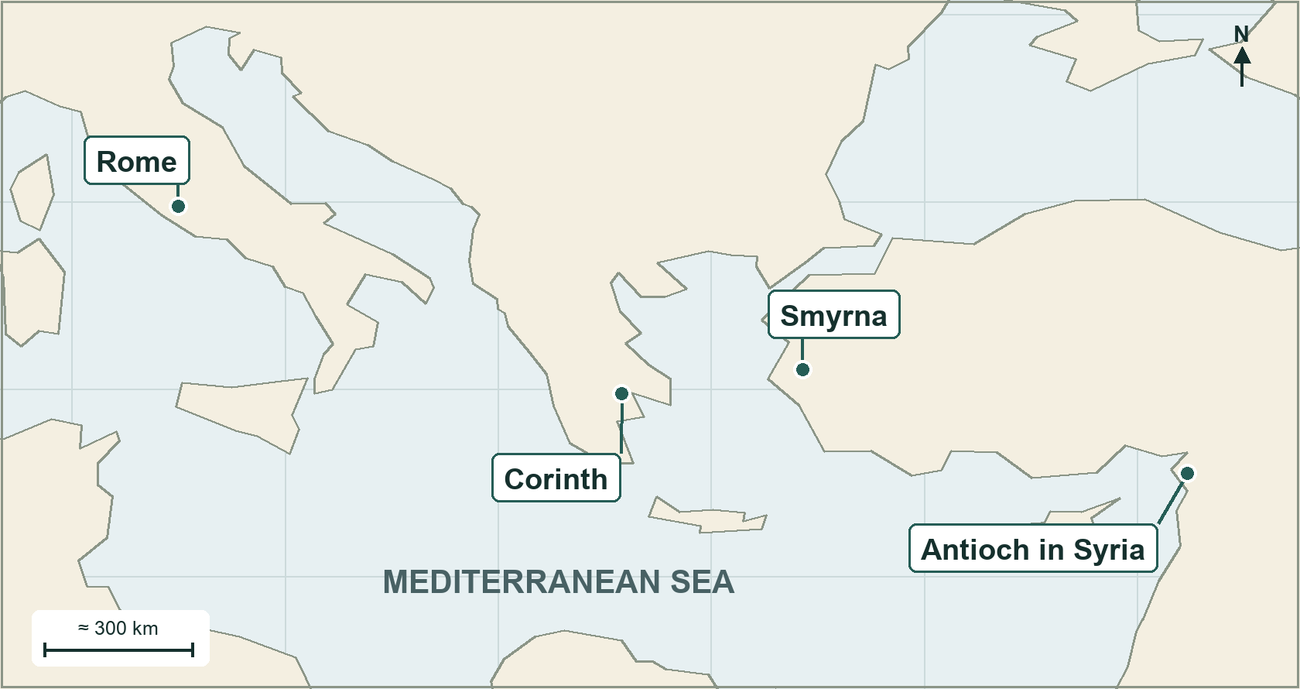
Place | What the Source Lets Us Say |
|---|---|
Rome | The greeting of 1 Clement names the church in Rome as the sender. |
Corinth | The church in Corinth receives Rome’s letter about a conflict over leaders (1 Clement 1, 44). |
Smyrna | Ignatius addresses the church in Smyrna (Smyrnaeans, greeting). |
Antioch in Syria | Ignatius is connected with this church. He asks the Smyrnaeans to send someone to the church in Syria (Smyrnaeans 11). |
1. Find the two cities named in the greeting of 1 Clement. Which lies farther west?
2. Which church received Ignatius’s letter? Where does the letter say he was writing from?
Leadership in Three Early Writings
Source | What the Writing Asks For | What Needs Further Evidence |
|---|---|---|
Didache 15 | The community should appoint tested bishops and deacons and honor them. | Who was actually appointed and how the choice was made. |
1 Clement 42–44 | Rome asks Corinth to treat leaders fairly. It appeals to the way the leaders were appointed and served. | What the people who removed them said and what happened after the letter arrived. |
Smyrnaeans 8 | Ignatius asks the church to follow the bishop and elders and honor deacons. The bishop or a person he authorizes should lead the Lord’s Supper. | How the readers responded and how other communities ordered their worship. |
Global Church Context
Letters show communication between cities. A teaching guide shows what a community was expected to do in its daily life. The late first and early second centuries are a useful setting for comparing these writings. Scholars still discuss the exact dates of the Didache and Ignatius’s letters. Similar titles across the texts invite comparison. The duties have to be read in each setting.
Reading an Old Copy of the Didache

Look at the written lines. Which date belongs to the surviving handwritten book? Which sources would help you learn what the guide’s first readers actually did?
What the Sources Can Tell Us
Claim | Location and Limit |
|---|---|
Date of Didache | The late first or early second century is a working range. AD 1056 dates the surviving copy shown in the figure. |
Rome and Corinth | 1 Clement 1 and 42–44 identify the churches and give Rome’s account of leadership and removals. |
Ignatius and Smyrna | The greeting names Smyrna. Chapters 11–12 refer to Antioch in Syria and writing from Troas. Chapter 8 gives instruction to this congregation. |
Reformed Assessment
Faithful Teaching and Accountable Service
Christ entrusts his church with teaching that must be passed on. Paul asks Timothy to entrust what he has heard to faithful people who can teach others. Titus must appoint elders whose lives fit their teaching and who hold to the trustworthy message. When Paul speaks to the elders of Ephesus, he tells them to watch over themselves and the flock. Peter tells elders to care for the flock willingly and to lead by example. Together these passages connect sound teaching, character and care for people. (2 Timothy 2:1–2; Titus 1:5–9; Acts 20:17, 28–31; 1 Peter 5:1–4.)
The Westminster Confession describes Christ as head of the church. It says church assemblies can settle disputes about teaching and hear complaints about the use of authority. Their judgments must agree with God’s Word, and assemblies themselves can make mistakes. In Presbyterian practice, this means that leaders give an account of their work and members can bring concerns through a fair process. The early texts show what particular communities valued in ministry. Scripture guides the way we evaluate that ministry today. (Westminster Confession of Faith 30.1 and 31.1–3, OPC edition.)
Leaders Also Need People Who Watch With Them
Paul tells the elders of Ephesus to watch over themselves as well as the flock. Start with that order. The people who teach and make decisions need to hear the Word and receive correction themselves. First Peter calls elders to lead by the example of their lives. Giving a clear account of a decision is one way to set that example. The Westminster Confession gives church assemblies a duty to hear complaints and says that assemblies themselves may err. When a concern is raised, ask what the person observed, hear the leader’s explanation and name the biblical reason for any decision. These steps help the church exercise authority as a responsibility under Christ. (Acts 20:17, 28–31. 1 Peter 5:1–4. Westminster Confession of Faith 30.1 and 31.2–3, OPC edition.)
Case Study
A Gifted Bible Group Leader Near Lagum
Fictional teaching case
A worker leads several Bible groups near Lagum in Cagayan. People trust him. When the elders ask to discuss what he teaches and how group money is used, he says that his call to ministry gives him enough authority. A student wants to honor his years of service and find a fair way for him to answer the elders.
Historical Evidence | Reformed Interpretation | Ministry Application |
|---|---|---|
Didache 15 values trustworthy local leaders. First Clement 44 challenges the removal of people the writers regard as faithful. | Titus 1:5–9 joins character and sound teaching. First Peter 5:1–4 connects authority with willing care and example. | Thank the worker for his service. Ask him to meet with two elders to explain his teaching and expenses. Give him time to respond and agree on a follow-up date. |
Give the Worker a Fair Hearing
A student can begin by writing down what is known. The worker has led several groups and people trust him. The elders have asked to discuss teaching and expenses. They still need to learn why he believes the request is unnecessary. An elder could thank him for his service and ask him to bring one recent lesson and a record of the related expenses. Two elders can hear him in a private conversation, explain their questions and give him time to respond. They can also ask how group members have been able to raise concerns.
Read the early sources before making a judgment. Didache 15 asks churches to recognize leaders whose conduct has been tested. First Clement 44 argues for fair treatment of leaders who have served faithfully. The modern church can hold both concerns together. Titus 1:5–9 joins a leader’s life and teaching. First Peter 5:1–4 calls leaders to care willingly and set an example. After the conversation, agree who reviews teaching, who keeps the expense record and when the elders and worker will meet again. A review after a month can check whether the shared arrangements are being used and whether the worker has the support he needs. That gives the church concrete information before it makes a larger decision.
Ministry Lessons for Today
• Ask how a worker teaches Scripture and how the worker treats the people in their care.
• Agree who supervises each group, which responsibilities the leader has and how expenses are recorded.
• Give people a clear way to raise concerns. Listen to the worker and to anyone affected before deciding what to do.
Activity
Plan a Fair First Conversation
Discuss in a language you share if helpful. Write your final evidence and plan in short English. Use the fictional details when you share your answers.
1. Observe. What do we know about the worker? Write one question the elders need to ask before reaching a judgment.
2. Connect. Choose a leadership quality from Titus 1:5–9 or 1 Peter 5:1–4. Explain how it guides the way the elders and the worker should speak.
3. Plan. Write a first sentence that honors the worker’s service. Then make one clear request about teaching or expenses. Fill in the rest of the plan.
Part of the Plan | My Answer |
|---|---|
Who will arrange the conversation and when | |
A strength to name and one request to make | |
How the worker can explain and respond | |
What the group will review by day 30 |
4. Revise. Check your plan against the Bible passage. Give the worker a clear chance to respond and say who will follow up.
Check Your Work
Write your answers first. Then use these examples to revise one sentence.
• Source comparison. Didache 15 asks a community to appoint worthy bishops and deacons. In Smyrnaeans 8, Ignatius asks the church to act in unity with the bishop, including in its celebration of the Lord’s Supper. Both value recognized leaders. On the map, Rome lies west of Corinth. Ignatius addresses Smyrna and says he is writing from Troas. The pictured copy is dated AD 1056. Each gives instructions to its own audience.
• First Clement. Chapters 42–44 connect ministry with apostolic appointment and challenge the removal of leaders the writers regard as faithful. The letter gives Rome’s appeal to Corinth. We would need other accounts to hear how the people in Corinth understood the dispute.
• Limit. The same title can have different duties in different settings. These three writings describe local concerns and instructions. Wider practice needs evidence from more communities.
• Case. Two elders could meet the worker this week, thank him for years of service and ask to review one lesson outline and one expense record with him. Give him a chance to explain both. By day 30, check whether the worker and elders have agreed on a clear way to review future teaching and expenses.
Discussion Questions
1. What kinds of writing are the Didache, First Clement and Ignatius’s letter? What is each trying to do?
2. What does Didache 15 ask the community to look for when it appoints leaders? What does Ignatius ask the church to do in Smyrnaeans 8?
3. How does First Clement 42–44 argue for keeping faithful leaders in ministry? What would you ask if you could hear from the people in Corinth?
4. How do Titus 1:5–9 and 1 Peter 5:1–4 help you hold teaching, character and accountability together?
5. In the Lagum case, what could the elders say that honors the worker and makes clear what needs to change?
In a group, give each person time to answer. On your own, write short answers to two questions and name a passage or detail to support each answer.
Reflection Prompt
Begin with the response below. In your notebook, develop it into a reflection of about 200–250 words. Give an exact source location, a biblical reason and one practical step.
Choose one quality from Titus 1:5–9 or 1 Peter 5:1–4. Write where you need to grow in your own service. Describe one step you can take this month and name someone who can help you follow through.
Prayer Points
• Thank God for people who have passed on the teaching of Scripture.
• Pray for leaders who teach faithfully, serve willingly and listen to correction.
• Ask God to give younger workers and their mentors patience and courage.
Readings
• Read Didache 15 and Smyrnaeans 8 for the source workshop. Read First Clement 42–44 for comparison.
• Read 2 Timothy 2:1–2, Titus 1:5–9, Acts 20:28–31 and 1 Peter 5:1–4 for biblical evaluation.
• For further study, read Ferguson, chapters 3 and 6, and the Westminster Confession of Faith, chapter 31.
References
Ancient Texts and Confession
The Didache (M. B. Riddle, Trans.). (1886). In A. Roberts & J. Donaldson (Eds.), Ante-Nicene Fathers (Vol. 7). Christian Literature Publishing. See chapters 7–8, 11–15. Didache text
Clement of Rome (traditional attribution). (1896). Letter to the Corinthians (J. Keith, Trans.). In A. Menzies (Ed.), Ante-Nicene Fathers (Vol. 9). Christian Literature Publishing. See 1 and 42–44. First Clement
Ignatius of Antioch. (1885). Epistle to the Smyrnaeans (A. Roberts & J. Donaldson, Trans.). In Ante-Nicene Fathers (Vol. 1). Christian Literature Publishing. See greeting, 2–3, 7–8 and 11–12. Smyrnaeans
Westminster Assembly. (n.d.). Westminster Confession of Faith. Chapters 30.1 and 31.1–3 in the Orthodox Presbyterian Church edition. Confession
History and Further Reading
Svigel, M. J. (2021). The Roman Empire in the era of the Apostolic Fathers. In M. F. Bird & S. Harrower (Eds.), The Cambridge companion to the Apostolic Fathers (pp. 10–28). Cambridge University Press. The opening on p. 10 discusses the range of dates. Publisher excerpt
Lookadoo, J. (2021). The letters of Ignatius. In M. F. Bird & S. Harrower (Eds.), The Cambridge companion to the Apostolic Fathers (pp. 208–225). Cambridge University Press. Public summary consulted. Chapter summary
Ferguson, E. (2005). Church history, volume one: From Christ to Pre-Reformation. Zondervan. See chapter 3, II.A and chapter 6 for further context. Drive copy
Image and Map Credits
Figure 1. Original teaching map made with public-domain Natural Earth land data at 1:110m. Natural Earth terms
City coordinates from the Digital Atlas of the Roman Empire. Rome
City coordinates from the Digital Atlas of the Roman Empire. Corinth
City coordinates from the Digital Atlas of the Roman Empire. Smyrna
City coordinates from the German Archaeological Institute gazetteer. Antioch
Figure 2. Harris, J. R. (Ed.). (1887). The teaching of the Apostles. Plate IX, folio 80r. Codex Hierosolymitanus 54, Patriarchal Library of Jerusalem, Holy Sepulchre collection. Cornell University Library scan via Internet Archive and Wikimedia Commons. Public Domain Mark 1.0. Facsimile and rights
Lesson 4
Worship Baptism and Christian Life
Hearing the Word, Sharing the Meal and Caring for Others
Key Bible Passages
Passage | Historical Focus | Ministry Use |
|---|---|---|
Acts 2:42 | Teaching, fellowship, the breaking of bread, and prayer belong together. | Notice how these practices shape a congregation’s life together. |
1 Corinthians 11:17–26 | The Lord's Supper must not become an act of division. | Ask whether everyone at the table receives the same care and respect. |
1 Corinthians 14:26 | Gifts in the gathering should build up the church. | Help each person understand and take part in ways that build up the church. |
Matthew 28:18–20 | Baptism and teaching belong within Christ's disciple making command. | Connect baptism with teaching and the ongoing life of a disciple. |
Lesson Overview
How did early Christian gatherings join teaching, worship and practical care? Early Christian worship included hearing Scripture, prayer, the Lord's Supper, and care for people in need. Baptism marked entry into Christian community. The evidence shows important shared concerns, together with differences between places and periods.
How to Study This Lesson
Read the Bible passages and the history first. Look at the visuals and complete the source questions in writing. Then read the assessment and work through the case and activity. Compare your work with the sample answers before writing your reflection and praying.
Learning Objectives
Area | Learning objective |
|---|---|
Historical understanding | Describe the main features of Justin's account of worship. |
Source and theological discernment | Distinguish a local description from a universal rule. |
Ministry application | Design a short teaching pathway that connects belief, worship, and care. |
Key Terms
Term | Simple meaning |
|---|---|
Liturgy | The ordered pattern of public worship. |
Baptism | The sacrament using water in the name of the triune God. |
Lord's Supper | The sacramental meal Christ gave to his church. |
Catechesis | Planned instruction in Christian faith and life. |
Catechumen | A person receiving instruction before baptism in an ancient church setting. |
Sacrament | A holy sign and seal of God's covenant grace, appointed by Christ. |
How the Early Churches Gathered
1. Hear a Roman Reader’s Question
A reader in the Roman world might ask what Christians actually do when they gather. In the middle of the second century, Justin gives his readers a description. He addresses rulers and a wider Roman audience. He asks that Christians be judged on evidence and conduct. Near the end of his First Apology, he explains baptism, a meal and a Sunday assembly. These chapters are part of a public defense. Justin selects things he believes will help outsiders understand the people he describes. That purpose is important when we read his account. It helps explain why he describes both the order of the gathering and the care offered to others. (First Apology 1–4, 61, 65–67)
Compare Justin’s purpose with the work of Paul in Corinth. Justin explains Christian practice to readers outside the church. Paul writes to people whose actions at a gathering he wants to change. Both help us study worship. One shows how a Christian writer presents the community to outsiders. The other gives an example of trouble within a congregation and an apostle’s response. (First Apology 1–4, 67. 1 Corinthians 11:17–26.)
2. See the Trouble at Corinth’s Table
Acts describes the first believers in Jerusalem learning from the apostles, sharing life, breaking bread and praying. In first-century Corinth, Paul finds division when believers come together. Some eat their own meal and others go hungry. Paul asks whether their conduct humiliates people who have little. In the middle of the correction, he passes on what he received about the night when Jesus took bread and the cup. In the Lord’s Supper the church proclaims the Lord’s death. The behavior Paul describes falls short of what that proclamation means for the people who share the table. (Acts 2:42. 1 Corinthians 11:17–26.)
Take two statements from the letter. Paul reports that one person is hungry while another is drunk. Paul then calls the church back to Jesus’ words and work. The first statement helps identify a problem. The second tells us how Paul understands the meal and why the problem is serious. If we asked how the Corinthians responded after hearing his correction, we would need a further account. If we asked how other churches cared for people at their gatherings, we would look for evidence from those places. (1 Corinthians 11:20–26)
3. Follow a Person Preparing for Baptism
The Didache gives directions in the form of a guide. It calls for baptism in the name of the Father, the Son and the Holy Spirit. It gives first preference to running water, then explains what to do if that water is unavailable. Other water may be used. The guide prefers cold water and allows warm water when needed. If the water needed for the other options is unavailable, the guide permits pouring water three times on the head. It also calls on the person who baptizes and the person preparing for baptism to fast, with others joining if they can. Chapter 8 goes on to give directions about prayer. This guide gives us evidence of what its readers were urged to do under different conditions. (Didache 7–8)
Justin writes from a different point of view. He says that those who believe the teaching and are willing to live accordingly learn to pray and fast, and that other believers pray and fast with them. The candidates are brought to water. After baptism the newly baptized person joins the others for common prayer. In chapter 66 Justin says that the people who share the meal are those who believe the teaching, have been baptized and are living as Christ commanded. His description lets us follow preparation into the public life of the church. It leaves open how long the preparation took and how a particular person was taught. (First Apology 61, 65–66)
4. Trace the Sunday Gathering from Reading to Care
Now follow the actions in chapter 67. People gather on Sunday and listen to the writings of the prophets or the records of the apostles. When the reading ends, the leader explains and urges people to live by what they heard. The people stand for prayer. The leader gives thanks, the people answer Amen and the meal is shared. The deacons take portions to those who are absent. Justin connects the choice of Sunday with the creation of the world and the resurrection of Jesus. Those are the reasons he gives his Roman readers. (First Apology 67)
Justin next describes giving by people who are able and willing. The leader receives the gifts and helps people in need. Justin names orphans, widows, the sick, those in prison and strangers who are staying among them. These details give substance to a general sentence like “Christians cared for people.” We can name the people Justin describes, who collected the gifts and who received help. We can also see that his description joins common prayer and the meal to care for people who could easily be overlooked. To learn how regularly someone was helped or what people received, we would need records of the giving and the people it reached. (First Apology 65, 67)
5. Read a Room Alongside the Written Accounts
Move east to Dura-Europos, a Roman frontier city on the Euphrates in what is now Syria. Here the material evidence includes a building adapted for Christian use and a room with a basin associated with baptism. Yale University Art Gallery dates the adaptation to around AD 240. Archaeologists have continued to study when and in what order the changes occurred. The photograph in the lesson was taken during excavations in 1932. It shows part of the room as excavators found it. The ancient use of the building and the date when it was photographed answer different questions. (Yale University Art Gallery, Christian Building and photograph y291a. Leon Angelo and Silver, 2024.)
Hold the photograph and the texts together. The basin and the altered room help us understand how a community set aside space for baptism. Justin and the Didache give words and explanations from other settings. We can learn from all three sources. To describe exactly what was said or what people did with the water in a particular ceremony at Dura, we would need testimony tied to that place and practice. When you describe the room, include an object that supports what you say and the archaeological interpretation you are using.
6. Compare What Each Source Can Show
Suppose you want to explain why worship and care belong together in the early evidence. Begin with Justin. Chapter 67 lets you trace a gathering from Scripture and prayer to giving and support. Add Paul’s letter. In 1 Corinthians 11:17–26 he challenges a church whose meal had become an occasion for division. Together they give a description and a correction. Add the archaeological evidence if you are asking about space, and use the Didache if you are asking what guidance a community received. The question you bring to a source helps you decide what that source can show.
Source Spotlight
Read Justin’s Account of Worship
Justin wrote a public defense of Christianity for Roman rulers and readers. Both cards come from the same work. The quotations use the English translation by Marcus Dods and George Reith. The cards restate the surrounding text.
Card A Welcome After Baptism
“to the place where those who are called brethren are assembled” (First Apology 65).
Justin says a newly baptized person joins the gathered believers for common prayer. The leader offers thanks over bread and wine mixed with water. The people say Amen. Deacons distribute the meal and carry portions to absent believers. Justin explains who may take part and what the meal means to Christians (65–66).
Card B The Sunday Gathering
“they who are well to do, and willing, give” (First Apology 67).
Justin describes a Sunday gathering. People hear the writings of the prophets or the accounts of the apostles. A leader teaches. The group prays and shares the meal after thanksgiving. People who choose to give provide support for orphans, widows, the sick, prisoners and strangers (67).
Compare Didache 7. It gives directions about baptism in the name of the Father, Son and Holy Spirit. It describes other options when the preferred kind of water is unavailable. It gives instructions, while Justin explains practices to outsiders.
1. Mark · In Card A, mark two things people do after the baptism. In Card B, mark one act of worship and one way people receive care.
2. Compare · compare a public defense and a church guide. Which audience does each text address, and what can each show? Write one difference.
3. Write · Use one detail from each Justin card to explain how worship and care are connected. Name one question about another church that the cards leave open.
My claim and source location
What remains open
4. Revise · Check that your claim says whose account you used, where to find it and what further evidence would help.
Historical Visuals
Follow the Practices Justin Describes

Part of community life | Main question for understanding |
|---|---|
Reading and teaching | What do people hear and understand? |
Prayer and thanksgiving | How does the community respond to God? |
Baptism and the Lord's Supper | How is covenant belonging expressed and taught? |
Giving and care | Who receives help and how are needs known? |
Global Church Context
Evidence | Place and period | What it adds |
|---|---|---|
Paul's correction | Corinth, first century | Worship can reveal social division. |
Justin's description | Rome, second century | Word, prayer, meal, and care are connected. |
Dura Europos building | Third century frontier city | Material evidence adds to written accounts. |
Look at the Room at Dura-Europos
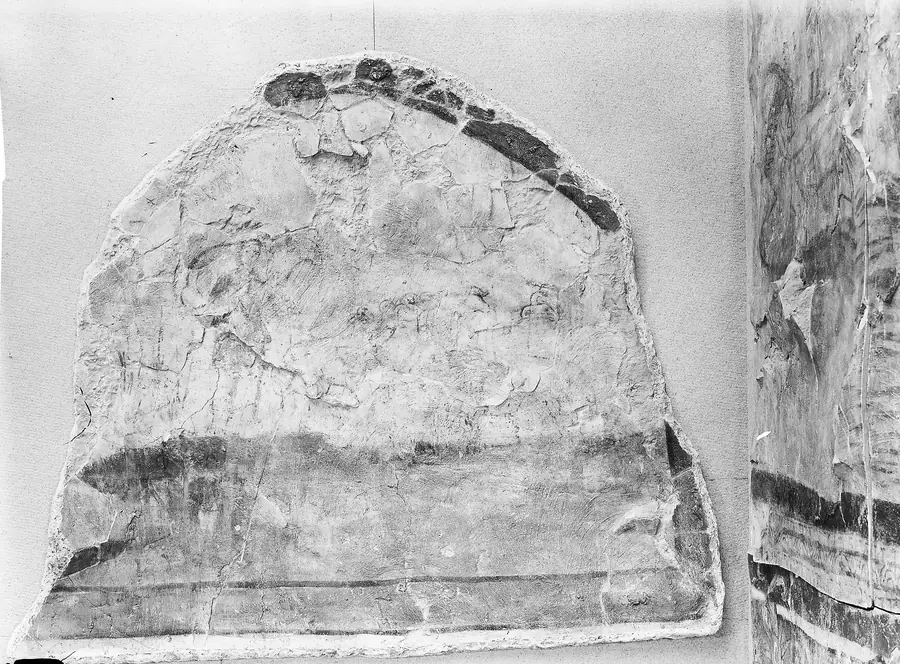
The building was adapted in the third century. The photo records part of the room as excavators found it in 1932. Point out one thing you can see. Name one detail about baptism that the photo leaves open.
What the Sources Can Tell Us
Claim | Location and limit |
|---|---|
Gathering and gifts | First Apology 65–67. The description represents Justin’s public account of these practices. |
Baptism in differing water conditions | Didache 7. The text gives directions and leaves their use in other churches open. |
Christian Building | Yale excavation account and Leon Angelo & Silver (2024), especially Fig. 2 and the discussion of changes to rooms 4 and 6. Third-century adaptation is supported. The exact date and sequence are debated. |
Sacramental grace | Westminster Confession 27–29. English sections read. This is a Reformed theological judgment distinct from the historical evidence. |
Reformed Assessment
The Word, sacraments and prayer are ordinary means through which God nurtures his people. Jesus joins baptism with teaching in his command to make disciples. Paul asks believers to build up the church when they gather. A congregation can do these things in a simple meeting place. It can teach the faith in words people understand and help them take part. (Matthew 28:18–20. 1 Corinthians 14:26.)
Christ gives his church baptism and the Lord’s Supper. Reformed churches receive them as signs and seals of his promises. Their effectiveness depends on the work of the Holy Spirit and Christ’s word. Baptism calls the church to teach and care for the people it welcomes. Obedience and generosity grow from the grace God gives. (Westminster Confession of Faith 27.1, 27.3, 28.5–6, 29.1.)
Why Preparation and Continuing Care Belong Together
Jesus commands his disciples to baptize and teach. Teaching helps people understand the promise baptism points to and learn to follow Christ in daily life. The Westminster Confession says the Holy Spirit grants the grace promised in baptism to those to whom it belongs, at God’s appointed time. This gives the church reason to pray for those it baptizes and keep teaching them after the service. Paul also asks what each contribution to a gathering does to build up the church. A family that understands a lesson but cannot come regularly still needs care. Ask what this family can hear and receive now, and what help would make it possible to keep learning with the congregation. (Matthew 28:18–20. 1 Corinthians 14:26. Westminster Confession of Faith 28.5–6.)
Case Study
Fictional case: A church plant near Lagum has several new households. Its leaders want an impressive public baptism service. A local worker notices that some candidates cannot yet explain the gospel, while others need help joining the congregation's regular life. The leaders must decide what preparation and follow up to provide.
Walk with a Household Before and After Baptism
A worker in Lagum might begin by listening to one household. Ask someone to tell the story of Jesus in their own words and explain why they want to be baptized. A person who struggles to answer may need teaching or a conversation in a familiar language. Someone who understands the gospel may still need help getting to the gathering. The church can learn what each person needs by asking them directly.
In Matthew 28:18–20, Jesus joins baptism and teaching in the work of making disciples. Justin describes believers praying and fasting with people who were preparing and welcoming them into prayer after baptism. His account gives the leaders a question to ask. What kind of care will accompany teaching before baptism and continue afterward? A local teacher could meet with candidates to read a passage about Jesus, ask them to retell it and invite questions. Another member could ask about transport and offer to introduce the households to people at the gathering. The leaders decide about readiness through the church’s ordinary care. After four weeks, the teacher can check which learners can explain the passage, who has a person to contact and which practical barriers still need attention. The review gives the church grounds for its next decision.
Ministry Lessons for Today
1. Explain one part of the worship service in language a new person can understand.
2. Connect new believer teaching with prayer, membership, and continuing care.
3. Ask people what would help them participate. Consider language, transport, available workers and family responsibilities.
Activity
A Four Week Teaching Pathway
1. Find a need in the Lagum case. Name one truth people need to understand and one barrier that could keep them from learning or taking part.
2. Plan four weeks of teaching. Give each week one main truth and one shared practice or act of care. Include a follow-up step after baptism. The weeks organize the plan. The church decides when a person is ready for baptism.
Week | Gospel Truth to Explain | Shared Practice or Care |
|---|---|---|
1 | ||
2 | ||
3 | ||
4 |
3. Choose one step to try with the leaders’ agreement. Name a person, a start date and a way to check by day 30 whether the step helped.
Part of the Plan | My Answer |
|---|---|
Person and first date | |
Action and reason from Scripture | |
Permission, support or resources | |
What to check by day 30 |
4. Compare your response with the sample answers after the activity. Revise one sentence.
Check Your Work
Write first, then use these examples to revise.
• In 65, deacons bring portions of the meal to people who are absent. In 67, willing givers provide for people in need. Justin’s account shows how these practices fit the gathering he describes. Another church’s records would be needed to compare its practice.
• Justin explains worship to outsiders. Didache 7 gives directions to a Christian audience. An instruction shows what its writer asks readers to do. Other evidence can help show what they did.
• Example pathway. Week 1, explain Christ’s death and resurrection and listen to each learner retell the message. Week 2, read Matthew 28 and discuss baptism with a teacher. Week 3, attend worship with a host and offer help with transport. Week 4, arrange a visit or conversation after baptism as appropriate. Ask a local teacher to begin this week and check by day 30 whether willing learners can explain the gospel and name someone they can turn to.
Discussion Questions
1. What does Justin's account establish about his community?
2. How does 1 Corinthians 11 challenge an ideal picture of early worship?
3. What can a building show that a letter cannot?
4. How would you explain what baptism means and how God works through it?
Write short answers to two questions and give evidence.
Reflection Prompt
Begin with the response below. In your notebook, develop it into a reflection of about 200–250 words. Give an exact source location, a biblical reason and one practical step.
Choose one part of your Sunday service. Explain its purpose in three sentences for a person attending for the first time.
Prayer Points
• Pray that the Word will be understood and received.
• Ask for patient teaching before and after baptism.
• Pray for worship that includes practical love for neighbors.
Readings
• Read Acts 2:42, 1 Corinthians 11:17–26 and 14:26, and Matthew 28:18–20.
• Read Justin Martyr, First Apology 65–67, and Didache 7–8. For Justin’s description of baptism itself, see chapter 61.
• Read Yale University Art Gallery’s account of the Christian Building at Dura-Europos and the Westminster Confession of Faith, chapters 27–29.
References
Justin Martyr. (1885). The First Apology (M. Dods & G. Reith, Trans.). In A. Roberts, J. Donaldson, & A. C. Coxe (Eds.), Ante-Nicene Fathers (Vol. 1). Christian Literature Publishing. Read chapters 1–4, 61 and 65–67. English translation
The Didache. (1886). (M. B. Riddle, Trans.). In Ante-Nicene Fathers (Vol. 7). Christian Literature Publishing. Read chapters 7–8. English translation
Biblical Studies Press. (2017). New English Translation (NET). Bible notes are paraphrases. 1 Corinthians 11
Yale University Art Gallery. (n.d.). Christian Building. Dura-Europos: Excavating Antiquity. Building and excavation records
Leon Angelo, C., & Silver, J. (2024). Debating the domus ecclesiae at Dura-Europos: The Christian Building in context. Journal of Roman Archaeology, 37(1), 264–303. Archaeological study
Westminster Assembly. (n.d.). Westminster Confession of Faith, 27.1, 27.3, 28.5–6 and 29.1. Orthodox Presbyterian Church edition
Yale University Art Gallery. (1932). Baptistery niche at Dura-Europos [Excavation photograph]. Yale Digital Dura-Europos Archive, negative y291a, object 12052. CC0 1.0. Archive photograph and rights

Day 2 Witness and Mission
Lesson 5
Persecution and Martyrdom
Roman Pressure and the Church’s Response
Key Bible Passages
Passage | Historical Focus | Ministry Use |
|---|---|---|
1 Peter 4:12–19 | Christians may suffer while continuing to do good. | Help believers keep doing good when their faith brings suffering. |
Matthew 10:23 | Jesus allows his disciples to flee from danger. | Recognize that a disciple can seek safety under pressure. |
Acts 5:27–32 | The apostles obey God under pressure. | Consider how to obey God when authorities forbid faithful witness. |
Hebrews 13:3 | The church remembers prisoners and people who are mistreated. | Stay in contact with people who are isolated or mistreated. |
Lesson Overview
How did Roman pressure on Christians change from Pliny’s cases to the measures from AD 303? Some early Christians faced punishment or death. The kind of pressure they faced varied over time and from place to place. You will compare local trials with later imperial measures. You will also examine how Christians remembered those who died and cared for people who survived.
How to Study This Lesson
Read the Bible passages and the history first. Look at the visuals and complete the source questions in writing. Then read the assessment and work through the case and activity. Compare your work with the sample answers before writing your reflection and praying.
Learning Objectives
Area | Learning objective |
|---|---|
Historical understanding | Compare persecution in different periods and places. |
Source and theological discernment | Explain the different viewpoints of an official letter and a martyr story. |
Ministry application | Describe a pastoral response that honors courage and protects vulnerable people. |
Key Terms
Term | Simple meaning |
|---|---|
Persecution | Harm or punishment directed at people because of their faith. |
Martyr | A witness who dies because of faithfulness to Christ. |
Martyr account | A written story that remembers a martyr's suffering and death. |
Sacrifice certificate | A written request or record that attests that someone performed a required sacrifice. |
Lapsed | An early church term for Christians who denied their faith or complied with certain demands under persecution. |
Restoration | A person's return to the community through a process of care and repentance. |
Roman Pressure and Christian Responses
1. A Governor Decides What to Do
Around AD 112, the Roman governor Pliny the Younger faced an unfamiliar kind of hearing. People in Bithynia and Pontus, in what is now northern Türkiye, had been accused of being Christians. Pliny wrote to Emperor Trajan with several questions. Should the age of the accused matter? What should happen to someone who had left the faith? Was the name Christian itself enough to justify punishment, or should an official look for a separate offense? His questions show that a governor with the power to punish still had to decide what counted as a case.
Pliny describes what he did while he waited for guidance. He questioned people several times and ordered the execution of those who continued to say they were Christians. He ordered that Roman citizens in the same situation be sent to Rome. People who denied the charge could show their loyalty by honoring the Roman gods and the emperor’s image and by cursing Christ. In one letter, we see both the governor’s doubts about the rules and his confidence in carrying out punishment. A person’s public words and actions could determine whether they went home alive. (Pliny, Letters 10.96)
Trajan told Pliny to punish people when the accusation could be established. Those who denied the charge and demonstrated it by worshiping the gods could be pardoned. The governor should leave Christians alone unless someone brought a charge, and he should reject anonymous accusations. Notice the two parts of the policy. One limited how a case could begin. The other still authorized punishment. To find out how a governor elsewhere acted, we would look for records from that province and compare them with this exchange. (Pliny, Letters 10.97)
2. Two Choices in Smyrna
The church of Smyrna, today İzmir in western Türkiye, wrote to the church at Philomelium and invited other churches to read its account. It tells of the death of Polycarp, the bishop of Smyrna. Historians often place his death around AD 155 or 156. The exact date remains debated. The letter teaches by placing different choices beside each other. Quintus, a man from Phrygia, came forward voluntarily for trial. When he saw what lay ahead, he gave in and offered sacrifice. The writers use his story to discourage Christians from volunteering for arrest. (Martyrdom of Polycarp, greeting and 4)
Polycarp initially wanted to stay in Smyrna. He agreed to leave at the urging of other believers and went to a house in the countryside. When the authorities eventually found him, the account says that he gave his visitors food and asked for time to pray. At the stadium, the Roman official pressed him to reject Christ. He refused, and the church remembers his death as faithful witness. Readers can follow two decisions in the same life. Polycarp accepted help to get away from danger. When he faced a public demand to deny Christ, he stood by his confession. (Martyrdom of Polycarp 5–7, 9–12)
The final chapters explain how Smyrna hoped to remember Polycarp. The writers distinguish the worship they give to Christ from the love they show to martyrs. They say that the community gathered his remains and hoped to meet again in memory of his death. This ending helps explain the letter’s purpose. Smyrna was writing to encourage other churches and to pass on a way of remembering faithful people. A governor’s letter, a church’s account and a record of the trial, if one survived, would give different views of what took place. (Martyrdom of Polycarp 17–18)
3. A Prison Story from Carthage
Around AD 203, another account brings us into a prison in Carthage, in present-day Tunisia. An editor introduces a group of people preparing for baptism and then hands the story over to Perpetua. In the first-person account attributed to her, we hear a father trying to persuade his daughter to give up her confession. We also hear her worry about her nursing child. In a later scene her father brings the child to the hearing, where the official Hilarianus calls on her to sacrifice. She refuses. Her words are preserved inside a work put together for later readers, so the change from the editor’s voice to hers matters. (Passion of Perpetua and Felicitas 1.1–2 and 2.1–2, Wallis edition)
The editor tells the story of Felicitas, an enslaved woman, in the third person. She gives birth before the group is taken to the arena. Another Christian woman raises the child. Put the two stories side by side. Perpetua’s words give us one mother’s account of prison and family pressure. The editor preserves the other mother’s story and gives us a glimpse of care beyond the prison. We hear less directly from Felicitas and from the woman who took in her child. (Passion of Perpetua and Felicitas 5.2, Wallis edition)
4. A Small Document Shows a Larger Change
On 16 June AD 250, Aurelia Charis asked officials in Theadelpheia, Egypt, to confirm that she had sacrificed. The papyrus in Berlin names her and the village. It records what she said she had done and includes the names of two witnesses, Aurelius Serenus and Aurelius Hermas, who say they saw her sacrifice. The short document tells us exactly where to look for evidence. We have a request, a statement of compliance and an official confirmation. The village named in the document is the place of the request. The location where the papyrus was found is uncertain. (Berlin Papyrus Database, P. 13430, SB I 5943, lines 1–21)
The certificate comes from the reign of Decius. Think back to Pliny. His procedure began with an accusation. The papyrus shows officials recording sacrifice in response to an order, with a petitioner asking for proof of compliance. The original order has been lost. The papyrus gives us a local example of how compliance was recorded, while the motives of Aurelia Charis and the complete wording of the imperial order remain open questions.
5. Imperial Measures and the Church Afterward
From AD 303, imperial measures under Diocletian took another form. Eusebius reports orders against church buildings and Scriptures, followed by orders to imprison church leaders and press them to sacrifice. In AD 311, an imperial decree again allowed Christians to assemble under stated conditions. Eusebius’s report tells us what he believed the measures required. To find out what happened to one congregation, we would need evidence about its city, its officials and its neighbors. Lesson 9 returns to the new public situation that followed. (Eusebius, Church History 8.2.4–5 and 8.17.3–10)
Pressure also left questions for church leaders after an immediate danger had passed. In Carthage, Cyprian urged people who had obtained certificates of sacrifice to take repentance seriously. His concern shows that a written claim of compliance could matter to the church even when someone said they had avoided the act itself. His argument gives us one pastor’s view. The story of any individual’s return would require a different record. Notice how each source places responsibility in a different setting. A governor handles accusations, witnesses attest an act, a church remembers courage and a pastor considers what restoration requires. (Cyprian, On the Lapsed 27)
Source Spotlight
Compare a Governor’s Letters and a Church’s Account
The first card summarizes an exchange between a governor and the emperor. The second summarizes a church’s account of a martyr’s death. Follow the source locations as you read.
Card A Pliny Asks and Trajan Replies
“They are not to be sought out; if they are denounced and proved guilty, they are to be punished” (Trajan to Pliny, Letters 10.97, Fordham English text).
Pliny tells Trajan that he questioned people accused of being Christians. He reports punishing people who continued to confess they were Christians and ordering Roman citizens to be sent to Rome. Trajan tells him to punish in proven cases, to pardon people who deny being Christian and worship the Roman gods, and to refuse anonymous accusations. He also tells Pliny to refrain from actively seeking Christians. (Letters 10.96–97)
Card B Smyrna Remembers Polycarp
“we do not commend those who give themselves up [to suffering]” (Martyrdom of Polycarp 4, Ante-Nicene Fathers translation).
The church of Smyrna sends a letter about persecution to the church at Philomelium and other churches. It recounts that Quintus volunteered for trial and later offered sacrifice. The writers discourage seeking arrest. They distinguish their worship of Christ from their love for the martyrs and explain why they planned to gather in Polycarp’s memory. (Martyrdom of Polycarp, greeting, 4, 17–18)
1. Mark · Underline one instruction in Trajan’s reply and one practice or value that the Smyrna writers commend.
2. Compare · identify each audience. Explain one difference between the evidence a governor’s exchange and a church’s remembrance give. Write one difference.
3. Write · Write one finding about each setting and cite the source. Give one example of evidence you would need to describe how Christians were treated in a different province.
My claim and source location
What remains open
4. Revise · Check that your claim says whose account you used, where to find it and what further evidence would help.
Historical Visuals
From Pliny to the Imperial Measures
Period | Place and Source | What the Evidence Adds |
|---|---|---|
About AD 112 | Bithynia and Pontus · Letters 10.96–97 | A governor asks how to handle accusations. The emperor gives directions. |
Second century | Smyrna · Martyrdom of Polycarp 4, 17–18 | A church remembers suffering and describes the kind of witness it commends. |
About AD 203 | Carthage · Passion of Perpetua and Felicitas | A narrator and a prisoner’s first-person voice give different perspectives. |
AD 250 | Theadelpheia in Egypt · SB I 5943 | A person seeks confirmation that she performed sacrifice. Witnesses attest it. |
From AD 303 | Roman Empire · Church History 8.2.4–5 | Eusebius reports wider imperial measures. Enforcement still needs local evidence. |
A Certificate of Sacrifice

Global Church Context
The table covers nearly two centuries. The sources come from different places and speak for different people. Pliny and Trajan show how an accusation might be handled. The Egyptian papyrus shows one way a local commission documented sacrifice. The martyr accounts show how Christians remembered their own communities. Which source would you use to ask what an official ordered? Which would you use to ask what a church wanted people to remember?
What the Sources Can Tell Us
Claim | Location and limit |
|---|---|
Accusations and imperial reply | Letters 10.96–97. The letters give a regional inquiry and the emperor’s reply, with limited evidence about enforcement elsewhere. |
Purpose of the martyr accounts | Martyrdom of Polycarp, greeting, 4, 17–18, and Passion of Perpetua and Felicitas, 1.1–2 and 5.2 (Wallis). The texts present Christian memory and selected voices. |
AD 250 recorded sacrifice | Berlin SB I 5943, catalogue record. One Egyptian petition and attestation. Stenzel’s catalogue commentary notes that the original edict is lost. |
Imperial measures from AD 303 | Eusebius, Church History 8.2.4–5, A historian’s report of orders and local experience. The degree of enforcement needs separate evidence. |
Reformed Assessment
Christ’s death is sufficient for our salvation. The church worships Christ and gives thanks for believers who remained faithful in suffering. First Peter calls people who suffer as Christians to entrust themselves to God and keep doing good. In Acts, the apostles obey God when leaders order them to stop teaching. These passages give us reasons to stand firm when faithfulness is costly. (1 Peter 4:12–19. Acts 5:27–32. Hebrews 10:10–14.)
Jesus also tells his disciples to seek safety in another town when persecuted. Hebrews asks the church to remember prisoners and people who are mistreated. A church can support a family that moves to protect its children. When repentance and restoration are needed, the church can listen patiently and respond to what actually happened. (Matthew 10:23. Hebrews 13:3.)
Ask What Kind of Suffering This Is
Peter distinguishes suffering for bearing Christ’s name from suffering for harm we have done. That distinction gives a congregation two duties when it hears about a conflict. It can protect someone who is threatened and still ask whether any complaint about that person’s conduct is true. Suppose a church worker is mocked for praying and is also accused of taking money without permission. The church can support the worker against threats while examining the accounts and hearing the people affected. If the complaint is true, the worker can admit the wrong and make it right. Christ’s sacrifice gives believers reason to tell the truth about their own conduct and to keep trusting him under pressure. (1 Peter 4:14–19. Hebrews 10:10–14.)
Case Study
A Family Under Pressure in Cagayan
Fictional teaching case. A church worker receives threats after a dispute connected with his ministry. His family moves temporarily to another town. Some church members praise him for protecting his children. Others say the move shows a lack of faith. The elders need to hear from the family and decide how to support them.
Worked Example A Church Supports a Family in Cagayan
Begin with the family’s account. An elder contacts the church worker in the language he prefers. The elder asks what happened, who may know where the family is staying and what would help this week. The answers tell the elders whether there is an immediate danger, what they may share and what help they can offer. A rumor about why the family moved cannot answer those questions.
In Smyrna, the church praised Polycarp’s confession and also recorded that he left town when friends urged him to do so (Martyrdom of Polycarp 5 and 9–10). We can learn from both details. The ancient account concerns a Roman official demanding that Polycarp deny Christ. The Cagayan family faces a local threat with its own circumstances. Matthew 10:23 gives disciples room to seek safety, and Hebrews 13:3 teaches the church to remember people who are mistreated. The elders can affirm the family’s care for its children and stand with them as they keep serving Christ.
With permission, name one person to make a private call this week. Ask the family to choose one practical form of support, such as help with travel. On day 30, ask whether contact remained private, whether the agreed help reached them and what the family wants the church to change.
Ministry Lessons for Today
1. Ask what happened before deciding how to describe it. Distinguish disagreement, threats and physical harm.
2. Ask the family what help they want. Keep contact details private and agree who will stay in touch.
3. Support people in ways the congregation can sustain. In Cagayan, that might mean a trusted contact, help with travel or a private check-in in a language the family prefers.
Activity
A Pastoral Response to a Threatened Family
1. Sort the facts in the Cagayan case. Write down one thing the elders know and one thing to ask the family in private.
2. Write two sentences for the elders. Name one way to honor the worker’s faithfulness or care for his family. Give one reason from this lesson’s Bible passages and one specific offer of help.
3. Choose one step to take with the family’s consent. Assign an elder or another trusted person, give a first date and say what that person will check by day 30.
Part of the Plan | My Answer |
|---|---|
Person and first date | |
Action and reason from Scripture | |
Permission, support or resources | |
What to check by day 30 |
4. Compare your response with the sample answers after the activity. Revise one sentence.
Check Your Work
Write first, then use these examples to revise.
• Trajan limits what Pliny should do with accusations, while still permitting punishment in proven cases (Letters 10.97). The Smyrna writers value faithful witness, discourage volunteering for trial and distinguish loving martyrs from worshiping Christ (Martyrdom of Polycarp 4, 17).
• An official in another province might have left separate letters or records. To understand a particular case, ask who wrote the record, when, where and for what purpose. Both sides of the Pliny and Trajan exchange concern the same cases.
• A sample response. ‘Jesus made room for his disciples to seek safety when threatened, and we respect your decision to protect your children (Matthew 10:23). With your permission, an elder will call privately this week and ask what practical help you need.’ By day 30, the elder can ask whether the agreed help is reaching the family.
Discussion Questions
1. How do these sources show that the pressure Christians faced varied across places and times?
2. What is lost when a martyr account is read as a simple transcript?
3. How can a church honor a martyr without making suffering a spiritual score?
4. What extra information would the elders need in the case?
Write short answers to two questions and give evidence.
Reflection Prompt
Begin with the response below. In your notebook, develop it into a reflection of about 200–250 words. Give an exact source location, a biblical reason and one practical step.
Write a short prayer for a person under pressure. Include one concrete form of support you could offer with that person's consent.
Prayer Points
• Remember Christians who face threats, imprisonment, or loss.
• Pray for faithful witness joined with wise protection.
• Ask for patient restoration after fear and failure.
Readings
• Read 1 Peter 4:12–19, Matthew 10:23, Acts 5:27–32 and Hebrews 13:3.
• Read Pliny and Trajan, Letters 10.96–97, and Martyrdom of Polycarp, greeting, 4 and 17–18.
• For comparison, read the Passion of Perpetua and Felicitas, 1.1–2 and 5.2 in the Wallis edition, and Cyprian’s On the Lapsed 27.
References
Pliny the Younger and Trajan. Letters 10.96–97. Internet History Sourcebooks Project, Fordham University. English translation
Martyrdom of Polycarp. (1885). (A. Roberts & J. Donaldson, Trans.). In Ante-Nicene Fathers (Vol. 1). Read the greeting and chapters 4–7, 9–12 and 17–18. English translation
Passion of Perpetua and Felicitas. (1885). (R. E. Wallis, Trans.). In Ante-Nicene Fathers (Vol. 3). English translation
Cyprian of Carthage. (1886). On the lapsed (R. E. Wallis, Trans.). In Ante-Nicene Fathers (Vol. 5). Treatise 3
Berlin Papyrus Database. SB I 5943 (P. 13430). Theadelpheia, AD 250. Papyrus catalogue
Stenzel, K. (2017, August 1). Certificate of sacrifice. Berlin Papyrus Database. Catalogue commentary
Eusebius. (1890). Church history (A. C. McGiffert, Trans.). In Nicene and Post-Nicene Fathers (2nd series, Vol. 1). See 8.2.4–5 and 8.17.3–10. Book VIII
Biblical Studies Press. (2017). New English Translation (NET). Bible notes are paraphrases. 1 Peter 4
Richardson, C. C. (Ed.). (1953). Early Christian Fathers. Introduction to The Martyrdom of Polycarp. Discussion of the date
Lesson 6
Defending and Explaining the Gospel
Speaking to Rulers and Testing What Churches Teach
Key Bible Passages
Passage | Historical Focus | Ministry Use |
|---|---|---|
1 Peter 3:15–16 | Christian answers should join reasons with gentleness. | Give a reason for Christian hope while treating the questioner with respect. |
Colossians 1:15–20 | Creation and reconciliation belong together in Christ. | Explain how Christ’s work joins creation and reconciliation. |
Luke 24:25–27 | Jesus is understood within the scriptural story. | Read a difficult passage in the wider story of Scripture. |
Jude 3 | The church is responsible for the faith entrusted to it. | Teach the faith entrusted to the church and listen carefully to questions. |
Lesson Overview
Why did Justin’s appeal to rulers and Irenaeus’s response to rival teaching use different arguments? Early Christians answered public criticism and debated rival teachings. Justin asked Roman rulers to hear Christians fairly. Irenaeus explained what he understood to be the churches’ common faith and responded to teachers with whom he disagreed. You will compare their arguments and practice explaining the gospel while representing another person’s concern fairly.
How to Study This Lesson
Read the Bible passages and the history first. Look at the visuals and complete the source questions in writing. Then read the assessment and work through the case and activity. Compare your work with the sample answers before writing your reflection and praying.
Learning Objectives
Area | Learning objective |
|---|---|
Historical understanding | Describe the different tasks of public defense and internal discernment. |
Source and theological discernment | Explain the main issue raised by Marcion's teaching. |
Ministry application | Give a brief answer that joins biblical clarity with respectful dialogue. |
Key Terms
Term | Simple meaning |
|---|---|
Apologetics | Giving reasons for Christian belief and answering criticism. |
Apology | A formal defense. In this lesson it is a written appeal. |
Heresy | Teaching that seriously departs from central Christian truth. |
Gnosis | A Greek word for knowledge. |
Gnosticism | A debated modern category for several ancient religious movements. |
Rule of faith | A summary of the apostolic message used in teaching and discernment. |
Two Ways to Explain and Defend the Faith
1. Justin Asks Rome for a Fair Hearing
In the middle of the second century, Justin addressed a written defense to the emperor Antoninus Pius, members of the imperial family, the Senate and the people of Rome. The opening identifies him as the son of Priscus and as a man from Flavia Neapolis in Roman Palestine. He speaks on behalf of people he says are being hated and mistreated. His choice of audience matters. An emperor could hear a request about how officials treated the accused. Senators and other readers could consider whether the accusations made sense. (Justin, First Apology 1–3)
Justin asks for a hearing based on what people teach and do. If a person has actually done wrong, the official should take that seriously. If the only evidence is the name Christian, the judge still needs to examine the person’s life. Think back to Pliny in Lesson 5. Pliny wondered whether the name itself or particular offenses should be punished. Justin raises a related question in a public appeal decades later. Pliny’s letter shows an official asking how to administer a province. Justin’s appeal shows a Christian asking rulers to reconsider the way a charge is judged. The two texts help us understand two sides of the wider dispute over accusations against Christians. (Pliny, Letters 10.96. Justin, First Apology 3–4.)
2. How a Defense Makes Christian Life Visible
Justin’s appeal does more than ask for a change in procedure. Later in the work, he tells readers what happens when Christians gather. He describes readings, an address, common prayers, the sharing of bread and wine and help for people in need. Lesson 4 considered this passage as evidence about worship. Here the question is why Justin explains it to outsiders. Readings and prayers show that the meeting has a recognizable purpose. The collection gives readers an example of how Christians care for others. These details help Justin invite people to judge actual practices. (First Apology 65–67)
A defense tells us which details an author chose to make visible. It also gives us particular claims to test. If a reader asks whether Justin described a collection for people in need, chapter 67 gives an answer. If the reader asks whether every congregation used the same arrangements, sources from other cities would help. If the reader asks whether Roman officials granted Justin’s request, an official reply or another record would be needed. As you read an apology, identify the claim, the audience and the kind of evidence that would show what happened next.
3. Irenaeus and the Churches’ Common Faith
In the late second century, Irenaeus served in Lyons in Roman Gaul, now Lyon in France. Eusebius preserves a letter in which believers commend Irenaeus to Eleutherus of Rome. Eusebius also names him as the successor of Pothinus in Lyons. The earlier letter reached readers inside a later history, so it helps to notice when Eusebius reports an event himself and when he gives the words of another document. The account places Irenaeus within a church that had ties beyond its own city. (Eusebius, Church History 5.4.1–2 and 5.5.8)
Irenaeus describes what he says the churches received from the apostles and their disciples. He begins with one God, the Father who made all things. He goes on to Jesus Christ, the Son who became human for our salvation, and the Holy Spirit who spoke through the prophets. He includes Christ’s suffering, resurrection and coming again. These parts belong together. The God who made the world also speaks through the prophets and brings salvation through the Son. This way of telling the whole message is an example of a rule of faith. (Irenaeus, Against Heresies 1.10.1)
Irenaeus imagines churches as one household that speaks with one voice. He names regions including Gaul, Spain, Egypt and Libya while recognizing that people speak different languages. He is explaining how the same faith could be handed on in different places. A reader can learn what he believed held these churches together. To learn which words a teacher in Egypt or Gaul used with new believers, the reader would look for teaching texts or other records from those communities. (Against Heresies 1.10.2)
4. Marcion Raises a Question About the Creator
In another part of the same book, Irenaeus introduces Marcion of Pontus. He says that Marcion distinguished the Father proclaimed by Jesus from the God who made the world and spoke through the law and the prophets. He also says that Marcion took out passages from the Gospel of Luke and from letters of Paul. Some of the passages that Irenaeus says were removed connect Jesus or the apostles to the Creator and to the prophets. In his account, the dispute about which writings Christians should read is bound up with a dispute about whose story those writings tell. (Against Heresies 1.27.2)
Who is speaking in this paragraph? Irenaeus is reporting a position he considers harmful. His language shows how strongly he objects. He describes passages as removed. That description is evidence of his argument about the text. To study the textual history further, a reader would need to compare the wording cited in other ancient sources and ask what version each author knew. For now, a careful conclusion is that Irenaeus presents Marcion as breaking the link between the Creator, Israel’s Scriptures and the Father proclaimed by Jesus.
The debate makes the practical work of Christian teaching easier to see. Imagine a listener hearing a prophet read on Sunday and then hearing Paul speak about Christ. One question would be whether the two readings tell one story. Irenaeus’s confession answers by naming one Creator and by placing the prophets and Christ’s saving work in the same account. In the next lesson, you will look more closely at how churches received and recognized Scripture.
5. Name the Claim Before You Name the Movement
Historians sometimes use the word Gnosticism for a range of ancient teachings. Modern scholars debate how useful the grouping is because teachers and texts differ. You can often learn more by writing down the particular claim first. In this lesson, ask who the writer says made the world, who sent Jesus and how the prophets fit into the story. Those questions help a reader identify the actual point at issue. (Williams, 2025)
Try this with the two passages from Irenaeus. Write that in 1.10.1–2 Irenaeus affirms one Creator and describes a faith shared across many churches. In 1.27.2 he attributes a different view of the Creator to Marcion. Both statements are grounded in the same book. The first tells us what the author confesses, while the second tells us how he represents someone he opposes. Remember that distinction when you hear another person’s beliefs summarized by a critic.
Source Spotlight
Reading Three Kinds of Evidence
These cards paraphrase the texts in easy English. Read the location beside each card as you work.
Card A Justin Asks for a Fair Hearing
“For from a name neither praise nor punishment could reasonably spring” (Justin, First Apology 4, Dods and Reith translation).
Justin addresses the emperor, the imperial family, the Senate and the Roman people. He asks the rulers to investigate charges. If a charge can be proved, they should judge the person’s conduct. A Christian name alone gives too little evidence for a verdict. (First Apology 1–4)
Card B Irenaeus States the Faith
“the Father Almighty, Maker of heaven, and earth, and the sea, and all things that are in them” (Irenaeus, Against Heresies 1.10.1, Roberts and Rambaut translation).
Irenaeus says that churches received their faith from the apostles and their disciples. He names one God who made all things, Jesus Christ who became human for our salvation, and the Holy Spirit who spoke through the prophets. He says churches pass on the same faith in different languages. (Against Heresies 1.10.1–2)
Card C Irenaeus Reports Marcion’s Teaching
According to Irenaeus, Marcion taught that the Father of Jesus was above the maker of the world. Irenaeus also says Marcion removed parts of the Gospel of Luke and of Paul’s letters. This is Irenaeus’s account of a teacher he opposes. (Against Heresies 1.27.2)
1. Mark · Underline one thing Justin asks rulers to do. Mark one phrase that Irenaeus affirms in Card B and one idea he attributes to Marcion in Card C.
2. Compare · compare Justin’s appeal to Roman rulers and readers with Irenaeus’s argument for Christian readers. Then compare who is speaking and whose views are described in Cards B and C. Write one difference.
3. Write · Write one sentence comparing Justin’s purpose with Irenaeus’s purpose. Cite one location from each writer. Then name one question that Irenaeus’s report leaves open about Marcion.
My claim and source location
What remains open
4. Revise · Check that your claim says whose account you used, where to find it and what further evidence would help.
Historical Visuals

Global Church Context
Setting | Question at Stake | Evidence to Read |
|---|---|---|
Rome, mid-second century | How should public authorities examine accusations against Christians? | Justin, First Apology 1–4 |
Marcion of Pontus, second century | How do the Creator, Jesus and the Scriptures relate? | Irenaeus’s description of a teacher he disputes in Against Heresies 1.27.2 |
Lyons, late second century | What teaching did churches receive and pass on? | Irenaeus’s summary of the faith in Against Heresies 1.10.1–2 |
Two Ways to Read One Author
Compare the two passages from Irenaeus. In 1.10.1–2 he explains what he affirms. In 1.27.2 he describes a view he disputes. The two passages have the same writer. Each supports a different kind of claim. Write one phrase you would use to help a reader tell these claims apart.
What the Sources Can Tell Us
Claim | Location and limit |
|---|---|
Justin’s request | First Apology 1–4 The address and request identify the intended audience and the judgment he seeks. A separate record would be needed to show an official response. |
The faith Irenaeus presents | Against Heresies 1.10.1–2 It expresses his account of apostolic faith shared among the churches. |
The teaching attributed to Marcion | Against Heresies 1.27.2 The report comes through Irenaeus, who argues against it. |
Irenaeus in Lyons | Eusebius, Church History 5.4.1–2 and 5.5.8, preserves a recommendation naming Irenaeus and gives later testimony about his role in Lyons. |
Gnosticism as a classification | Williams (2025), It describes the historical and scholarly debate over the category. |
Reformed Assessment
Colossians says that all things were created through Christ and that God brings reconciliation through the blood of his cross. The God who creates is the God who saves. On the road to Emmaus, Jesus uses Moses and the Prophets to explain why the Messiah had to suffer and enter his glory. Read difficult passages in their own setting and in light of the whole story of Scripture. (Colossians 1:15–20. Luke 24:25–27.)
Peter urges believers to explain their hope with gentleness and respect. Jude urges them to stand for the faith entrusted to the church. A faithful answer does both. Listen until you can state the question accurately. Then explain what Scripture teaches and give the person room to ask again. (1 Peter 3:15–16. Jude 3.)
Let the Whole Story Shape the Answer
Irenaeus places the prophets and the work of Jesus within the confession of one Creator. A learner can try that way of reading when a passage raises a hard question. Suppose someone asks why a prophet speaks so sharply to people who are suffering. First read the surrounding verses and identify whom the prophet addresses and what that person or community has done. Then ask what the passage shows about God’s concern for his people. Jesus taught his disciples to read Moses and the Prophets in light of the Messiah’s suffering and glory. Give the learner room to name what still troubles them as you read the passage in that larger story. (Irenaeus, Against Heresies 1.10.1. Luke 24:25–27. 1 Peter 3:15–16.)
Case Study
A Question in a Home Bible Group
Fictional teaching case. In a home Bible group near Lagum, a young adult says, “The Old Testament God is cruel, but Jesus is kind.” The leader wants to call the statement Marcionism. Another member suggests first asking which passages troubled the young adult. The group needs a response that takes the question seriously and connects creation and salvation in Christ.
Worked Example Hear the Question Before Answering
At the Bible group near Lagum, ask the young adult which passage raised the concern. Suppose the question came from a passage about judgment. You might ask whether the main difficulty is how God can judge and still show mercy. Let the person correct your account of the question. Irenaeus’s report of Marcion reminds us how much depends on whose words we have (Against Heresies 1.27.2). Here the speaker is in the room and can explain what he means.
Read Colossians 1:15–20 together. Ask the group to find what Paul says about creation and what he says about peace through Christ’s cross. You could say, “You are asking how the God who judges can also show mercy. Paul says that everything was made through Christ and that God brings peace through his cross. Could we read the passage about judgment together and ask what it tells us about God’s purposes?” Irenaeus’s confession joins the Creator, the prophets and Christ’s saving work in one account (Against Heresies 1.10.1).
Choose a time before the next meeting to read the passage with the young adult in a language he understands. At the next meeting, ask him to explain how the cross relates to the God who made the world and what question still needs time. The answer will help you decide what to read together next.
Ministry Lessons for Today
1. Ask what the person heard and which passage raised the concern. Restate the question and invite the person to correct you.
2. Read the passage together in a language the person understands. Connect the immediate setting with the wider story of Scripture.
3. Use historical labels to identify particular teachings. Give the person time and space to ask further questions.
Activity
A Three Sentence Answer
1. Read the Lagum case and Colossians 1:15–20. Write down which part of the young adult’s concern is clear and what you would ask to understand it better.
2. Draft three sentences. Restate the concern fairly. Connect creation and reconciliation in Christ. Invite the person to read one passage together.
Part of the Response | My Sentence |
|---|---|
The concern I heard | |
The truth I can explain from Colossians | |
An invitation to read together |
3. Plan a follow-up within 30 days. Name a person and a first date. Ask the learner to confirm that you have understood the question.
Part of the Plan | My Answer |
|---|---|
Person and first date | |
Action and reason from Scripture | |
Permission, support or resources | |
What to check by day 30 |
4. Compare your response with the sample answers after the activity. Revise one sentence.
Check Your Work
Write first, then use these examples to revise.
• Justin asks rulers to examine conduct and evidence in First Apology 3–4. Irenaeus states the faith he says the churches received from the apostles in Against Heresies 1.10.1–2. Each chooses an argument that fits his audience and purpose.
• Against Heresies 1.27.2 tells us how Irenaeus presents Marcion. To reconstruct Marcion’s own teaching, historians would look for words attributed to Marcion, compare their transmission and assess whether the sources give independent evidence.
• A sample answer. ‘It sounds as if the way God acts in some Old Testament passages seems hard to connect with what you see in Jesus. Colossians 1:15–20 says that the Son through whom God made all things also brings reconciliation. Which passage has raised this concern for you, and could we read it together next week?’ With the learner’s agreement, the Bible group leader can meet within 30 days and ask whether the restatement is fair.
Discussion Questions
1. How did Justin’s appeal to Roman rulers shape the case he presented?
2. Why is the unity of creation and redemption important?
3. What does Irenaeus’s account tell us about Marcion? What evidence would help you learn more?
4. How can a teacher explain a disputed idea while helping a learner feel heard?
Write short answers to two questions and give evidence.
Reflection Prompt
Begin with the response below. In your notebook, develop it into a reflection of about 200–250 words. Give an exact source location, a biblical reason and one practical step.
Remember a question you once answered too quickly. Write a better opening response that shows both conviction and willingness to listen.
Prayer Points
• Ask for wisdom to explain the whole biblical story.
• Pray for people confused by competing religious messages.
• Ask for truthful speech about those with whom we disagree.
Readings
• Read 1 Peter 3:15–16, Colossians 1:15–20, Luke 24:25–27 and Jude 3.
• Read Justin, First Apology 1–4, and Irenaeus, Against Heresies 1.10.1–2 and 1.27.2.
• For the debate over historical labels, see Williams (2025), ‘Gnosticism.’
References
Justin Martyr. (1885). The First Apology (M. Dods & G. Reith, Trans.). In A. Roberts, J. Donaldson, & A. C. Coxe (Eds.), Ante-Nicene Fathers (Vol. 1). Chapters 1–4 and 65–67
Irenaeus of Lyons. (1885). Against Heresies (A. Roberts & W. Rambaut, Trans.). In A. Roberts, J. Donaldson, & A. C. Coxe (Eds.), Ante-Nicene Fathers (Vol. 1). Book 1 Chapter 10
Irenaeus of Lyons. (1885). Against Heresies (A. Roberts & W. Rambaut, Trans.). Same translation, 1.27.2. Book 1 Chapter 27
Eusebius. (1890). Church History (A. C. McGiffert, Trans.). In Nicene and Post-Nicene Fathers (2nd series, Vol. 1). Read 5.4.1–2 and 5.5.8. Book 5
Williams, M. A. (2025). Gnosticism. In R. Flower (Ed.), The Cambridge Companion to Christian Heresy (pp. 115–135). Cambridge University Press. Chapter summary
Biblical Studies Press. (2017). New English Translation (NET). Bible notes in this lesson are paraphrases. Colossians 1
Lesson 7
Scripture and the Rule of Faith
How Early Churches Read and Received Scripture
Key Bible Passages
Passage | Historical Focus | Ministry Use |
|---|---|---|
2 Timothy 3:14–17 | Scripture teaches and equips God's servant. | Let Scripture teach and equip the church for good work. |
1 Corinthians 15:1–4 | Paul passes on the gospel he received. | Explain the gospel before explaining how churches summarized it. |
Acts 20:27–32 | Leaders teach God's purpose and entrust the church to his Word. | Help leaders teach God’s Word faithfully and care for the church. |
Galatians 1:6–9 | Another message must be tested against the gospel. | Test a new message against the gospel the church received. |
Lesson Overview
What do Eusebius and Athanasius show about how churches recognized Scripture? Early Christians read Israel’s Scriptures and apostolic writings before the earliest surviving list of the 27 New Testament books. You will compare a historian’s account with a bishop’s letter. Then you will use the records to answer a question about the Council of Nicaea.
How to Study This Lesson
Read the Bible passages and the history first. Look at the visuals and complete the source questions in writing. Then read the assessment and work through the case and activity. Compare your work with the sample answers before writing your reflection and praying.
Learning Objectives
Area | Learning objective |
|---|---|
Historical understanding | Distinguish Scripture, a canon list, and a summary of belief. |
Source and theological discernment | Explain what Eusebius and Athanasius show about received writings. |
Ministry application | Correct a misleading statement about the formation of the New Testament. |
Key Terms
Term | Simple meaning |
|---|---|
Canon | The collection of books received as Scripture. |
Inspiration | God's work by which Scripture is his written Word. |
Reception | The way a writing or decision is received and used by communities. |
Creed | A formal statement of faith used by the church. |
Rule of faith | A summary of apostolic teaching used to guide belief. |
Public reading | Reading a text aloud for a gathered community. |
Reading Scripture Before and After the Lists
1. What a Congregation Heard
Imagine visiting a Christian gathering in the Roman world in the middle of the second century. You hear a reading from the prophets or from the accounts associated with the apostles. When the reading ends, the person leading the gathering speaks about what has been read and urges people to follow it. Justin describes this pattern when he explains Christian worship to Roman readers. His account places readings and teaching together. The gathering was a place where people heard texts in common and learned to live by what they heard. (Justin, First Apology 67)
The words Justin uses give us a starting point. He mentions both the prophets and the accounts of the apostles. If someone claims that Christians began to hear apostolic writings in worship only after a fourth-century list appeared, Justin’s account gives a second-century example to examine. If the question is exactly which books were read during a year in that congregation, Justin’s description gives less detail. A list of readings or quotations from particular books would help. Evidence of reading and evidence of a complete collection answer different questions.
2. How a Historian Describes Reception
In the early fourth century, Eusebius of Caesarea, on the Mediterranean coast of Roman Palestine, looks back on Christian writings in his Church History. He summarizes books that had come up earlier in the work. The four Gospels and Acts come first among writings he counts as accepted. He also lists Paul’s letters and names the first letters of John and Peter. In a separate group he places James, Jude, Second Peter and Second and Third John. He describes them as disputed while also saying that many people knew or recognized them. (Eusebius, Church History 3.25.1–3)
Eusebius puts the Shepherd of Hermas in another category. The McGiffert translation describes the books in that category as rejected. He treats writings he associates with heretical teachers separately. The Book of Revelation also needs close attention. He mentions it with a qualification among accepted works and then reports that others class it differently. His summary gives us a historian’s account of both shared practice and disagreement. It would take records from particular churches to find out what each congregation read in worship or used in teaching. (Church History 3.25.2–6)
3. What an Easter Letter Tells Its Readers
In AD 367, Athanasius, bishop of Alexandria in Egypt, sent the Easter letter we know as Festal Letter 39. He says he wants readers to recognize the books received as Scripture and to avoid confusing them with other writings. He lists the books of the Old Testament and then the New Testament. His list of New Testament books includes the four Gospels, Acts, the seven general letters including James, the fourteen letters he groups with Paul and Revelation. This is the earliest surviving list known to name exactly the 27 books of today’s New Testament. The date belongs to the letter. Many of the writings had already been read and used for generations. (Athanasius, Festal Letter 39.2–5. Brakke, 2010.)
After naming these books, Athanasius speaks about a second set of readings. He includes the Teaching of the Apostles and the Shepherd among books assigned to people learning the faith. Their place in the letter makes their value and their function visible. A teacher could put one of these works in a learner’s hands while treating Scripture as the source with a different authority. The letter gives the guidance of one bishop in a particular setting. To follow what happened elsewhere, we would look for the writings and practices of other churches. (Festal Letter 39.6–7)
4. Work Through Two Examples
Start with James. In Church History 3.25.3, Eusebius reports that it was disputed and recognized by many. In Festal Letter 39.5, Athanasius places James in his New Testament list. You can say that the two writers describe its status differently. Suppose someone asks the year when James was first accepted in every city. Our two passages give neither the first date of reception in each place nor a list of every community. To study that question, you could look for early quotations of James, old manuscripts and other lists, recording where and when each source was produced.
Now look at the Shepherd. Eusebius places it among works he labels with a different category from the Gospels (Church History 3.25.4). Athanasius recommends it as reading for learners while marking off the books he calls canonical (Festal Letter 39.7). Try to explain its place in your own words. One way to put it is that the Shepherd could be known and valued in a church without having the status of Scripture in that writer’s list. The history of a book’s use has room for more than one role.
5. Scripture, Creed and Church Rules
When Irenaeus summarized the faith in Lesson 6, he traced one story from the Creator through the prophets to the saving work of Christ. A rule of faith helps people teach that story and see how its parts belong together. A creed is a written confession that a church can state together. The canon of Scripture is the collection of books the church receives as God’s written Word. A canon list names those books. The term canon can also mean a church rule, depending on the document you are reading. When you meet the word, ask what the writer is naming. (Irenaeus, Against Heresies 1.10.1–2)
The Council of Nicaea met in AD 325. Its surviving creed gives a confession about God and Christ. Its surviving church rules include a rule about appointing bishops and a rule about standing for prayer at specified times. These are examples of canons in the sense of church rules. A reader looking for a New Testament book list will find it in Athanasius’s later letter. If a video claims that Constantine chose the New Testament at Nicaea, ask which surviving source the speaker can show. Begin your own reply by naming the documents and explaining what each one contains. Lesson 10 will return to Nicaea and its confession about the Son. (Creed of Nicaea. Canons of Nicaea 4 and 20. Festal Letter 39.5.)
Source Spotlight
Follow James and the Shepherd
These cards restate the sources in easy English. Use the chapter and section numbers when you write.
Card A A Historian Reports Different Judgments
Eusebius names the four Gospels and Acts among the accepted writings. He places James among disputed writings that many nevertheless recognized. He puts the Shepherd of Hermas in a different group. In the McGiffert translation, that group is called rejected writings. He treats works he says were cited by heretical teachers as a separate group. (Church History 3.25.1–6)
Card B A Bishop Gives Guidance
“appointed by the Fathers to be read by those who newly join us” (Athanasius, Festal Letter 39.7, R. Payne-Smith translation).
Athanasius lists the books he calls canonical. The New Testament list includes James. He then names other books that were assigned to be read by people receiving instruction. The Shepherd belongs to that second group. (Festal Letter 39.4–7)
1. Mark · Find James and the Shepherd in both cards. Mark the category each writer gives to each book.
2. Compare · Explain how a historian’s account of differing judgments and a bishop’s directions answer different questions. Write one difference.
3. Write · Write one sentence explaining the difference in how James appears in the two texts. Cite both locations. Then name one question about another church’s reading that the texts leave open.
My claim and source location
What remains open
4. Revise · Check that your claim says whose account you used, where to find it and what further evidence would help.
Historical Visuals

Global Church Context
Evidence | Setting | Question We Can Ask |
|---|---|---|
A description of worship | Justin, mid-second century, Rome | What kinds of writings does Justin say people heard at a gathering? |
A historian’s account | Eusebius, early fourth century, Caesarea | Which writings does he say people received or disputed? |
A council’s creed and rules | Nicaea, AD 325 | What faith did the bishops confess? What rules did they adopt? |
A bishop’s letter | Athanasius, Alexandria, AD 367 | Which books does he call canonical? What else does he recommend for teaching? |
Match the Claim to a Source
Which example shows that people read apostolic writings before AD 367? Which shows that Athanasius distinguished canonical books from other reading? Write a source location for each answer.
What the Sources Can Tell Us
Claim | Location and limit |
|---|---|
Public reading | First Apology 67 Justin describes readings without naming every work read. |
Categories and guidance | Church History 3.25.1–6 and Festal Letter 39.4–7 They represent two authors in distinct settings. |
Earliest surviving exact NT list | Brakke (2010), The claim is about extant documents and the New Testament books. |
Nicaea’s surviving documents | The AD 325 creed and canons The surviving texts contain confession and church rules. The video’s claim would require separate evidence. |
Reformed Assessment
Paul tells Timothy that Scripture comes from God and equips God’s people for good work. In Reformed teaching, God’s authorship gives Scripture its authority. The church receives it as God’s Word, and the Holy Spirit assures believers of its truth through the Word itself. A list of books is evidence of how people recognized Scripture in a particular setting. (2 Timothy 3:14–17. Westminster Confession of Faith 1.4–5.)
In 1 Corinthians, Paul passes on the gospel he received, including Christ’s death and resurrection. He entrusts the elders from Ephesus to God and to the word of his grace. In Galatians, he tells the churches to hold to the gospel they received. A creed or confession helps the church say what it believes and teach it to others. Scripture remains the final standard for examining any summary. (1 Corinthians 15:1–4. Acts 20:27–32. Galatians 1:6–9. Westminster Confession of Faith 1.10.)
Test a Confession by Reading the Passage
A confession can help a new believer connect truths that appear in several books. For example, when a class learns that Christ died for our sins and rose from the dead, read 1 Corinthians 15:1–4 aloud and ask students to point to both parts of the message. Then invite them to explain why Paul says he received this gospel before he passed it on. The activity lets the class see where its confession comes from. The Westminster Confession gives Scripture the final word in disputes about faith. If a class summary leaves out the resurrection, the teacher can use the passage to revise the summary and let students try it again. (1 Corinthians 15:1–4. Westminster Confession of Faith 1.10.)
Case Study
A Video Shared with a Youth Group
Fictional teaching case. A youth group in Cagayan sees a video that says Constantine selected the New Testament at Nicaea. The youth leader asks a GRUTS student to prepare a short reply. The student reads the surviving creed and rules to see what they actually contain.
Worked Example Check the Claim Behind a Video
A Cagayan youth group shares a video claiming that Constantine selected the New Testament at Nicaea. Start by asking the group to write that claim in a sentence. Open the surviving creed and read its statements about the Father and Son. In Canons 4 and 20, look for the instructions about appointing bishops and standing for prayer. The group can describe those documents in its own words. Then open Athanasius’s Festal Letter 39.5 and find the book list, written in AD 367. Ask what the group would need to see in order to support the claim about the AD 325 council.
You could answer, “The surviving Nicene documents give us a confession and rules for churches. Athanasius lists the 27 New Testament books in his letter of AD 367. Justin was already describing the reading of apostolic writings in worship in the second century.” Give the group the source locations so they can check each sentence. Second Timothy 3:14–17 teaches that Scripture comes from God and equips believers for good work. That gives us a reason to read it closely and to speak carefully about its history.
At the next meeting, hand out three slips marked list of Scripture books, confession of faith and church rule. Ask each learner to match one source to each slip and explain one choice. Use their answers to see which distinction still needs attention.
Ministry Lessons for Today
1. State the claim fairly before answering it. Open the source and write down the location of the passage you use.
2. Explain the difference between a canon of Scripture, a creed and a church rule in language the group understands.
3. Tell the group what the evidence shows and what still needs checking. Ask a learner to explain the difference between canon and creed in their own words.
Activity
Repair a Popular Claim
1. Choose one claim to examine. ‘Nicaea made the Bible.’ ‘Churches first read New Testament writings in AD 367.’ ‘Early lists all agreed.’
2. Write three short sentences for a youth Bible group. Restate the claim, explain what a document actually shows and give a limit. Cite at least one source and its location.
Part of the Response | My Sentence |
|---|---|
The claim I heard | |
What the source shows and where to find it | |
A question the source leaves open |
3. Choose a leader and date to try your explanation. Ask a learner to explain the difference between a canon and a creed in their own words. Plan a check by day 30.
Part of the Plan | My Answer |
|---|---|
Person and first date | |
Action and reason from Scripture | |
Permission, support or resources | |
What to check by day 30 |
4. Compare your response with the sample answers after the activity. Revise one sentence.
Check Your Work
Write first, then use these examples to revise.
• Eusebius includes James among disputed writings recognized by many (3.25.3). Athanasius lists James among canonical books (39.5) and puts the Shepherd among readings for instruction (39.7).
• Example reply. ‘The video says Constantine selected the New Testament at Nicaea. The surviving creed confesses the church’s faith, and canons 4 and 20 give rules for church life. These documents give no list of New Testament books, so we would need other evidence for the claim.’
• Justin’s description of worship shows that apostolic writings were read well before AD 367 (First Apology 67). Eusebius and Athanasius give examples of different judgments about James. A youth leader can ask a learner to explain both canon and creed after hearing the reply and review the answer by day 30.
Discussion Questions
1. How can we tell that Christians read apostolic writings before we have a surviving list of 27 books?
2. What does Athanasius's list establish?
3. Why are educational books and canonical books different categories?
4. How does a creed help the church teach what it learns from Scripture?
Write short answers to two questions and give evidence.
Reflection Prompt
Begin with the response below. In your notebook, develop it into a reflection of about 200–250 words. Give an exact source location, a biblical reason and one practical step.
Explain canon and creed in two simple sentences each. Imagine speaking to a church member who has never attended seminary.
Prayer Points
• Give thanks for the preservation and translation of Scripture.
• Pray for truthful Bible teaching in churches and online.
• Ask for confidence joined with intellectual honesty.
Readings
For direct reading, open the source links in the references at the end of this lesson.
• Read 2 Timothy 3:14–17, 1 Corinthians 15:1–4, Acts 20:27–32 and Galatians 1:6–9.
• Read Eusebius, Church History 3.25.1–6, and Athanasius, Festal Letter 39.4–7.
• For further study, compare First Apology 67 with the Nicene creed and canons 4 and 20.
References
Eusebius. (1890). Church history (A. C. McGiffert, Trans.). In Nicene and Post-Nicene Fathers (2nd series, Vol. 1). Book 3 Chapter 25
Athanasius. (1892). Festal Letter 39 (R. Payne-Smith, Trans.). In Nicene and Post-Nicene Fathers (2nd series, Vol. 4). Sections 2–7
Justin Martyr. (1885). The First Apology (M. Dods & G. Reith, Trans.). In Ante-Nicene Fathers (Vol. 1). Chapter 67
Irenaeus of Lyons. (1885). Against Heresies (A. Roberts & W. Rambaut, Trans.). In Ante-Nicene Fathers (Vol. 1). Book 1 Chapter 10
Council of Nicaea. (325). Creed of the Council of Nicaea (A. West, Trans.). Fourth Century Christianity. Creed of AD 325
Council of Nicaea. (325). Canons of the Council of Nicaea (A. West, Rev. Trans.). Fourth Century Christianity. Canons 1–20
Brakke, D. (2010). A new fragment of Athanasius’s thirty-ninth Festal Letter: Heresy, apocrypha, and the canon. Harvard Theological Review, 103(1), 47–66. Public extract
Westminster Assembly. (n.d.). Westminster Confession of Faith 1.4–5, 1.10. Orthodox Presbyterian Church edition
Biblical Studies Press. (2017). New English Translation (NET). Bible notes are paraphrases. 2 Timothy 3
Lesson 8
Everyday Christians and Mission
Evidence from Homes Work and Care
Key Bible Passages
Passage | Historical Focus | Ministry Use |
|---|---|---|
Romans 16:1–7 | Women and men participate in varied forms of service. | Notice the people who make ministry possible through welcome and practical service. |
1 Peter 2:9–12 | The whole community bears witness through its life. | Consider what neighbors learn about the church from the way believers live. |
Acts 16:11–15 | Travel, a household, and hospitality meet in mission. | Ask how a household can welcome people and take part in mission. |
James 2:14–17 | Faith is expressed in practical care. | Give practical help when people lack what they need. |
Lesson Overview
How did everyday relationships make Christian witness visible, and what can we say about their effects? Homes, journeys, work and care brought people into contact with Christians. You will read what different sources tell us about the people involved. You will also ask what other evidence would help us understand the effects of their work.
How to Study This Lesson
Read the Bible passages and the history first. Look at the visuals and complete the source questions in writing. Then read the assessment and work through the case and activity. Compare your work with the sample answers before writing your reflection and praying.
Learning Objectives
Area | Learning objective |
|---|---|
Historical understanding | Identify several ways ordinary Christians participated in mission. |
Source and theological discernment | Distinguish evidence of care from proof of a growth rate. |
Ministry application | Design a ministry pathway that joins witness, dignity, and local participation. |
Key Terms
Term | Simple meaning |
|---|---|
Network | A set of relationships through which people communicate and act. |
Hospitality | Receiving and caring for guests. |
Patron | A person whose resources support others, sometimes with unequal power. |
Agency | A person's ability to act and contribute rather than only receive. |
Mercy ministry | Organized care for people in need. |
Coercion | Pressure that uses power to force or control a response. |
The Gospel in Everyday Relationships
1. Lydia Makes Room for Travelers
Acts follows Paul and his companions from Troas across the water to Neapolis and then to Philippi in Macedonia. On the Sabbath they go outside the city gate to a place by a river and speak with women who have gathered there. One is Lydia, a seller of purple cloth from Thyatira. Luke says that the Lord opens her heart to what Paul is saying. Lydia and her household are baptized. She then asks the travelers to stay in her home. The story gives Lydia an active part in what happens. She listens and offers the travelers a place to stay. (Acts 16:11–15)
Think about what that invitation made possible. A home could give visitors a place to sleep, share news and talk with people they might otherwise have missed. Acts names the ports and the places the travelers visited and identifies Lydia’s home as their place of welcome. The passage gives less detail about each person in the household. If you want to know how Lydia’s household members understood their baptism, or what they later did in the church, record that as a question for further evidence. We can see Lydia’s contribution clearly within the limits of the account.
2. A Letter Names the People Who Carry the Work
In Romans 16, Paul introduces Phoebe, who serves the church at Cenchreae. He asks his readers to welcome her and give her whatever help she needs. He says she has helped many people, including Paul himself. The letter names a person who gives support and also needs the support of another church. Those two actions show how relationships between churches can work in both directions. Paul expects his readers to take responsibility for a visitor because they belong to the same Lord. (Romans 16:1–2)
Paul also greets Prisca and Aquila as fellow workers and sends greetings to the church that meets in their house. The greetings help us ask different questions from the ones we might ask in a history centered on Paul alone. Whose home was available for a meeting? Who helped a visitor? Who received a greeting for hard work? A letter like this gives names and some details. It also leaves questions about the daily work of people it mentions briefly. Read the words beside each name before deciding what kind of responsibility a person carried. (Romans 16:3–7)
3. Two Women in a Governor’s Report
Around AD 112, Pliny wrote about people he had questioned in Bithynia and Pontus. He reports that he questioned two enslaved women under torture. They were called ministrae. The term points to service or a recognized role. The translation linked in the references uses the word deaconesses. That English word can bring to mind a specific church office. To decide whether that meaning fits Pliny’s setting, we would need to know more about what these women did and how their church appointed or recognized them. (Pliny, Letters 10.96)
Paul writes to commend Phoebe. Pliny writes to seek advice about trials. That difference helps explain what we can learn about the women in the two letters. In Romans we hear why Paul asks the readers to welcome someone he knows by name. In Pliny we hear the account of an official who used his power against two people whose names and words he does not preserve. Both letters tell us that women carried responsibilities in Christian communities. Each gives readers a different view of the women involved.
4. What Christians Did With Their Gifts
Around AD 200, Tertullian, a Christian writer in Roman North Africa, described a gathering with prayer, reading and instruction. He also described a fund. People who wished to give could put in a small amount on a regular occasion, according to their ability. The money went to people in need. Tertullian mentions poor people, children without parents or resources, older people who had to stay at home and people in prison on account of their faith. He even names people who had survived shipwreck. His examples show how a shared gift could respond to needs that looked quite different from each other. (Tertullian, Apology 39)
This passage appears in a defense of Christians addressed to Roman readers. Tertullian wants outsiders to know what he sees as the good of the community’s life. If you are looking for evidence that a Christian author described a fund for people in need, the chapter speaks directly to that question. If you want to know how much the fund held in a particular month, how far its help reached or what effect it had on church growth, look for other kinds of records. The account is especially clear about the purpose of the gifts and the people Tertullian says they helped.
5. Listen to Both Voices in a Dispute
In the third century, Origen answered Celsus, a critic who had written in the previous century. In the passage Origen preserves, Celsus describes people who work with wool and leather speaking with women and children in private homes and shops. He accuses them of turning listeners away from parents and teachers. Origen answers that Christian teachers seek to lead people toward the Creator. He asks Celsus to show what sound teaching Christians have drawn their listeners away from. In the same text we have a charge and a reply, with different speakers and purposes. (Origen, Against Celsus 3.55–56)
Read the passage as evidence about an argument. First, write that Celsus accused Christians of teaching in familiar places and undermining family or educational authority. Then write how Origen replied. A listener’s account, if we had one, could tell us how that person heard the teaching and what happened afterward. The work preserves the voices of two writers. We have less access to the women, children and workers they discuss.
6. From a Reported Practice to a Careful Claim
A home can be a place of welcome. A letter can carry a request for help. A fund can share the cost of care. A workshop can become a place where neighbors discuss the faith. The sources give us examples or claims about each of these possibilities. To explain growth in a particular town, we would need evidence that connects a practice to the people who responded there. This same care helps a church report its work today. A record can show how many households received food. A conversation with a family can show what the help meant to them. A claim about their faith requires attention to what they actually say.
Source Spotlight
Read a Defense and a Reply to Criticism
These cards restate the passages in easy English. In Card B, pay attention to who says each thing.
Card A Tertullian Describes Shared Care
“only if it be his pleasure, and only if he be able” (Tertullian, Apology 39, S. Thelwall translation).
Tertullian tells Roman officials that Christians gathered for prayer and instruction. Members who could afford it contributed if they wished. The funds helped people who were poor, children who lacked parents and resources, older people unable to leave their homes and Christians held in prison. Tertullian presents this care as part of the life Christians share. (Apology 39)
Card B Origen Quotes and Answers Celsus
Celsus alleges that Christian workers taught women and children in homes and workshops and drew them away from parents and teachers. Both the accusation and the reply survive in Origen’s book. Origen responds that Christian teachers aim to lead people toward the Creator. He challenges Celsus to show that Christians drew people away from good instruction. (Against Celsus 3.55–56)
1. Mark · In Card A, mark who gives and who receives help. In Card B, mark the accusation C and the reply O.
2. Compare · Explain why Tertullian describes his community and why Origen includes Celsus’s accusation before answering it. Write one difference.
3. Write · Write one claim a source supports about ordinary Christians. Give a source location and name one outcome the source leaves unmeasured.
My claim and source location
What remains open
4. Revise · Check that your claim says whose account you used, where to find it and what further evidence would help.
Historical Visuals

Global Church Context
Setting | What the Evidence Adds | Location |
|---|---|---|
Philippi and Rome, first century | People offer hospitality, use homes and support others. | Acts 16:11–15. Romans 16:1–7. |
Bithynia and Pontus, about AD 112 | A Roman governor reports questioning two enslaved women. | Pliny, Letters 10.96. |
North Africa, about AD 200 | A Christian writer describes giving for people in need. | Tertullian, Apology 39. |
Roman world, third century | Origen preserves and answers an earlier critic’s claims about Christian teaching. | Origen, Against Celsus 3.55–56. |
What the Sources Can Tell Us
Claim | Location and limit |
|---|---|
Lydia’s hospitality at Philippi | Acts 16:11–15. The narrative identifies Lydia as from Thyatira and places the encounter near Philippi. |
Two enslaved women in Bithynia-Pontus | Pliny, Letters 10.96, around AD 112. The governor reports interrogation. The exact responsibilities of the women remain uncertain. |
Contributions and care around AD 200 | Tertullian, Apology 39. The author’s defense describes practice. Local records would help test its extent and effects. |
Celsus’s accusation about teaching | Origen, Against Celsus 3.55–56, mid-third century. Origen transmits and contests a critic’s words. The passage gives no measure of conversions. |
Reformed Assessment
Christ gathers a people who belong to him and bear witness together. Romans 16 names people with different forms of service. In Acts 16, Lydia receives the message and opens her home. First Peter connects the church’s witness with the good its neighbors can see. These passages invite us to notice the gifts and contributions of people whose work can easily be missed.
James asks how faith acts when a person lacks food or clothing. In Reformed teaching, good works are the fruit of a living faith. A church can offer help freely and welcome questions about Christ. A neighbor can receive food and decide whether to accept an invitation to talk or study. (James 2:14–17. Westminster Confession of Faith 16.2.)
Let the People You Help Take Part
Paul introduces Phoebe as someone who has helped many people. He then asks another church to give her the help she needs. In the same two verses, she is both a person who serves and a person who receives. This matters when a church plans an act of mercy. A parent who receives food this week may know which families cannot reach the distribution point. An older neighbor may be able to explain the plan in a language the volunteers rarely use. Ask whether they would like to contribute and listen to what they say. The church has a way to thank God for their gifts and to put the good works of faith into practice. (Romans 16:1–2. James 2:14–17. Westminster Confession of Faith 16.2.)
Case Study
Food Support After Heavy Rain
Fictional teaching case. After heavy rain near Lagum, a congregation organizes food support for nearby households. A volunteer proposes requiring a Bible study before a family can receive food. The team needs a simple way to offer care and a separate, voluntary invitation to learn about Christ.
Worked Example Offer Help and Let Neighbors Choose
After heavy rain near Lagum, the church asks residents which households have difficulty reaching food and what would make help accessible. A family may be able to collect supplies early in the morning, while another may need a delivery. The team chooses a public distribution time and gives the same help to families with similar needs. A neighbor who wants to hear about Christ can choose a separate conversation at a later time.
Tertullian’s account gives one ancient example of a community sharing resources for people in need (Apology 39). He describes willing contributions and names several groups who received support. A church planning food relief today has a different task. James 2:14–17 brings our attention to the person who lacks food or clothing. It gives the team a reason to respond to that need with practical help. The team can explain its Christian purpose openly and give each neighbor room to decide whether to join a Bible discussion.
A volunteer can put the arrangements on a sign in language residents use. At the end of the week, record how many households received food and ask residents privately whether anyone felt that a Bible meeting was required. After 30 days, let those answers guide one change to the way the church offers help.
Ministry Lessons for Today
1. Ask residents what they need and let them help shape the plan.
2. Use the same access rules for neighbors who accept or decline a Bible conversation.
3. Record the help actually offered and invite private or anonymous feedback.
Activity
Plan Food Support and a Voluntary Invitation
1. Ask what a neighbor would need to know before coming for help. Write two fair access rules in words a volunteer could explain.
2. Write a short invitation to a separate Bible conversation. State plainly that a person may decline and still receive the same help. Identify one way to learn how neighbors experienced the process.
3. Name the coordinator and first date. Agree where neighbors can give anonymous feedback. State which sign of fair access the team will check by day 30.
Part of the Plan | My Answer |
|---|---|
Person and first date | |
Action and reason from Scripture | |
Permission, support or resources | |
What to check by day 30 |
4. Compare your response with the sample answers after the activity. Revise one sentence.
Check Your Work
Write first, then use these examples to revise.
• In Apology 39, Tertullian says willing contributors give as they are able and that the funds help people who need support. This is his description in a defense of Christians. To estimate effects on conversion, we would need different evidence.
• Celsus’s charge about teaching in homes and workshops is preserved by Origen. Mark the accusation and Origen’s response separately (Against Celsus 3.55–56). The exchange gives neither a count of listeners nor a conversion rate.
• Sample. ‘Food support is open to households on the same terms. If you would like to talk about the Bible, we are available in the side room later. You can choose whether to come.’ Ask a coordinator to begin this week and check anonymous feedback by day 30 for reports of pressure.
Discussion Questions
1. What do Lydia’s actions in Acts 16 show about hospitality and mission?
2. What does Pliny’s letter tell us about the two enslaved women, and what does it leave open?
3. What could we responsibly report about the care Tertullian describes?
4. How can the Lagum team offer food freely and still welcome questions about Christ?
Write short answers to two questions and give evidence.
Reflection Prompt
Begin with the response below. In your notebook, develop it into a reflection of about 200–250 words. Give an exact source location, a biblical reason and one practical step.
Identify one person whom your ministry usually treats only as a recipient. Describe a way that person could become a partner in planning.
Prayer Points
• Give thanks for less visible workers and receiving families.
• Pray for care that protects dignity and freedom.
• Ask for honesty in reports about ministry results.
Readings
• Read Romans 16:1–7, 1 Peter 2:9–12, Acts 16:11–15 and James 2:14–17.
• Open the full primary texts linked in the references at the end of this lesson. Read Tertullian, Apology 39, and Origen, Against Celsus 3.55–56. Mark the lines behind the source cards.
• For comparison, read Pliny, Letters 10.96, and Westminster Confession of Faith 16.2.
References
Tertullian. (1885). Apology (S. Thelwall, Trans.). In Ante-Nicene Fathers (Vol. 3). Read chapter 39. English translation
Origen. (1885). Against Celsus (F. Crombie, Trans.). In Ante-Nicene Fathers (Vol. 4). Read 3.55–56. Book III
Pliny the Younger and Trajan. Letters 10.96–97. Internet History Sourcebooks Project, Fordham University. English translation
Biblical Studies Press. (2017). New English Translation (NET). Bible notes are paraphrases. Acts 16
Biblical Studies Press. (2017). New English Translation (NET). Bible notes are paraphrases. Romans 16
Westminster Assembly. (n.d.). Westminster Confession of Faith 16.2. Orthodox Presbyterian Church edition
Pliny the Younger. Letters 10.96. Dickinson College Commentaries. Latin text
Day 3 Empire and Christian Confession
Lesson 9
The Church and Imperial Power
Permission Support and Religious Control
Key Bible Passages
Passage | Historical Focus | Ministry Use |
|---|---|---|
1 Timothy 2:1–6 | The church prays for rulers and the public good. | Pray for rulers and ask how the church can serve the public good. |
Romans 13:1–7 | Civil authority has a God given responsibility. | Explain why public authority carries responsibility for justice. |
Acts 5:27–32 | Obedience to God can require refusal of a ruler's demand. | Consider what to do when officials ask the church to disobey God. |
Mark 10:42–45 | Christian leadership is shaped by service rather than domination. | Use any authority you receive to serve others. |
Lesson Overview
How did Roman rulers change their treatment of Christian communities in 311, 313 and 380? Roman rulers could permit a gathering, return property, offer support or use law to favor a confession. You will compare examples of these decisions and ask what happened when officials put them into practice.
How to Study This Lesson
Read the Bible passages and the history first. Look at the visuals and complete the source questions in writing. Then read the assessment and work through the case and activity. Compare your work with the sample answers before writing your reflection and praying.
Learning Objectives
Area | Learning objective |
|---|---|
Historical understanding | Distinguish the main features of the three measures. |
Source and theological discernment | Separate a legal requirement from evidence of its actual enforcement. |
Ministry application | Evaluate a proposed partnership without making power the standard of success. |
Key Terms
Term | Simple meaning |
|---|---|
Empire | A political system ruling many peoples and territories. |
Edict | An official order issued by a ruler. |
Toleration | Permission for a group to exist or practice its belief. |
Patronage | Support given by a person or institution with resources. |
Imperial intervention | Action by the emperor in a church dispute or decision. |
Religious coercion | Using political or social force to control religious belief or action. |
Imperial Measures and the Churches
1 The Loss of a Place to Gather
Imagine arriving for worship and finding that officials have taken your congregation’s meeting place. What could your community do if it also lost its copies of Scripture or its leaders were arrested? Those questions help us read the imperial measures that began in AD 303. In his Church History, Eusebius reports an order to pull down church buildings and burn the Scriptures. He also describes later orders concerning church leaders, including imprisonment and pressure to sacrifice. The measures reached directly into the daily life of Christian communities. A church needed people to lead, texts to read and space to gather. (Eusebius, Church History 8.2.4–5.)
Lactantius tells the story of one building at Nicomedia, an imperial center in Bithynia in present-day Türkiye. He describes officials and soldiers breaking into the church and pulling down its walls. In the following chapter he describes restrictions on legal rights and standing. Eusebius gives an overview of several measures. Lactantius supplies a place and a sequence of events in his account of one city. Both Christian authors write about persecution with deep concern for what happened to believers. Their accounts give us places to start when we ask how widely a particular order was carried out. (Lactantius, Deaths of the Persecutors 12–13.)
2 Galerius Permits Christian Gatherings in AD 311
In AD 311 a Roman order issued under Galerius allowed Christians to gather again under stated conditions. Lactantius preserves the text. In it, the rulers recall their effort to bring Christians back to older religious practices. They acknowledge that many Christians continued in their convictions. The order allows them to remain Christians and to reassemble, provided they observe public order. It asks them to pray for the rulers, the state and themselves. Permission and a request for prayer belong to the same document. (Lactantius, Deaths of the Persecutors 34.)
In the next chapter Lactantius describes what happened in Nicomedia. He places the posting of the order there and tells Donatus, the man to whom he addressed his book, that he and other imprisoned Christians were freed. The shift from chapter 34 to chapter 35 matters. In the first passage a ruler announces permission. In the second a Christian author reports an outcome for people he names or addresses. To find out whether an imprisoned Christian in another province was released, we would need a report from that place. This is a simple example of how one book can contain evidence of more than one kind. (Lactantius, Deaths of the Persecutors 34–35.)
3 Milan, Nicomedia and the Return of Property in AD 313
Constantine and Licinius met in Milan in AD 313. The instructions Lactantius preserves mention this meeting and were later published by Licinius at Nicomedia. Readers often meet the phrase Edict of Milan. In this source, Milan is the place of the agreement, and Nicomedia is the place Lactantius identifies for the publication he describes. Keep both places in view. Eusebius also preserves a version of the instructions. (Lactantius, Deaths of the Persecutors 48. Eusebius, Church History 10.5.)
The instructions grant Christians and others freedom to follow the religion they choose. They also address a practical problem. A place where Christians used to gather might now belong to someone who bought it or received it as a gift. The instructions require the property to be returned to the Christian community without payment from the community. A person returning it could ask the authorities for compensation. The text also extends the return to other property held by Christian communities. The arrangements tell us who was to receive what and who could seek compensation. A dated property register, a petition or a governor’s record would help us follow a particular return. (Lactantius, Deaths of the Persecutors 48.)
4 Constantine and the Council at Nicaea
Imperial power could also supply transport and bring church leaders together. Eusebius says that Constantine called bishops to Nicaea in AD 325 and arranged help for their journeys. In his account the emperor entered the meeting and spoke about the need for peace and agreement. Eusebius admires Constantine and presents his part in the meeting favorably. The historian’s admiration is part of the account, alongside the practical information he provides about the summons, the meeting and the use of imperial resources. (Eusebius, Life of Constantine 3.6, 10, 12–13.)
The council’s creed answers a question about the Son’s relation to the Father. To study that teaching, read the creed alongside Eusebius’s account. The summons shows who made the meeting possible and how some bishops could travel. The creed records what the council confessed. Both belong to the history of Nicaea. They answer different questions. In Lesson 10 you will read the creed and a letter from Arius and his supporters to see what the debate was about. (Creed of Nicaea, AD 325, Son clause.)
5 The Religious Standard Issued at Thessalonica in AD 380
In AD 380 an imperial law issued at Thessalonica and addressed to the inhabitants of Constantinople named the faith followed by Damasus of Rome and Peter of Alexandria. The text speaks of the Father, Son and Holy Spirit as one deity with equal majesty. It gives the name Catholic Christians to those who follow that confession, calls rival groups heretical and threatens penalties. The word Catholic here is a label in an ancient law for the people whose confession it favors. The law names places and people, sets a standard and describes how its authors intend to treat other groups. (Theodosian Code 16.1.2, opening and closing clauses and Latin heading and date.)
Read AD 313 and AD 380 side by side. In the 313 instructions the reader can choose a religion, and Christian communities can claim the return of property. The 380 law says which confession is to receive a favored name and standing. That difference is visible in the texts. To discover what a person believed after hearing the 380 law or how an official acted, we would need another witness. A local church letter could describe a dispute, for example. A court record could show how officials acted in one case. Each answer requires evidence suited to the question. (Lactantius, Deaths of the Persecutors 48. Theodosian Code 16.1.2.)
6 Read a Law and Its Effects in Two Steps
Begin with a narrow claim that you can locate in the document. You could write, ‘The 311 order permitted Christians to gather under stated conditions.’ Point to chapter 34 in Lactantius. Then choose evidence of what happened. Chapter 35 lets you add that Lactantius reports the release of Donatus and other prisoners at Nicomedia. If your question concerns the whole empire, say that you have a report from one place and name the other records you would seek. Try the same method with the property instructions in 313 and the favored confession in 380. Read the words of each order first. Then ask which parts of its local effect the surviving evidence helps you see.
Source Spotlight
Compare Three Imperial Measures
These cards restate the sources in easy English. Track who speaks, what is ordered and what is reported to have happened.
Card A Permission for Christian Gatherings
The order in 311 allows Christians to gather again subject to public order. It asks them to pray for the rulers, the state and themselves. Lactantius then reports that the order was posted at Nicomedia and that Donatus and other Christian prisoners were released. (Deaths of the Persecutors 34–35)
Card B Religious Choice and the Return of Property
“liberty to follow that mode of religion which to each of them appeared best” (Lactantius, Deaths of the Persecutors 48, W. Fletcher translation).
The instructions published at Nicomedia in 313 refer to the meeting of Constantine and Licinius at Milan. They give Christians and other people freedom to follow the religion they choose. They also direct officials to return Christian assembly places and other communal property without charge. (Deaths of the Persecutors 48)
Card C An Approved Confession
The law issued from Thessalonica in 380 identifies the faith it expects people to follow. It names one deity in the Father, Son and Holy Spirit in equal majesty. It gives the name Catholic Christians to those who follow it and threatens penalties for others. This is the label the law uses for the approved confession. (Theodosian Code 16.1.2)
1. Mark · In each card, underline who receives permission, property or favored standing. Circle the sentence in Card A that reports what happened to prisoners.
2. Compare · Explain how the instructions in 313 and the law in 380 treat religious choice differently. Write one difference.
3. Write · Use two locations to explain one change in policy. Name a local record you would need to check how a measure was carried out.
My claim and source location
What remains open
4. Revise · Check that your claim says whose account you used, where to find it and what further evidence would help.
Historical Visuals

Global Church Context
Date | Place and Evidence | What We Can Check |
|---|---|---|
303 | Imperial measures described by Eusebius | The orders he reports concerning buildings and Scriptures. |
311 | Order posted at Nicomedia, Lactantius 34–35 | Permission to gather and a reported release of prisoners. |
313 | Milan meeting and Nicomedia publication, Lactantius 48 | Religious choice and terms for returning Christian property. |
380 | Law issued from Thessalonica and addressed to Constantinople, Theodosian Code 16.1.2 | The confession the law favors and the treatment it threatens for others. |
Look for Evidence of Enforcement
Which text reports a release from prison? What record would help you check whether a particular congregation received its property back?
What the Sources Can Tell Us
Claim | Location and limit |
|---|---|
AD 303 measures | Eusebius, Church History 8.2.4–5, describes imperial orders. Enforcement in each province requires local evidence. |
AD 311 and AD 313 at Nicomedia | Lactantius 34–35 records the AD 311 permission and then reports releases. In 48, Licinius publishes instructions at Nicomedia after the agreement with Constantine at Milan. Eusebius 10.5 preserves a version of the instructions. |
AD 380 law at Thessalonica | The Latin heading and subscription identify the addressees at Constantinople and the place of issue as Thessalonica in AD 380. The law points to Damasus of Rome and Peter of Alexandria. Practice and individual belief need different sources. |
Imperial support for a council | Eusebius, Life of Constantine 3.6, describes the summons and travel assistance. It reflects the perspective of a favorable biographer. |
Reformed Assessment
First Timothy asks churches to pray for rulers so people may live in peace. Romans 13 describes government as having a duty to serve the public good. Christians can welcome fair protection for worship and useful support for work that helps their neighbors.
Acts shows the apostles obeying God when authorities tell them to stop teaching. Jesus tells leaders in Mark to serve the people they lead. A church can cooperate with officials while its elders remain responsible for what the church teaches and asks of its members. (1 Timothy 2:1–6. Romans 13:1–7. Acts 5:27–32. Mark 10:42–45.)
The Public Good and the Church’s Witness
In 1 Timothy 2:1–6, Paul moves from praying for rulers to confessing that Christ is the one mediator who gave himself for others. Peaceful public life gives people room to hear and respond to that message. An official can help a congregation by ensuring fair access to a public service or by protecting worship. Christ is the one the church proclaims, and the church answers to him for what it teaches. For example, a congregation can thank a local government for improving the road to its meeting place and still explain that its worship is open to neighbors of every political preference. Let Romans 13:3–4 and Acts 5:27–32 guide both parts of the response.
Case Study
A Literacy Room in Cagayan
Fictional teaching case. A public official offers a room for a literacy program. The offer includes a request to display campaign signs and to endorse the official. The church team wants to help its neighbors learn to read. It must decide what terms it can accept and who will review the agreement.
A Worked Example for the Cagayan Literacy Program
The room could give adult learners a dry, accessible place to meet. The offer also asks the church to display campaign signs and endorse the official. Before agreeing, the team could ask learners how those conditions would affect them. A learner might worry that access depends on political support. An elder could ask for the terms in writing and find out who controls the schedule, who may attend and who handles complaints.
Lactantius 48 helps us ask practical questions about the terms attached to public action. It tells who could receive property, what officials were to do and how someone could ask for compensation. The Cagayan situation is an offer of a room, while the imperial instructions concern the return of communal property. The example invites the team to read its agreement carefully. Mark 10:42–45 gives the biblical reason for doing so. Jesus teaches that leadership serves people.
The team could propose written terms that make attendance open to eligible learners and keep campaign activity out of the room. One elder and one learner representative could review the terms with the official before the first class. After four weeks, they could ask attendees privately whether they understood the access rules and felt free to attend regardless of political preference. Their answers would help the team decide whether the agreement is serving its neighbors.
Ministry Lessons for Today
1. Write down what each partner offers and what each asks in return.
2. Give elders and the people who will use the room a chance to raise concerns.
3. Set a date to check whether the program serves people fairly and follows the agreed terms.
Activity
Review a Public Partnership
1. List the benefit offered and the two conditions. Consider who would gain access and what the church would be asked to say.
2. Recommend accepting, revising or declining the offer. Write one condition you would put in the agreement and give one reason from a Bible passage in this lesson.
3. Name the reviewer and a first date. Decide what to check by day 30, including who can use the room and how to raise a concern privately.
Part of the Plan | My Answer |
|---|---|
Person and first date | |
Action and reason from Scripture | |
Permission, support or resources | |
What to check by day 30 |
4. Compare your response with the sample answers after the activity. Revise one sentence.
Check Your Work
Write first, then use these examples to revise.
• Lactantius 34 preserves permission for Christians to gather under stated conditions. Chapter 35 reports the release of Donatus and others. The two chapters give different kinds of evidence about the same change.
• Lactantius 48 grants freedom of religious choice and orders the return of Christian property. Theodosian Code 16.1.2 names an approved trinitarian faith. Local records could show how a particular place applied either measure.
• Example. ‘Use of the room is open to learners on the same terms, and the program stays free of campaign signs and endorsements.’ An elder and a learner representative could review a written proposal this week. At day 30 they could ask participants privately whether everyone felt welcome.
Discussion Questions
1. What different changes do the texts of AD 311, 313 and 380 describe?
2. What would help you tell how a particular city followed an imperial order?
3. How can a church receive useful support and keep responsibility for what it teaches?
4. How would the proposed conditions affect learners who support other candidates or belong to another faith?
Write short answers to two questions and give evidence.
Reflection Prompt
Begin with the response below. In your notebook, develop it into a reflection of about 200–250 words. Give an exact source location, a biblical reason and one practical step.
Name a form of outside support your ministry values. Write two questions that would help keep the relationship honest and accountable.
Prayer Points
• Pray for rulers to exercise justice.
• Give thanks for opportunities to worship and serve.
• Ask for courage and wisdom when support carries harmful conditions.
Readings
• Read 1 Timothy 2:1–6, Romans 13:1–7, Acts 5:27–32 and Mark 10:42–45.
• Read the primary texts linked in the references at the end of this lesson. Compare Lactantius, Of the Manner in Which the Persecutors Died 34–35 and 48, with Theodosian Code 16.1.2.
• For comparison, read Eusebius, Church History 10.5, for another version of the AD 313 instructions.
References
Lactantius. (1886). Of the Manner in Which the Persecutors Died (W. Fletcher, Trans.). In Ante-Nicene Fathers (Vol. 7). Read 34–35 and 48. English translation
Theodosian Code 16.1.2. (1913). In J. C. Ayer, Jr., A Source Book for Ancient Church History (pp. 367–368). Charles Scribner’s Sons. English translation
Theodosian Code 16.1.2. (T. Mommsen & P. M. Meyer, Eds., 1905). See the names and place in the Latin text. Latin edition
Eusebius. (1890). Church History (A. C. McGiffert, Trans.). In Nicene and Post-Nicene Fathers (2nd series, Vol. 1). Read 8.2.4–5. Book VIII
Eusebius. (1890). Church History 10.5 (A. C. McGiffert, Trans.). Same edition. Book X
Eusebius. (1890). Life of Constantine (E. C. Richardson, Trans.). In Nicene and Post-Nicene Fathers (2nd series, Vol. 1). See 3.6 on the council summons and travel. Book III
Biblical Studies Press. (2017). New English Translation (NET). Bible notes are paraphrases. 1 Timothy 2
Council of Nicaea. (325). Creed of the Council of Nicaea (A. West, Trans.). Fourth Century Christianity. Greek and English
Lesson 10
Nicaea and the Son of God
The Son and the Father in the Creed of AD 325
Key Bible Passages
Passage | Historical Focus | Ministry Use |
|---|---|---|
John 1:1–3 | The Word is God and creation comes through him. | Read how John describes the Word and his work in creation. |
Colossians 1:15–20 | Christ's identity is related to creation and reconciliation. | Explain how creation and reconciliation belong together in Christ. |
Hebrews 1:1–4 | The Son reveals God's glory and is distinguished from creatures. | Ask what the Son reveals about God and why he is worthy of worship. |
John 20:28 | Thomas addresses the risen Jesus as Lord and God. | Help a learner connect the identity of Jesus with worship and trust. |
Lesson Overview
Why did the bishops at Nicaea say that the Son shares the Father’s divine being? At the Council of Nicaea in AD 325, bishops had to explain how the Son relates to the Father. They used the Greek word homoousios to confess that the Son is of the same being as the Father. You will compare this confession with a letter that presents the position of Arius and his supporters.
How to Study This Lesson
Read the Bible passages and the history first. Look at the visuals and complete the source questions in writing. Then read the assessment and work through the case and activity. Compare your work with the sample answers before writing your reflection and praying.
Learning Objectives
Area | Learning objective |
|---|---|
Historical understanding | Describe a real difference between Arius and the Nicene confession. |
Source and theological discernment | Explain the purpose of the term homoousios. |
Ministry application | Give a clear answer to a learner who calls Christ God's greatest creature. |
Key Terms
Term | Simple meaning |
|---|---|
Preexistence | The Son's existence before his human birth. |
Creature | Something brought into existence by God. |
Begotten | A word about the Son’s relation to the Father. The creed pairs it with the words ‘not made.’ |
Homoousios | Of the same being or essence. |
Council | A gathering of church leaders to consider doctrine and church matters. |
Eternal | Without beginning or end. |
From Alexandria to the Council of Nicaea
1 A Letter from Alexandria
In the early fourth century, Christians in Alexandria, Egypt, faced a question about the Son whom they worshiped. Arius, a presbyter in the city, and Alexander, his bishop, disagreed about how the Son relates to the Father. A letter from Arius and his supporters to Alexander gives us the writers’ own account of their teaching. Presbyters and deacons greet their bishop and present the faith they say they received. The document survives within works by later writers, including Athanasius and Epiphanius. When you read the letter, distinguish the people who wrote it from the authors who preserved it. (Arius and his supporters, Letter to Alexander 2–5.)
The letter gives the Son a high place. The writers say that he existed before the ages and that the Father made all things through him. They also describe him as created by the Father’s will and as receiving his life and being from the Father. In their account, the Father alone is without beginning. The writers reject the idea that the Son is a piece of the Father. Read those statements together. Their dispute concerns the kind of existence the Son has and how he receives it. A short description that calls him merely a human teacher would miss the letter’s emphasis on his existence before the ages and his part in creation. (Letter to Alexander 2–5.)
2 The Bishops Gather at Nicaea in AD 325
The dispute reached beyond Alexandria. In AD 325 the emperor Constantine called bishops to Nicaea in Bithynia, the city now called İznik in Türkiye. In his Life of Constantine, Eusebius of Caesarea reports that the emperor arranged travel help and that a formal meeting took place in the palace. A meeting on this scale required letters, time and a way for bishops to travel. Constantine’s support helps explain how they gathered. Eusebius describes those arrangements as a Christian writer who admired the emperor. (Eusebius, Life of Constantine 3.6, 10.)
The bishops issued a creed, a public statement of the faith they confessed. After speaking of the Father, the creed describes the one Lord Jesus Christ, the Son through whom all things came to be. It calls him true God from true God. It says he was begotten, not made, and is homoousios with the Father. The creed also speaks of the Son’s incarnation, suffering and resurrection. The issue under debate concerns the same Son whom Christians confess as their Savior. The closing statements reject claims that he came into being from nothing, that there was a time when he did not exist or that he belongs among created things. (Creed of Nicaea, AD 325, Son clause and closing condemnations.)
3 Begotten and of the Same Being
Both sources use language of begetting. The letter also describes the Son as created. The council joins begetting to the explicit denial of making. This gives the two words different work to do. The creed speaks of the Son’s relation to the Father and places him with the Father in the one divine being. Homoousios means of the same being or essence. In ordinary language, we might say that the Son is truly and eternally God with the Father. The Father and the Son are personally distinct. The confession concerns divine being and the Son’s eternal relation to the Father. (Letter to Alexander 2–5. Creed of Nicaea, AD 325, Son clause.)
Eusebius of Caesarea also wrote to his own church about the council. He knew that reports could spread before a full account reached his congregation. He gives the wording he presented and the creed the bishops issued. He then explains how he understood its language. He says that the Son is of the Father’s essence and that this involves no division of the Father. This responds to a concern we also hear in Arius’s letter about treating the Son as part of a divided Father. The letter gives us the explanation of one bishop who accepted the creed and had to explain it at home. (Eusebius, Letter to His Church 1, 8–13.)
4 Read the Bible Passages Together
John 1:1–3 tells readers that the Word was with God, that the Word was God and that all things came into being through him. Ask which words show distinction and which words express deity. Then follow the passage into its description of creation. John presents the Word as the one through whom every created thing came to be. Colossians 1:15–20 uses firstborn and then speaks of all things as created through Christ and for him. Its point becomes clearer when we read the whole paragraph, including Christ’s place over creation and his reconciliation of all things through the cross.
Hebrews 1:1–4 speaks of the Son as the radiance of God’s glory and says that God made the world through him. In John 20:28 Thomas addresses the risen Jesus as Lord and God. These passages let us connect the creed to the worship and hope of Christians. They ask us to explain who the Son is, how he relates to the Father and why people may trust him as Savior.
5 The Conversation Continued at Antioch
In AD 341 bishops at Antioch issued a creed that describes the Son as the exact image of the Father’s deity and quotes John 1:1. It affirms that all things came to be through the Son. It does not use homoousios in its description of him. Reading the two creeds in order shows that bishops continued to use and test different language after AD 325. The date and the words of a creed help us know what its writers put forward. To learn whether a church used it in teaching, we would look for a letter to that church, a sermon or another record that describes its use. (Second Creed of Antioch, AD 341, Son clause.)
6 Make a Claim from Two Sources
Start by finding a genuine point of agreement. Arius’s letter and the council’s creed both connect the Son with the creation of all things. Then ask what each text says about the Son’s own origin. The letter says the Son receives being by the Father’s will and was created before the ages. The creed says he was begotten and shares the Father’s divine being. Give both locators when you explain the difference. Eusebius’s letter to his congregation answers a further question. It lets us see how one signer explained the creed. The council text establishes the words to which he responds. (Letter to Alexander 2–5. Creed of Nicaea, AD 325, Son clause. Eusebius, Letter to His Church 9–13.)
Source Spotlight
Read the Letter and the Creed
Each card gives a short English quotation and a plain-English summary. The letter states the position of Arius and his supporters. The creed sets out what the council confessed.
Card A Arius and His Supporters Write to Alexander
“he was created at the will of God, before time and before the ages” (Letter to Alexander 3, G. Thompson translation).
The writers say the Son received his life and being from the Father. They call the Father alone without beginning and deny that the Son existed before he was begotten. They also object to the idea that the Son is a part cut off from the Father. (Letter to Alexander 3–5)
Card B The Bishops State Their Confession
“begotten, not made, of the same being as the Father” (Creed of Nicaea, AD 325, Son clause, A. West translation).
The creed calls the Son true God from true God and says all things came to be through him. Its closing condemnations include the claims that the Son came to be from nothing or was a created being. (Creed of Nicaea, AD 325, Son clause and closing condemnations)
1. Mark · In Card A, underline the words about the Son’s origin. In Card B, underline the words about his relation to the Father and find one claim the creed rejects.
2. Compare · Explain why saying that the Son existed before his human birth gives too little information to distinguish the two positions. Write one difference.
3. Write · Use a phrase from each card to explain the difference. Cite both sources. Name one kind of evidence that could show how a local church received the creed.
My claim and source location
What remains open
4. Revise · Check that your claim says whose account you used, where to find it and what further evidence would help.
Historical Visuals

Global Church Context
Setting | What Was at Stake | Evidence |
|---|---|---|
Alexandria, early fourth century | Arius and his supporters explain the Son’s relation to the Father in a letter to their bishop. | Letter to Alexander 3–5. |
Nicaea in Bithynia, AD 325 | Bishops meet at an imperial council and state their confession. | Life of Constantine 3.6, 10. Creed of Nicaea. |
Antioch, AD 341 | Bishops use different language to describe the Son and the Father. | Second Creed of Antioch, Son clause. |
Separate the Decision from Its Reception
Which source gives the decision at Nicaea? What other evidence could show whether a congregation taught the creed in the years that followed?
What the Sources Can Tell Us
Claim | Location and limit |
|---|---|
Arius and the Son’s origin | Letter to Alexander 2–5. The letter says the Son existed before time and the ages and came into being by the Father’s will. The text survives through later writers. |
The council of AD 325 at Nicaea | The council creed, Eusebius 3.6 and the İznik site description anchor the council and location. The summons comes through Eusebius’s account. |
The Son’s divine being | Creed of Nicaea (325), Son clause and final condemnations. Homoousios describes the Son’s relation to the Father in divine being. Later reception requires separate evidence. |
Debate after AD 325 | The Second Creed of Antioch (AD 341) uses a different set of words for the Son. One formula gives limited evidence about regional reception of Nicaea. |
Reformed Assessment
John says the Word was with God and was God, and that all things came to be through him. Colossians says all things were created through Christ and for him. It calls him firstborn and gives him first place over creation. Hebrews calls the Son the radiance of God’s glory. Thomas addresses the risen Jesus as his Lord and God. (John 1:1–3. Colossians 1:15–20. Hebrews 1:1–4. John 20:28.)
Reformed churches receive the council’s confession that the Son shares the Father’s divine being because it expresses biblical teaching. The Father and the Son are distinct persons. The Son is fully and eternally God, and Christians worship him with the Father. Scripture remains the final authority when the church tests a council’s teaching. (Westminster Confession of Faith 2.3 and 31.3 in the OPC edition.)
Read Firstborn in Its Paragraph
A learner may hear firstborn in Colossians 1:15 and assume Paul is naming the first thing God made. Read through verse 18 and list what Paul says Christ does. All things were created through him and for him, he is before all things, and in him they hold together. Verse 18 also connects firstborn from the dead with Christ’s first place in everything. These details explain why a Reformed reader hears the title as honoring Christ’s supremacy over creation. The Westminster Confession calls the Son eternally begotten of the Father (2.3). Ask the learner to put Paul’s reasoning in one sentence before introducing the creed’s Greek word. A confession helps a learner remember the sense of the passage.
Case Study
A Question in a New Believer Class
Fictional teaching case. A learner in Cagayan says that God made Jesus first and then made the world through him. Ask what the learner means before you answer. The teacher wants to explain what John says about the Word and why the church worships Jesus.
A Worked Example for the New Believer Class
In Cagayan a learner says that God made Jesus before making the world. Start by asking what the learner means by made. The learner may be trying to explain how Jesus can be God’s Son or how Jesus was alive before Bethlehem. Listen before choosing which part of the question to answer.
Arius’s Letter to Alexander 2–5 gives one example of a writer who can say the Son existed before the ages and still describe him as created. Nicaea’s Son clause answers the question of his origin and divine being. Use that distinction when you read John 1:1–3 together. One response might be, ‘John says the Word was God and was with God. Every created thing came into being through him. God’s Son is eternally God with the Father, and we worship him as Lord.’ Then ask the learner to explain in their own words what John says about the Word.
The teacher can try the explanation during the next meeting and write down one question that remains. Within four weeks, ask two learners to explain how John distinguishes the Word from the things that came into being through him. Their responses show which part of the teaching is clear and where the class needs more time with the passage.
Ministry Lessons for Today
1. Ask what the learner means by made or Son.
2. Read the whole passage together and let the learner describe what it says.
3. Use one plain sentence to connect the Son’s deity with worship and trust.
Activity
Four Sentences for a New Believer
1. Write a clarifying question. Ask what the learner means by saying God made Jesus before the world.
2. Write three more sentences. Give one observation from a Bible passage. Explain what it means that the Son shares the Father’s divine being. End with one consequence for Christian worship.
3. Choose a time to try the explanation. Ask a teacher or learner to retell it and say what part needs more explanation. Check their retelling by day 30.
Part of the Plan | My Answer |
|---|---|
Person and first date | |
Action and reason from Scripture | |
Permission, support or resources | |
What to check by day 30 |
4. Compare your response with the sample answers after the activity. Revise one sentence.
Check Your Work
Write first, then use these examples to revise.
• Arius’s letter describes the Son as existing before time and the ages and as receiving his being from the Father by the Father’s will. The creed confesses that the Son was begotten and shares the Father’s divine being. Use the exact locators in the source reading.
• The creed answers the question about the Son’s divine being. Letters or other records from a region would help show how Christians there received it.
• Example. ‘What do you mean when you say God made Jesus? John 1:1–3 says that the Word was God and that everything made came into being through him. The Son is eternally God with the Father. That is why we worship Jesus as Lord.’ Ask a learner to explain why the Son belongs on the Creator side of John’s account.
Discussion Questions
1. What could both documents affirm about the Son before his human birth?
2. What question about the Son does the word homoousios answer?
3. What does Constantine’s role in summoning the council establish? What do we learn from the creed itself?
4. Which sentence in your explanation could a new learner repeat in their own words?
Write short answers to two questions and give evidence.
Reflection Prompt
Begin with the response below. In your notebook, develop it into a reflection of about 200–250 words. Give an exact source location, a biblical reason and one practical step.
Write a brief explanation of why Jesus is more than an inspiring religious teacher. Avoid words you cannot explain to an ordinary church member.
Prayer Points
• Give thanks for the eternal Son who became our Savior.
• Pray for sound teaching in new believer classes.
• Ask for accuracy and gentleness in doctrinal disagreement.
Readings
• Read John 1:1–3, Colossians 1:15–20, Hebrews 1:1–4 and John 20:28.
• Open the texts linked in the references at the end of this lesson. Compare Arius and his colleagues, Letter to Alexander 2–5, with the Son clause and closing condemnations in the Creed of Nicaea (325).
• Read Westminster Confession of Faith 2.3 and 31.3 for a later Reformed statement.
References
Arius and colleagues. Letter to Alexander of Alexandria (G. Thompson, Trans.). Fourth Century Christianity, Urkunde 6. Read sections 2–5 and the greeting. Greek and English
Council of Nicaea. (325). Creed of the Council of Nicaea (A. West, Trans.). Fourth Century Christianity, Urkunde 24. Greek and English
Eusebius. (1890). Life of Constantine (E. C. Richardson, Trans.). In Nicene and Post-Nicene Fathers (2nd series, Vol. 1). Read 3.6 and 3.10. Book III
Second Creed of Antioch. (341). Preserved in Athanasius, De Synodis 23 and other sources. NPNF II.4 translation adapted by Fourth Century Christianity. English text
Eusebius of Caesarea. (325). Letter to His Church Regarding the Nicene Creed (J. H. Newman & A. Robertson, Trans., rev. A. West). Fourth Century Christianity, Urkunde 22. Read 12–13. English text
Permanent Delegation of Türkiye. (2014). İznik. UNESCO World Heritage Centre Tentative Lists. Ancient Nicaea and modern İznik
Biblical Studies Press. (2017). New English Translation (NET). Bible notes are paraphrases. John 1
Westminster Assembly. (n.d.). Westminster Confession of Faith 2.3 and 31.3. Orthodox Presbyterian Church edition
Lesson 11
The Holy Spirit and the Trinity
How the Early Church Spoke about the Holy Spirit
Key Bible Passages
Passage | Historical Focus | Ministry Use |
|---|---|---|
Matthew 28:18–20 | Jesus names the Father, Son and Holy Spirit together in baptism. | Explain what Christians confess when they baptize in this one name. |
2 Corinthians 13:14 | Paul blesses the church by naming the Son, God and the Holy Spirit. | Notice what Paul says about each in this blessing. |
Acts 5:3–4 | Peter describes lying to the Holy Spirit as lying to God. | Ask what Peter’s words show about the Spirit’s identity. |
1 Corinthians 12:4–6 | Different gifts, forms of service and works belong to the work of one God. | Connect the Spirit’s gifts with serving the church. |
Lesson Overview
How did fourth-century Christians explain the Holy Spirit’s place in the worship of one God? You will trace the debate from Nicaea to Constantinople and read what Chalcedon records about the longer creed. Then you will practice explaining the Trinity in words that a listener can retell.
How to Study This Lesson
Read the Bible passages and the history first. Look at the visuals and complete the source questions in writing. Then read the assessment and work through the case and activity. Compare your work with the sample answers before writing your reflection and praying.
Learning Objectives
Area | Learning Objective |
|---|---|
Historical understanding | Explain why the Spirit’s relation to the Father and Son was debated. |
Source and theological discernment | Compare two Spirit clauses and explain what the 381 and 451 records show. |
Ministry application | Explain the Trinity in plain words that express both unity and distinction. |
Key Terms
Term | Simple Meaning |
|---|---|
Trinity | The one God eternally exists as Father, Son and Holy Spirit. |
Essence | What God is. God has one divine being. |
Person | Who the Father, Son or Spirit is in their real distinction. |
Hypostasis | A Greek word later used to speak of each distinct divine Person. |
Procession | The Spirit’s eternal relation to the Father, expressed by the words “proceeds from the Father.” |
Filioque | Latin for “and the Son,” words added to the Spirit clause in later Western use. |
From Nicaea to Chalcedon
1 A Short Clause and a Larger Question
The creed issued at Nicaea in AD 325 spends many words explaining the Son’s relation to the Father. Its clause on the Holy Spirit is only a few words long. Read both parts of the creed and notice the difference in detail. The bishops name the Spirit as part of their confession of faith. Later teachers wanted to explain more fully how the Spirit relates to the Father and the Son. They also asked what that relationship means when Christians baptize, pray and worship. The issue reached into practices that people knew from the life of their church. (Creed of Nicaea, AD 325, Son and Holy Spirit clauses.)
When reading this part of church history, distinguish two questions. What did the bishops in 325 put in their creed? What did later writers and councils say about the Spirit? We can answer the first from the short clause. For the second, we need to open other documents. Basil’s writing on baptism, the first canon of Constantinople and the records of Chalcedon give different kinds of evidence. The longer creed also lets us see what its words say about the Spirit. (Basil, On the Holy Spirit 10.24. Constantinople, Canon 1. Acts of Chalcedon, Session II.)
2 Basil Begins with Baptism
Around AD 375, Basil of Caesarea in Cappadocia wrote about the place of the Spirit in Christian worship. In On the Holy Spirit 10.24 he takes up an objection about naming the Spirit with the Father and the Son. To answer it, he directs readers to Jesus’ words in Matthew 28:19. Jesus tells the disciples to baptize the nations in the one name of the Father, the Son and the Holy Spirit. Basil asks why the church would put the Spirit in a lower rank when the Lord names him with the Father and the Son at baptism. (Basil, On the Holy Spirit 10.24.)
Follow the argument in three steps. First read the command in Matthew. Then state the objection Basil addresses. Finally explain why Basil thinks Jesus’ command matters for the church’s practice. The author gives us a reason for connecting doctrine with baptism. We can also hear the connection in Paul’s blessing in 2 Corinthians 13:14. Paul names the grace of the Lord Jesus Christ, the love of God and the fellowship of the Holy Spirit. Read the blessing aloud and notice what a church asks to receive when it prays these words.
3 Gregory Speaks of One Divine Being
Basil, Gregory of Nazianzus and Gregory of Nyssa are often called the Cappadocian Fathers. In his Fifth Theological Oration, Gregory of Nazianzus asks how the Spirit can be fully divine and personally distinct. He explains that Father, Son and Spirit are distinct in their relations while sharing one divine nature. Gregory asks directly whether the Spirit is God and answers that he is. Gregory’s argument gives us language for two truths Christians confess together. There is one God. The Father, Son and Holy Spirit are eternally distinct persons. (Gregory of Nazianzus, Oration 31.9–10.)
The words being and person serve different questions in this confession. Being answers what God is. Person points to the Father, the Son or the Spirit in their real distinction. Our usual experience of three human persons often brings to mind three separate beings. Gregory’s claim is that the three share one divine nature. This is one reason an illustration drawn from a group of people can confuse a learner. When teaching, ask what the learner understands by one and what the learner understands by three. (Gregory of Nazianzus, Oration 31.9–10.)
4 Constantinople Reaffirms Nicaea in AD 381
In AD 381 bishops gathered at Constantinople. Their surviving first canon upholds the faith of the bishops at Nicaea and condemns several teachings. Its list includes the Pneumatomachians, a name used for people who opposed giving the Spirit full divine honor. The canon gives evidence for what the council decided about the Nicene faith. A longer creed has traditionally been associated with this council. Read its Spirit clause as a distinct text. (Constantinople, Canon 1. Creed associated with Constantinople, Holy Spirit clause.)
The longer creed calls the Spirit Lord and giver of life. It says he proceeds from the Father, receives worship and glory with the Father and the Son and spoke through the prophets. These words express divine honor and the Spirit’s personal relation to the Father. Readers may know a Western form that includes the Latin addition filioque, meaning and the Son. In the Greek text used here, the clause on procession names the Father. Keep the historical texts in view when you compare the forms used by churches. (Creed associated with Constantinople, Greek and English Spirit clause.)
5 Chalcedon Records a Reading in AD 451
In AD 451 bishops at Chalcedon in Bithynia heard the reading of earlier confessions. Aëtius, a deacon from Constantinople, read the longer creed as the creed of the 150 fathers. The session record reports the bishops voicing agreement. The edition used here preserves the sequence and their response and abbreviates the words of the creed. To study the full Holy Spirit clause, use the Greek and English text of the longer creed. To identify what the bishops did at Chalcedon, read the session record. (Acts of Chalcedon, Session II.)
Here is a claim you can test. The record shows that the council heard the longer creed in 451 and received it as the faith of the 150 fathers. A second claim would say exactly when and by whom each line of the longer creed was composed. To establish that, historians need earlier evidence about the wording and the document’s transmission. A record of reception is valuable because it anchors a text in a dated event. Trace earlier events with evidence from earlier sources. (Acts of Chalcedon, Session II.)
6 Say What the Evidence Shows
Try writing three sentences about the sources. The 325 creed names the Holy Spirit in a brief clause. Constantinople’s Canon 1 reaffirms the faith of Nicaea in 381. At Chalcedon in 451 the bishops heard and received the longer creed. Next, turn to the longer creed itself and name one thing it says about the Spirit that the short clause leaves open. You could mention that the Spirit gives life and receives worship with the Father and the Son. Notice that your last answer depends on the wording of a creed, while the sentence about 451 depends on the report of an event.
Source Spotlight
Compare the Two Spirit Clauses
Card A Nicaea, AD 325
“And in the Holy Spirit.” (Creed of Nicaea, Spirit clause, A. West translation.)
Card B The Longer Creed Associated with Constantinople, AD 381
“the Lord, the giver of life” (Creed associated with Constantinople, Spirit clause, Fourth Century Christianity English text.)
The longer clause says the Spirit proceeds from the Father, receives worship and glory with the Father and Son, and spoke through the prophets.
Card C A Record of Reception at Chalcedon, AD 451
Percival’s edition records the reading of the creed of the 150 fathers and the bishops’ agreement. It abbreviates the words of the creed. Use Card B for the Spirit clause and Card C for the report of how the bishops received the creed. (Acts of Chalcedon, Session II.)
1. Mark · Underline three things Card B says about the Spirit. Circle the words in Card C that show what the bishops did.
2. Compare · Which words help explain why the Spirit receives worship with the Father and the Son? Discuss or write one sentence on your own.
3. Write · Give one difference between the two Spirit clauses and one fact we learn from the Chalcedon record. Cite a card for each. Then name one question about the creed before 451 that needs more evidence.
My claim and source location
What remains open
4. Revise · Check that you gave the date of the event each source describes and said what each source can show.
Historical Visuals

Global Church Context
Setting | Evidence and What It Shows |
|---|---|
Nicaea in Bithynia, AD 325 | The creed names the Holy Spirit in a brief clause. |
Caesarea in Cappadocia, around AD 375 | Basil uses Jesus’ baptism command to explain why he names the Spirit with the Father and Son. |
Constantinople, AD 381 | Canon 1 upholds the Nicene faith. The longer creed associated with this council describes the Spirit’s divine honor. |
Chalcedon in Bithynia, AD 451 | Session II records the reading and reception of the creed of the 150 fathers. |
Use the Right Evidence
Which source helps you explain Basil’s reason for placing the Spirit with the Father and Son? Which source shows that bishops heard and received the longer creed in 451?
What the Sources Can Tell Us
Claim | Location and limit |
|---|---|
The Spirit clauses | Creed of Nicaea (325) and longer creed traditionally associated with Constantinople (381). The texts support a comparison of wording. |
Constantinople in AD 381 | Canon 1 reaffirms the faith of Nicaea. The canon gives limited evidence for the earlier transmission of the longer creed’s exact wording. |
Reading at Chalcedon in AD 451 | Session II records the reading of the creed of the 150 fathers and abbreviates its wording in this edition. The separate Greek and English text gives the fuller Spirit clause. |
Basil’s argument from baptism | On the Holy Spirit 10.24. Basil appeals to baptism in the Father, Son and Holy Spirit and argues from their association in the rite. |
Reformed Assessment
Jesus sends his disciples to baptize in the one name of the Father, the Son and the Holy Spirit. Paul’s blessing names the grace of Christ, the love of God and the fellowship of the Holy Spirit. Acts links lying to the Spirit with lying to God. First Corinthians speaks of different gifts and the work of the same Spirit, the same Lord and the same God. (Matthew 28:18–20. 2 Corinthians 13:14. Acts 5:3–4. 1 Corinthians 12:4–6.)
In Reformed teaching, there is one God. The Father, Son and Holy Spirit are three distinct persons who share one divine being. The Spirit is fully God and receives worship with the Father and the Son. Our words should protect both truths when we teach, pray and worship. (Westminster Confession of Faith 2.3.)
Hear the Doctrine in the Blessing
At the end of a service, a congregation may hear the blessing in 2 Corinthians 13:14. Notice how Paul speaks to the same people about Christ’s grace, the Father’s love and the Spirit’s fellowship. He names each distinctly, and the whole church receives one blessing. When teaching the passage, invite a learner to name what is given and who is named with each gift. Then ask what would change if the Spirit were described simply as a force. The Westminster Confession gives a reason to speak of the Spirit personally. It confesses that the Spirit shares the same divine being, power and eternity as the Father and the Son (2.3). The blessing gives people words for receiving God’s care together.
Case Study
A Meaning Check in Lagum
Fictional teaching case. A teacher in Lagum describes the Trinity as three leaders working together. A learner hears the example and concludes that the church worships three gods. The teacher asks local speakers and church leaders to help revise the explanation.
A Worked Example for the Teacher in Lagum
The teacher’s story about three leaders working together left the learner picturing three gods. Ask the learner to describe the picture in their own words. This helps the teacher identify where the comparison went wrong and choose a clearer way to speak. A local speaker can help decide which words express one God and three distinct persons without suggesting three independent divine beings.
Read Matthew 28:19 together. Jesus names the Father, Son and Holy Spirit in the one name in which disciples baptize. Basil uses this verse to explain why the church gives the Spirit honor with the Father and the Son (On the Holy Spirit 10.24). One possible explanation is, ‘There is one God. The Father, the Son and the Holy Spirit are distinct persons. The Holy Spirit is fully God, and we worship him with the Father and the Son.’
The teacher and a local speaker can prepare the sentences before the next lesson. Ask two listeners what the word one refers to, how the three are distinct and why the Spirit receives worship. Make a note of any phrase that suggests three gods. Revise that phrase and try the explanation again within four weeks. The learners’ answers will show whether the revised words express the confession more clearly.
Ministry Lessons for Today
1. Ask listeners to explain the words in their own language.
2. Check difficult words and translations with local teachers.
3. Use simple statements from Scripture and ask what each statement means to a listener.
Activity
Explain the Trinity in Three Sentences
1. Write one sentence saying that there is one God. Write one saying that Father, Son and Spirit are distinct persons.
2. Write a third sentence that states the Spirit’s full deity. Read all three to a partner and ask them to retell the meaning. On your own, say the sentences aloud and compare with the sample answers after the activity.
3. Revise one word that could give the wrong impression. Choose a local teacher or listener and a first date. Check by day 30 whether the learner can explain the unity and distinction in their own words.
Part of the Plan | My Answer |
|---|---|
Person and first date | |
Action and reason from Scripture | |
Permission, support or resources | |
What to check by day 30 |
4. Compare your response with the sample answers after the activity. Revise one sentence.
Check Your Work
Write first, then use these examples to revise.
• The creed of 325 names the Holy Spirit briefly. The longer creed calls him Lord and giver of life, says he spoke through the prophets and places him with Father and Son in worship. Chalcedon’s record documents the longer creed being read in AD 451.
• Canon 1 reaffirms the faith of Nicaea in AD 381. We need separate evidence to trace the exact longer wording before the record of the reading in AD 451.
• Example. ‘There is one God. The Father, the Son and the Holy Spirit are three distinct persons. The Holy Spirit is fully God, and we worship him with the Father and the Son.’ Ask the listener what one refers to and what three refers to.
Discussion Questions
1. What does the longer creed say about the Spirit that the 325 creed leaves brief?
2. What does the Chalcedon record establish about the longer creed?
3. How does the baptism passage help us speak about divine unity and personal distinction?
4. What question could help you tell what a learner heard in your explanation?
Write short answers to two questions and give evidence.
Reflection Prompt
Begin with the response below. In your notebook, develop it into a reflection of about 200–250 words. Give an exact source location, a biblical reason and one practical step.
Write three simple sentences about the Trinity. Identify one familiar illustration you would avoid or explain more carefully.
Prayer Points
• Worship the Father, Son, and Holy Spirit.
• Pray for local language teachers and translators.
• Ask for humility when explaining difficult doctrine.
Readings
• Read Matthew 28:18–20, 2 Corinthians 13:14, Acts 5:3–4 and 1 Corinthians 12:4–6.
• Open the sources in the references at the end of this lesson. Read both Spirit clauses, Constantinople Canon 1, and the reading of the longer creed at Chalcedon, Session II.
• Read Basil, On the Holy Spirit 10.24, and Westminster Confession of Faith 2.3 for theological study.
References
Council of Nicaea. (325). Creed of the Council of Nicaea (A. West, Trans.). Fourth Century Christianity, Urkunde 24. Greek and English
Creed associated with Constantinople (381). Fourth Century Christianity. See the Holy Spirit clause. Greek and English
Council of Constantinople. (381). Canon 1 (H. R. Percival, Ed.). In Nicene and Post-Nicene Fathers (2nd series, Vol. 14, 1900). Canon 1
Council of Chalcedon. (451). Session II (H. R. Percival, Ed.). In Nicene and Post-Nicene Fathers (2nd series, Vol. 14, 1900). Acts of the Council
Basil of Caesarea. (1895). On the Holy Spirit (B. Jackson, Trans.). In Nicene and Post-Nicene Fathers (2nd series, Vol. 8). Read 10.24. English translation
Gregory of Nazianzus. (1894). Fifth Theological Oration, On the Holy Spirit (C. G. Browne & J. E. Swallow, Trans.). In Nicene and Post-Nicene Fathers (2nd series, Vol. 7). Read 31.9–10. English translation
Biblical Studies Press. (2017). New English Translation (NET). Bible notes are paraphrases. 2 Corinthians 13
Westminster Assembly. (n.d.). Westminster Confession of Faith 2.3. Orthodox Presbyterian Church edition
Lesson 12
One Christ in Two Natures
How the Early Church Explained the Incarnation
Key Bible Passages
Passage | Historical Focus | Ministry Use |
|---|---|---|
John 1:14 | The Word truly became flesh. | Identify who became human and what he took on. |
Hebrews 2:14–18 | Christ shares our humanity and helps his people. | Explain why Christ’s full humanity matters to people facing temptation. |
Philippians 2:5–11 | The one Lord takes the place of a servant. | Trace the actions of the same Lord through the passage. |
Colossians 2:9 | The fullness of deity dwells bodily in Christ. | Show how Paul speaks of Christ’s full deity and bodily life together. |
Lesson Overview
Why did church leaders use four safeguards to speak about the one incarnate Christ? Gregory of Nazianzus explained why Christ’s full humanity matters for salvation. At Ephesus and Chalcedon, bishops considered how to confess the eternal Son as fully divine and fully human. You will compare the sources and explain their concerns in everyday words.
How to Study This Lesson
Read the Bible passages and the history first. Look at the visuals and complete the source questions in writing. Then read the assessment and work through the case and activity. Compare your work with the sample answers before writing your reflection and praying.
Learning Objectives
Area | Learning Objective |
|---|---|
Historical understanding | Explain what was at stake in the debates about Christ’s full humanity and his unity as one person. |
Source and theological discernment | Use a phrase from Cyril’s letter and sort the four safeguards in the Definition of Chalcedon. |
Ministry application | Explain Christ’s full deity and full humanity in two sentences and listen to how someone understands them. |
Key Terms
Term | Simple Meaning |
|---|---|
Incarnation | The eternal Son becoming truly human. |
Nature | What someone is. Christ has full divine nature and full human nature. |
Person | Who someone is. In this lesson, Christ is the one eternal Son. |
Theotokos | A Greek title for Mary, often translated “Mother of God.” It identifies who was born from her in his humanity. |
Chalcedonian | Receiving the doctrinal statement of the Council of Chalcedon. |
Miaphysite | A term for the teaching that speaks of one united incarnate nature of the Word and affirms his full deity and humanity. |
From Full Humanity to One Christ in Two Natures
1 Gregory Asks What Christ Heals
The confession that the Word became flesh raised a practical question for Christian teachers. What belongs to the humanity that the Son took for our salvation? In the late fourth century Gregory of Nazianzus wrote to Cledonius against teaching associated with Apollinarius. In the teaching Gregory describes, the Word takes the place of a human mind in Christ. Gregory asks what this would mean for people who need their whole humanity to be healed. Christ took our humanity in its fullness, Gregory argues, because all of it needs salvation. His reasoning includes both a human body and a human mind. (Gregory of Nazianzus, Letter 101 to Cledonius, paragraph on assuming and healing.)
Read Hebrews 2:14–18 with Gregory’s question in mind. It speaks of the Son sharing flesh and blood, suffering when tempted and helping his brothers and sisters. To follow the letter, ask which part of human life is at stake and why Gregory connects it with salvation. Hebrews gives the biblical reason a learner might care about his answer. The one who helps us has truly shared the human life in which we need help.
2 Cyril Asks Who Was Born of Mary
In the early fifth century Cyril, the bishop of Alexandria, and Nestorius, the bishop of Constantinople, disputed how to speak of the one Christ. In his second letter to Nestorius, Cyril begins from the faith of Nicaea and asks what Christians mean when they say that the Word became human. He says the eternal Word personally took flesh with a rational soul. The two natures remain distinct in a true union. The one who receives birth from Mary according to his humanity is the same Son who eternally comes from the Father. (Cyril, Second Letter to Nestorius, Acts of Ephesus, Session I.)
Cyril uses the Greek title Theotokos, commonly rendered Mother of God. His explanation focuses on the identity of the person Mary bore. The Word’s divine life is eternal, and the birth is his birth according to his humanity. Cyril applies the same reasoning to suffering and death. The Son truly suffers in the body he made his own. By following Cyril’s use of the title through his letter, you can see how his concern about Christ’s unity extends to his birth, suffering and resurrection. (Cyril, Second Letter to Nestorius, paragraphs on birth, suffering, resurrection and Theotokos.)
3 Ephesus Reads the Letter in AD 431
At Ephesus in AD 431, bishops heard Cyril’s second letter. The session record reports that after the reading, Cyril asked whether he had written in accord with the faith taught at Nicaea. The bishops judged his letter to agree with that faith. They then heard Nestorius’s reply. The order of reading helps us trace the council’s reasoning. The creed serves as a standard against which earlier letters are read and assessed. (Acts of Ephesus, Session I, reading of Cyril’s second letter and the bishops’ responses.)
This account has two layers. Cyril’s letter gives his explanation of the incarnation. The acts record how the assembled bishops evaluated his letter. When you cite Ephesus, decide which layer answers your question. For example, the letter itself explains what Cyril means by Theotokos. The account following the letter reports the bishops’ agreement. The replies of other parties or the records of another meeting can help us see how others understood or contested the decision. (Acts of Ephesus, Session I.)
4 Chalcedon Confesses One and the Same Son in AD 451
Twenty years later bishops gathered at Chalcedon in Bithynia. The acts show that they heard earlier creeds and letters, including texts from Cyril and Leo of Rome. Their Definition repeatedly identifies one and the same Lord Jesus Christ. It confesses him as complete in deity and complete in humanity, truly God and truly human, with a rational soul and a body. It says that he shares the Father’s divine being and shares our humanity. These descriptions answer two questions. Who acts in the Gospel story? The one Son. What is true of him? He is fully divine and fully human. (Acts of Chalcedon, Sessions II and V, Definition of Faith.)
The Definition uses four safeguards. Without confusion and without change preserve the properties of the two natures. Christ’s humanity is truly human. Without division and without separation protect the union in the one Son. The two sets of words belong together. Imagine explaining the line in John 1:14 that says the Word became flesh. The eternal Word is the subject of the sentence, and his humanity is real. The safeguards help us hold these claims together when we speak about the incarnation. (Acts of Chalcedon, Session V, Definition of Faith. John 1:14.)
5 Councils and the Churches That Receive Them
A council’s acts give a statement and a record of the meeting. The reception of Chalcedon also has a history in particular churches. To study that history, look for later confessions, correspondence and other sources that describe how communities understood the council. A source from a modern dialogue can answer a question about that dialogue. In 1990, for example, delegates from Eastern Orthodox and Oriental Orthodox churches affirmed Christ’s full deity and humanity. They described how Oriental Orthodox churches use Cyril’s language of one incarnate nature and how the two families view the later councils. Their statement helps students read the words of the delegates and ask what the terms meant to them. (Joint Commission, Second Agreed Statement, §§2, 7–8.)
6 Build One Claim from Each Source
Gregory asks whether the Son took a human mind and explains why it matters for salvation. Cyril explains who was born of Mary and says that the two natures are united in one Christ. The Definition of Chalcedon confesses the same Son in two natures and gives four safeguards. Give each claim its own locator. Then compare the two phrases from Cyril and Chalcedon about the unity of Christ. Both lead you to the same question when you read the Gospels. Who was born, suffered and rose? The eternal Son who became truly human. A further question about how a church heard a council’s decision needs evidence of that church’s response.
Source Spotlight
Read the Letter and the Definition
Card A Cyril’s Second Letter to Nestorius, Read at Ephesus in AD 431
“the two natures being brought together in a true union, there is of both one Christ and one Son” (Acts of Ephesus, Session I, H. Percival translation).
Cyril says the Word personally took on human flesh with a rational soul. He uses Mary’s title to identify the one born of her as that same Word in his humanity.
Card B The Definition of Chalcedon, AD 451
“in two natures, unconfusedly, immutably, indivisibly, inseparably [united]” (Acts of Chalcedon, Session V, H. Percival translation).
The four words mean without confusion, without change, without division and without separation. The definition says that each nature keeps what is proper to it and that both belong to one and the same Son.
1. Mark · Underline Cyril’s words that identify one Christ. Circle the four safeguards in Card B.
2. Compare · Sort the four safeguards into two pairs. Which pair protects the distinct natures? Which pair protects their union in the one Son? On your own, write both pairs.
3. Write · Explain how Cyril and the Definition each express Christ’s unity. Cite a phrase from each card. Name one source that could show how a particular church received Chalcedon.
My claim and source location
Evidence I would look for
4. Revise · Check that you distinguish what the texts teach from evidence about who received them.
Historical Visuals

Global Church Context
Setting | Question | Evidence |
|---|---|---|
Gregory and Cledonius, late fourth century | Why does Christ’s human mind matter for salvation? | Gregory of Nazianzus, Letter 101. |
Alexandria, Constantinople and Ephesus, AD 431 | Who was born of Mary in his humanity? | Cyril, Second Letter to Nestorius. Acts of Ephesus, Session I. |
Chalcedon in Bithynia, AD 451 | How do two natures belong to one and the same Son? | Acts of Chalcedon, Session V, Definition of Faith. |
Put the Four Terms to Work
Which safeguard answers the claim that Christ’s humanity changed into deity? Which pair answers the claim that Jesus and God’s Son are two separate persons?
What the Sources Can Tell Us
Claim | Location and limit |
|---|---|
The Son took real humanity | Gregory, Letter 101, argues that the human mind must be assumed and healed. The letter gives his response in a specific dispute. |
Ephesus, AD 431 | Session I preserves Cyril’s second letter and records its approval. Its closing explanation of Theotokos concerns the identity of the one born of Mary. |
Chalcedon, AD 451 | The Definition confesses one and the same Christ in two natures and includes four safeguards. The decision gives limited evidence about later reception. |
Modern dialogue | The Joint Commission’s 1990 statement documents what these delegates affirmed. Its reception by particular churches is a separate question. |
Reformed Assessment
John says the Word became flesh. Philippians tells how the one Lord took the place of a servant. Colossians says the fullness of deity dwells bodily in Christ. The one who came among us is the eternal Son. He is truly God and truly human. (John 1:14. Philippians 2:5–11. Colossians 2:9.)
Hebrews connects the Son’s real humanity with his help for people who are tempted. Reformed churches receive the central Chalcedonian confession as a faithful summary of Scripture. The two natures remain distinct and united in one person, our mediator Jesus Christ. We can state this confession clearly and ask other Christians to explain their own words. (Hebrews 2:14–18. Westminster Confession of Faith 8.2.)
Follow the Same Son through His Humiliation
Read Philippians 2:5–11 and trace who acts through the passage. Christ Jesus takes the form of a servant, humbles himself and obeys to the point of death. God then exalts him, and every tongue confesses him as Lord. The passage follows the same person throughout. The Westminster Confession says that the Son took our human nature with its essential properties and ordinary weaknesses, without sin (8.2). This helps us speak about Jesus’ obedience as something the Son truly lived in his humanity. For example, when a believer is tempted to give up doing what is right, connect Philippians to Hebrews 2:18. The Savior who obeyed through suffering is the one who can help those being tempted.
Case Study
Help a Teacher Explain the One Son
Fictional teaching case. In Cagayan, a teacher tells a class that Jesus was a man beside whom God worked. A learner asks who became flesh and who can help us in temptation. The teacher asks for two clear sentences for the next class.
A Worked Example for the Cagayan Class
A teacher describes Jesus as a man beside whom God worked. The class asks who became flesh and who can help when they face temptation. Begin by reading John 1:14 aloud and asking the class to name the subject of the sentence. Then read Hebrews 2:14–18 and ask what the same Son shares with us. Their answers can help you see whether they hear one Savior and a truly human life.
Cyril’s second letter, read at Ephesus, says the eternal Word made human flesh and a rational soul his own. Chalcedon’s Definition keeps his deity and humanity distinct and united in one person. Try two sentences. ‘The eternal Son of God became truly human and remains truly God. He shared our human life and suffered when tempted, so he can help us in our need.’
After the next class, invite two learners to explain who became human and why his humanity matters for temptation. Let them answer in their own words. If a listener describes two different people acting together, return to John’s sentence and name its subject again. Record one useful question and revisit it within four weeks. The purpose is to help a learner know the Savior whom the passage teaches them to trust.
Ministry Lessons for Today
1. Explain the identity of the one Son before explaining the two natures.
2. Name Christ’s full deity and full humanity in simple language.
3. Ask a listener to repeat your explanation and give them time to ask a question.
Activity
Repair an Explanation of Jesus Christ
1. Read John 1:14 and Hebrews 2:14–18. Identify the one person each passage describes. Mark one action that shows his real humanity.
2. Write two short sentences for the Cagayan class. Say who Jesus is and explain why his full humanity matters for someone who faces temptation. Check that your sentences make both his deity and his humanity clear.
3. Choose a teacher and a first date to try the explanation. Record one question from a listener. Check by day 30 whether learners can describe the one Son and both natures in their own words.
Part of the Plan | My Answer |
|---|---|
Person and first date | |
Action and reason from Scripture | |
Permission, support or resources | |
What to check by day 30 |
4. Compare your response with the sample answers after the activity. Revise one sentence.
Check Your Work
Write first, then use these examples to revise.
• The first pair, without confusion and without change, preserves the distinction of the natures. The second pair, without division and without separation, protects their union in one Christ.
• Cyril’s second letter treats the one born of Mary as the eternal Word incarnate. The title Theotokos serves that claim. The letter and the council’s definition give evidence of confession and decisions. Records from particular churches would help show reception.
• Example. ‘Jesus is the eternal Son of God who took a real human nature and is fully God and fully human. He lived as one of us and can help us when we face temptation.’ A listener can point to the one subject Jesus and identify what both natures mean.
Discussion Questions
1. How does Gregory’s concern about a human mind connect with the salvation Christ brings?
2. What does the title Theotokos say about the identity of the one born of Mary?
3. How do the first two safeguards differ from the last two?
4. What evidence would help you understand how a church received the definition or used different language?
Write short answers to two questions and give evidence.
Reflection Prompt
Begin with the response below. In your notebook, develop it into a reflection of about 200–250 words. Give an exact source location, a biblical reason and one practical step.
Read Hebrews 2:14–18. Write two sentences about how Christ’s real humanity helps you explain comfort and trust to someone who is struggling.
Prayer Points
• Give thanks for the one Savior who is truly God and truly human.
• Pray for clear preaching about the incarnation.
• Ask for truthful and respectful conversation across church traditions.
Readings
• Read John 1:14, Hebrews 2:14–18, Philippians 2:5–11 and Colossians 2:9.
• Open the source links in the references at the end of this lesson. Read Gregory, Letter 101, Cyril’s second letter to Nestorius and the Definition of Chalcedon.
• Read Westminster Confession of Faith 8.2. For a modern dialogue example, read the Joint Commission’s Second Agreed Statement, sections 2 and 7–8.
References
Gregory of Nazianzus. (1894). Letter 101 to Cledonius (C. G. Browne & J. E. Swallow, Trans.). In Nicene and Post-Nicene Fathers (2nd series, Vol. 7). See the paragraph beginning ‘If anyone has put his trust in Him’. English translation
Cyril of Alexandria. Second Letter to Nestorius, in the Council of Ephesus (431), Session I (H. R. Percival, Ed., 1900). In Nicene and Post-Nicene Fathers (2nd series, Vol. 14). Letter and session record
Council of Chalcedon. (451). Definition of Faith, Session V (H. R. Percival, Ed., 1900). In Nicene and Post-Nicene Fathers (2nd series, Vol. 14). Definition and council record
Joint Commission of the Theological Dialogue between the Orthodox Church and the Oriental Orthodox Churches. (1990). Second Agreed Statement, Chambésy, sections 2 and 7–8. Coptic Orthodox Church-hosted text
Biblical Studies Press. (2017). New English Translation (NET). Bible notes are paraphrases. Hebrews 2
Westminster Assembly. (n.d.). Westminster Confession of Faith 8.2. Orthodox Presbyterian Church edition
Day 4 Churches across Cultures
Lesson 13
Beyond the Roman Empire
Christians at the Roman Frontier and in Other Kingdoms
Key Bible Passages
Passage | Historical Focus | Ministry Use |
|---|---|---|
Acts 11:19–26 | Unnamed believers help carry the message across boundaries. | Notice who takes part in sharing the gospel and teaching new believers. |
Acts 1:8 | Jesus describes a widening horizon for the church’s witness. | Ask where and among whom your church can bear witness. |
Colossians 3:11 | Christ unites people across ethnic and social boundaries. | Explain what people from different backgrounds share in Christ. |
Revelation 7:9–10 | People of many nations and languages worship the Lamb. | Name one way a congregation can welcome worshipers who speak another language. |
Lesson Overview
What kinds of evidence show that Christianity had spread beyond familiar Roman centers? You will locate cities near Rome’s eastern frontier and two kingdoms outside Roman rule. Then you will compare a dialogue, an excavated building, a founding tradition and a king’s public words and symbols.
How to Study This Lesson
Read the Bible passages and the history first. Look at the visuals and complete the source questions in writing. Then read the assessment and work through the case and activity. Compare your work with the sample answers before writing your reflection and praying.
Learning Objectives
Area | Learning Objective |
|---|---|
Historical understanding | Locate Edessa, Dura-Europos, Armenia and Aksum and describe their settings. |
Source and theological discernment | Explain what a written argument, a building, a founding tradition and a royal object can each show. |
Ministry application | Invite local speakers to test whether an explanation carries the meaning of a Bible passage. |
Key Terms
Term | Simple Meaning |
|---|---|
Syriac | A form of Aramaic used by many early Christian writers and communities. |
Frontier | A region near the edge of a territory controlled by a kingdom or empire. |
Baptistery | A space used for baptism. |
Founding tradition | An account that a community passes on about how it began. |
Inscription | Writing cut or placed on stone, a coin or another surface. |
Material evidence | Physical remains, such as buildings and objects, that can help answer historical questions. |
Christians in Several Regions
1 Find the Frontier on the Map
Christianity spread across many settings. In earlier lessons we met churches at Jerusalem, Antioch, Rome and Lyons. Looking east and south brings other places into view. Edessa, now Şanlıurfa in southeastern Türkiye, became a center of Syriac Christian writing. Syriac is a form of Aramaic. Greek-speaking and Syriac-speaking writers could address some of the same questions about God and human life. A translation or quotation sometimes preserves a discussion long after the first readers and their communities have disappeared.
Dura-Europos lies farther southeast on the Euphrates, in present-day Syria. It was under Roman rule when Christians used the building we will examine. Being near the frontier meant living near the edge of imperial power. It did not make Dura part of every kingdom that appears on the map. Armenia lay between Rome and Persia. Aksum lay much farther south in the Horn of Africa, in what is now northern Ethiopia. These names belong on the same map for comparison. A student who draws a line between all the dots would still need independent evidence to identify a route taken by a particular missionary.
2 Read the Rooms at Dura
Archaeologists at Dura found a building that had been altered. One space could hold a gathering. Another had wall paintings and a basin that excavators identify as a baptismal font. Imagine visiting the site with a record sheet. You could describe the size and arrangement of rooms, the location of the basin and the subjects or remaining fragments of paintings. Comparing several features helps establish the building’s Christian use. Evidence for the activities comes from what people did to the building and what survived in it.
Yale’s account places the adaptation around AD 240. David Pettegrew’s 2024 study reexamines the order and timing of building changes and argues that the house may have retained a domestic role while its religious use developed. The broadly supported claim is that people used the building for Christian activities in Roman-held Dura in the third century. The exact sequence of changes is a narrower claim and needs its own evidence. Names of founders, the number of regular worshipers and the precise actions at a baptism would require additional sources. (Yale University Art Gallery, Christian Building. Pettegrew, 2024.)
3 Follow the Argument in the Syriac Tradition
Eusebius of Caesarea, a fourth-century writer, preserves an earlier dialogue associated with Bardaisan and his circle at Edessa. The author of the dialogue asks whether the stars at a person’s birth determine all their actions. He compares customs in different lands. The section about Christians names places including Parthia, Media and Persia. His argument depends on people who live in different places following a shared religious teaching even where local customs differ.
Keep two dates in mind. The dialogue belongs to an earlier setting. The surviving Greek quotation comes through Eusebius’s work in the fourth century. He includes the dialogue as part of a larger case against the rule of fate. This gives two historical questions to ask. What did the earlier writer claim about Christians in several regions? Why did a later author choose to preserve that claim? The passage shows an awareness of believers east of the Roman frontier. A dated local inscription, letter or building could help identify a particular community and how it lived. (Eusebius, Preparation for the Gospel 6.10.)
4 Read Armenia’s Founding Story
A history transmitted under the name Agathangelos tells how Gregory the Illuminator and King Trdat became central to the memory of Armenia’s Christian beginnings. The account describes the royal court receiving the faith and being baptized. Robert Thomson places the surviving Armenian version in the second half of the fifth century. The account tells of beginnings set earlier, in the early fourth century. A reader therefore works with a later telling of an earlier event.
A founding story helps people understand how a community sees itself. Names, places and the place given to baptism are important even when a reader is still testing details. A historian asks what else might confirm the order of events, the date of an individual baptism or the pattern of Christian life outside the court. A local inscription with a date, an outside observer’s letter or another early account might answer one of those questions. (Agathangelos, History, book 4. Thomson, “Agathangelos.”)
5 Read What the King of Aksum Made Public
For Aksum we can compare a royal inscription with coins. In a fourth-century inscription in Greek, Ezana invokes the Father, Son and Holy Spirit and names Jesus Christ. Crosses appear on issues associated with his reign. A gold coin catalogued by the Ashmolean Museum places cruciform signs in its design. An inscription and a coin make a public statement in different ways. A stone text holds words in one place. Coins can circulate and carry a ruler’s symbols to people who never hear him speak.
The inscription supports a claim about how the king publicly expressed faith. A coin supplies another example of public symbolism. A household’s prayers, the worship language of a village and the pace at which churches grew are questions about other kinds of practice. They call for evidence from those settings. (Ezana, RIÉ 271, in Butts, 2025, pp. 9–11. Ashmolean Museum, HCR54223.)
6 Compare Four Kinds of Evidence
Put the four examples side by side. Dura offers material evidence from a single place. The dialogue names several regions for an argument about human action. The Armenian account gives a later community’s memory of an earlier beginning. At Aksum, royal words and symbols make a ruler’s faith publicly visible. Each helps us understand early Christianity across cultures. Give each claim a source and place it in the right time and setting.
Try this before reading the source cards. Write one sentence beginning “At Dura, the building gives evidence for …” and one beginning “In the dialogue, the writer claims …”. Make the two endings different. Then ask which sort of record could add what each leaves open. You can use the same approach for a history in Cagayan. A photograph, an interview and a church letter each offer information from a particular position in time. A careful writer can bring them together while showing readers what each contributes.
Source Spotlight
Compare a Written Argument and a Building
Card A The Bardaisan Dialogue Quoted by Eusebius
“we who hold those opinions have arisen in multitudes in different climes” (Preparation for the Gospel 6.10, E. H. Gifford translation).
“Climes” here means regions. The speaker names Christians in Parthia, Media and Persia. He uses their conduct as an example of how people can follow their faith when customs around them differ. His purpose is to argue against the idea that stars determine human actions.
Card B The Excavated Christian Building at Dura-Europos
At Dura, excavators identified an assembly room made from two adjoining rooms. A separate room had paintings and a baptismal font. These features show how a community used a particular building in a city under Roman rule. (Yale University Art Gallery, Christian Building, “Unearthing the Christian Building.”)
1. Mark · Underline the regions named in Card A. In Card B, circle two features that help identify what people did there.
2. Compare · Which card gives evidence about one place? Which names Christians in several regions as part of an argument? On your own, write one difference.
3. Write · Give one supported claim and one question that needs more evidence for each card. Cite both sources.
My claims and source locations
What remains open
4. Revise · Check that your claims match what the writer or the building can show.
Historical Visuals
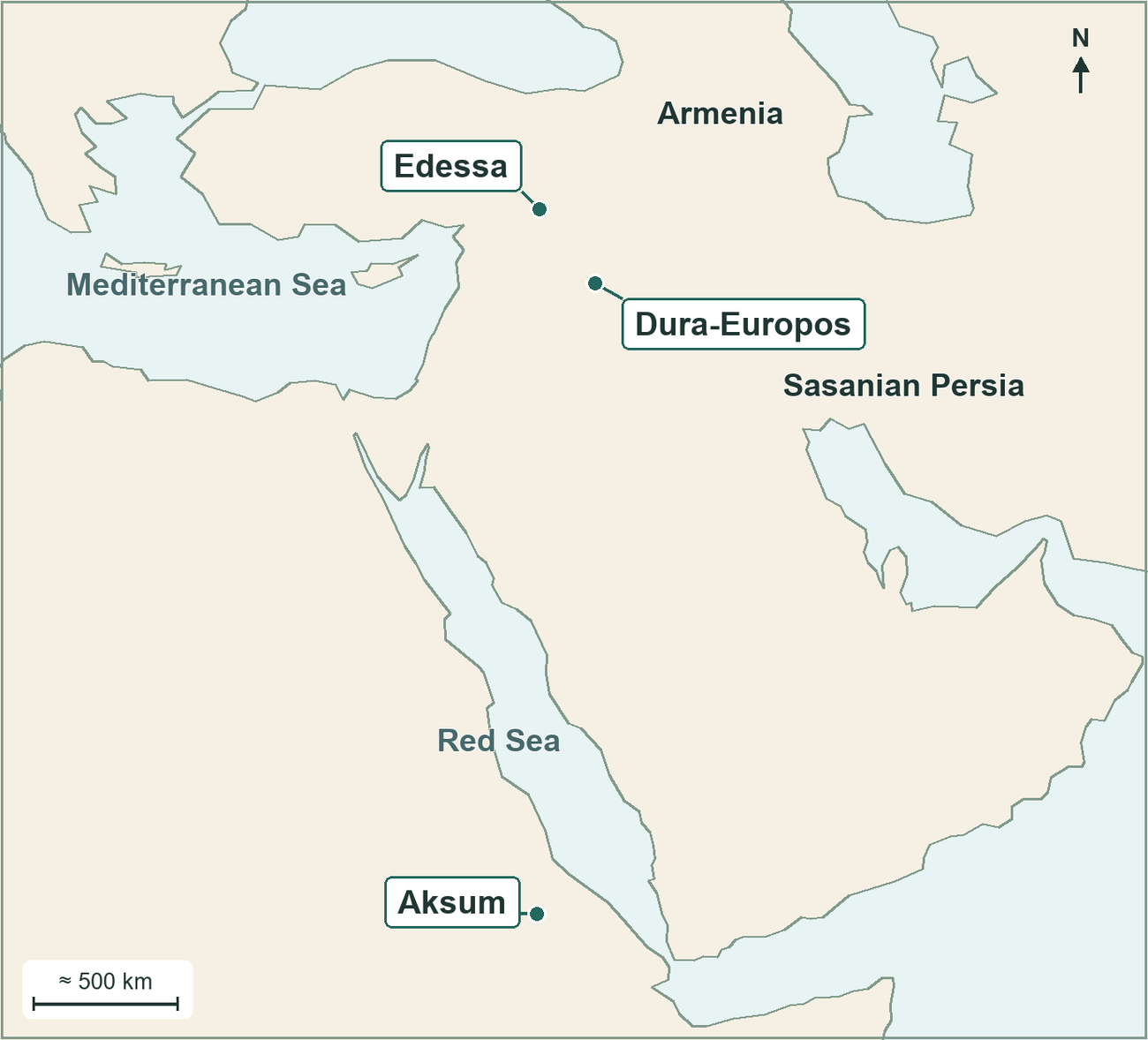
Global Church Context
Place | What the Evidence Shows |
|---|---|
Edessa | The dialogue linked to Bardaisan shows how one Syriac Christian circle pictured believers in several regions. |
Dura-Europos | An assembly room and baptistery show Christian activity at a particular site within the Roman frontier. |
Armenia | A later founding tradition remembers Gregory and the conversion of the royal court. |
Aksum | An inscription and coins show public expressions of Christian faith under King Ezana. |
Read the Map Alongside the Sources
Find Edessa, Dura-Europos, Armenia and Aksum. Choose one example near the Roman frontier and one from a neighboring kingdom. Name the evidence for each.
What the Sources Can Tell Us
Claim | Location and limit |
|---|---|
Reported Christian presence east of Rome | Preparation 6.10 names regions including Persia in an argument against fate. Population totals and routes require separate evidence. |
Dura’s Christian building | Yale describes the Roman frontier site and a third-century adaptation. Pettegrew revisits the chronology. The archaeology provides a place and context rather than a known founder. |
Armenia and Aksum | Agathangelos preserves a later Armenian tradition about Gregory and the king. Ezana’s fourth-century inscription provides a separate royal witness at Aksum. Neither measures the faith of all households. |
Reformed Assessment
Acts shows believers carrying the message across boundaries and tells of witnesses who would go to the ends of the earth. Colossians says that Christ is all and in all. Revelation pictures people of many nations and languages worshiping the Lamb together. A church can share one faith and teach it in languages its neighbors understand. (Acts 11:19–26. Acts 1:8. Colossians 3:11. Revelation 7:9–10.)
Andrew Walls describes the gospel taking root in a culture while also calling people to examine their lives. This is a modern mission framework. We can use it to ask whether our words carry the meaning of Scripture and whether our teaching welcomes the knowledge of local Christians. (Walls, 1996, pp. 7–9.)
What Unity Asks of a Teacher
Colossians 3:11 places Christ at the center of a renewed people drawn from different backgrounds. Revelation 7:9–10 lets us see the peoples and languages of the worshipers around the Lamb. Read the two passages together. The first helps you explain what believers share. The second helps you explain why a difference in language can remain visible in a united church. When a teacher explains a passage in Lagum, a listener’s ability to repeat the teacher’s words is one check. A stronger check asks whether that person can say in their own words what the passage means. If two groups use different words and each can explain the biblical point, the teacher has evidence of shared understanding.
Case Study
Two Languages Around Lagum
Fictional teaching case. Two groups near Lagum use different languages when they discuss Scripture. Local teachers say some examples in a shared study guide are hard to understand. They want to retain the meaning of the biblical passage and revise one explanation with speakers from both groups.
Work Through the Language Question
At the Lagum meeting, one listener hears the word “people” and thinks of people who speak the teacher’s language. Another hears the same word and includes neighbors who use other languages. The teacher can check the difference by asking each listener to explain who is present in Revelation 7:9–10. The passage itself gives the measure. It describes worshipers from every nation, tribe, people and language.
The Bardaisan dialogue in Eusebius 6.10 gives an ancient example of someone thinking about Christians who live under different customs. It supports the claim that the writer could picture the same faith across regions. It leaves open the best word to use in Lagum today. That choice needs the knowledge of the people who speak and hear the language. The group could try this sentence first. “People from many languages stand together and worship the Lamb.” A local speaker can suggest a natural expression, and a listener can tell the teacher who is included and whom the group worships.
For the next meeting, one person prepares the sentence and another checks it with a speaker from each group. By day 30, the teacher asks for a short retelling from a willing listener in each group. The teacher writes down one word that carried the meaning well and one word that needs a second try.
Ministry Lessons for Today
1. Identify the biblical meaning your explanation needs to preserve.
2. Invite local speakers to check terms and suggest familiar examples.
3. Ask a listener to tell you what they heard before the group adopts a revision.
Activity
Test a Short Explanation in Two Languages
1. Choose one sentence from this lesson that your church could teach. Underline the part that carries its main biblical meaning.
2. Ask two speakers to check the sentence. Use languages represented in your group or two plain versions in one language. Ask a listener to retell the idea and change one word or example if needed.
3. Name a reviewer and a date to try the revision. By day 30 ask a listener from each group to retell the idea and note what still needs work.
Part of the Plan | My Answer |
|---|---|
Person and first date | |
Action and reason from Scripture | |
Permission, support or resources | |
What to check by day 30 |
4. Compare your response with the sample answers after the activity. Revise one sentence.
Check Your Work
Write first, then use these examples to revise.
• Eusebius preserves a dialogue that names Christians in Persia and other regions as part of an argument against fate (Preparation for the Gospel 6.10). It can support a claim about their reported presence. It gives limited evidence for population size or the path people traveled.
• The Dura building provides evidence for Christian gathering and baptismal space at one site. Ezana’s inscription gives a royal expression of faith. Agathangelos gives a later written memory about Armenia. Each supports a different kind of claim.
• Example. ‘People of many languages worship the same Lord’ (Revelation 7:9–10). Ask local speakers to check whether the translation includes all languages. Invite a listener to explain who worships and whom they worship. Set a date to try a revised sentence.
Discussion Questions
1. Why does the map include both a Roman-held city and places outside Roman rule?
2. Why does the dialogue name Christians in more than one region?
3. What can a royal inscription or a later founding story tell us about faith in a particular place?
4. How can local speakers help a church teach the same biblical message well?
Write short answers to two questions and give evidence.
Reflection Prompt
Begin with the response below. In your notebook, develop it into a reflection of about 200–250 words. Give an exact source location, a biblical reason and one practical step.
Choose a Christian term in a language you use. Explain a possible misunderstanding and one question that could check its meaning.
Prayer Points
• Give thanks for Christians in many languages and places.
• Pray for local translators, teachers, and church leaders.
• Ask for courage to change practices that conflict with Scripture.
Readings
• Read Acts 11:19–26, Acts 1:8, Colossians 3:11 and Revelation 7:9–10.
• Open the primary links in the references at the end of this lesson. Read the concluding discussion in Eusebius, Preparation for the Gospel 6.10, and compare the Yale Christian Building record.
• For Armenia and Aksum, compare the later Armenian narrative and the translated opening of Ezana’s inscription. Read Walls, pages 7–9, for the language exercise.
References
Eusebius. (1903). Preparation for the Gospel (E. H. Gifford, Trans.), 6.10. Read the discussion of customs beginning ‘And neither in Parthia do the Christians’. English translation
Yale University Art Gallery. (n.d.). Christian Building. Dura-Europos: Excavating Antiquity. Site and archaeological record
Pettegrew, D. K. (2024). The Christian building at Dura-Europos: Rethinking the archaeology of the world’s oldest house church. American Journal of Archaeology, 128(3), 341–379. Archaeological dating study
Agathangelos. History of the Armenians, part 4, especially 4.6 in this rendition. English web rendition
Thomson, R. W. (1984). Agathangelos. Encyclopaedia Iranica. Background to the narrative
Butts, A. M. (2025). Ezana of Aksum: The first Christian African king. Aethiopica, 28, 7–38. See p. 9 for the inscription opening. Translation and discussion
Ashmolean Museum. (n.d.). Gold coin of Ezanas from Aksum, HCR54223. Catalogue date c. AD 360–380. Object record
Walls, A. F. (1996). The missionary movement in Christian history (pp. 7–9). Orbis Books and T&T Clark. Google Drive copy
Natural Earth. (n.d.). 1:110m land data. Map drawn for this lesson using public-domain base geography. Public-domain terms
UNESCO World Heritage Centre. (n.d.). Aksum maps. Site map
Lesson 14
Augustine Grace and Church Unity
Two Controversies in Roman North Africa
Key Bible Passages
Passage | Historical Focus | Ministry Use |
|---|---|---|
Ephesians 2:8–10 | Salvation is by grace and leads to good works. | Explain how serving others follows God’s gift of salvation. |
John 15:4–5 | Disciples bear fruit by remaining in Christ. | Use the vine and branches to explain dependence on Christ. |
2 Timothy 2:24–26 | A servant of the Lord corrects others with patience and gentleness. | Describe what patient correction would sound like in a church meeting. |
2 Corinthians 4:1–2 | Paul calls for honest and open ministry. | Review an appeal for service and look for plain, honest reasons. |
Lesson Overview
Why did Augustine defend imperial pressure in one dispute and argue for the need for grace in another? You will read two letters about the North African church conflict and a treatise on sin and grace. Notice whom Augustine addresses and what he wants each reader to understand or do.
How to Study This Lesson
Read the Bible passages and the history first. Look at the visuals and complete the source questions in writing. Then read the assessment and work through the case and activity. Compare your work with the sample answers before writing your reflection and praying.
Learning Objectives
Area | Learning Objective |
|---|---|
Historical understanding | Explain the distinct questions raised in the Donatist and Pelagian controversies. |
Source and theological discernment | Identify the recipient and purpose of each source. Explain why Augustine’s two letters need to be read together. |
Ministry application | Write an invitation to serve that connects good works with grace and respects a volunteer’s responsibilities. |
Key Terms
Term | Simple Meaning |
|---|---|
Grace | God’s undeserved favor and help. |
Original sin | The sinful condition of humanity connected with Adam’s fall. |
Pelagian controversy | A debate about sin, human ability and the grace needed for righteousness and obedience. |
Donatist controversy | A North African dispute about church fellowship, legitimate leadership and sacraments. |
Communion | Shared life and recognized fellowship among churches and believers. |
Coercion | The use of force or penalties to make people act in a certain way. |
Augustine’s Arguments in Two Settings
1 Meet a Bishop in Roman North Africa
Augustine lived from AD 354 to 430. He served as bishop in Hippo, near present-day Annaba in Algeria. Imagine reading a collection of his letters. A letter to a church opponent might discuss baptism and the people with whom Christians should worship. A letter to an imperial officer might ask about a punishment. A treatise might answer a book about human nature. The same writer could speak on all these subjects. The person he addressed and the problem before him help us understand why he chose particular words.
This lesson follows a dispute over church fellowship and a dispute over grace. They took place in the same period of Augustine’s ministry. Their questions differed. One asked how Christians divided by a long conflict should relate to one another and whether civil authorities should intervene. The other asked what sin had done to human nature and why people needed Christ’s grace. Keep the questions beside the sources as you read.
2 Why Church Fellowship Was in Dispute
The conflict that came to be called Donatist had roots in church divisions after persecution. Christian communities disputed who should be recognized as a bishop. In Letter 93.4.13, Augustine names the dispute over Caecilianus, bishop of Carthage. Whether a person could receive a valid baptism in a separated church was another question. A minister’s character mattered to a congregation. Augustine argued that Christ was the giver of baptism and that the sacrament kept its value regardless of the minister’s personal merit. The letter connects this reasoning with his appeal for fellowship with the wider church. (Letter 93.4.13, 11.46–47.)
The words Catholic and Donatist identify positions in the ancient conflict. Augustine calls the fellowship he defends Catholic. He speaks about his opponents with the purpose of persuading them and answering their claims. His letter gives a bishop’s argument from one side. When we ask how another congregation understood its own baptism or its own history, we need to hear its account if one is available.
3 Augustine Explains a Change of Mind
Around AD 408, Augustine wrote to Vincentius, associated with a branch of the Donatist movement known as the Rogatists. He remembers his earlier preference for teaching and argument. He then gives examples that his colleagues reported to him. He came to think that fear of imperial penalties could lead people to reconsider their position and join the fellowship he defended. He presents cases as reasons for changing his mind. (Letter 93.3.11, 5.16–17.)
Read the paragraph as an argument with steps. First Augustine says what he used to think. Next he recalls what others told him. Finally he explains the policy he now supports. It is possible to identify his conclusion without accepting every claim he makes about the effect of pressure. To understand those effects, we would want to know what choices people faced, what they said under pressure and what they said afterward. The bishop’s satisfaction with a result and a family’s experience of the same decision are distinct historical questions.
4 Augustine Requests Restraint from an Official
Around AD 411–412, Augustine wrote to the imperial official Marcellinus. The linked English edition dates the letter to 412. Another chronology places it in late 411. Augustine reports an investigation into attacks on two clergy. One died, and the other suffered serious harm. He says many of the people questioned admitted involvement. Augustine asks that their lives and bodies be spared. He allows for restraint and a penalty that might lead to correction. (Letter 133.1–2.)
The two letters help us avoid reducing Augustine’s position to one sentence. To Vincentius he explains why he came to support some imperial pressure. To Marcellinus he argues for limits on punishment in a specific case. The second letter tells us what he asks of that officer. A sentencing record would help us know what the officer finally did. A letter from those who experienced the proceedings would answer different questions.
5 Augustine Asks Why People Need Grace
Around AD 415, Augustine wrote On Nature and Grace in response to a work by Pelagius. The opening chapters state the issue through the work of Christ. If human nature could make itself righteous by its own powers, Augustine asks, why was Christ’s death needed? He says God created human nature good. Fallen human nature still has gifts from its Creator and also suffers the wound of sin. Augustine uses a medical picture. A sick person needs a physician. In his argument Christ supplies the healing grace that sinners cannot supply for themselves. (On Nature and Grace 1–3.)
This line of thought explains why gratitude and obedience belong together. A person who receives healing can live differently because help has come. Augustine’s treatise is a response to a particular argument. We learn directly what Augustine says about created goodness, sin and grace. To describe the full range of Pelagius’s views we would need to examine his own works and the ways they survive.
6 Ask What Kind of Claim You Are Making
Read Letter 93 first to identify a defense of pressure. Then read Letter 133 to identify a limit Augustine wanted in a judicial case. Finally, read On Nature and Grace to trace an argument about the human need for Christ. Put the title of each text beside one sentence it supports. As you do this, notice the kinds of judgment involved. A historian can explain why a bishop changed his policy. A Christian can ask whether that policy fits the patient correction commanded in Scripture. A church team can decide how to invite service in its own setting.
One person’s defense of coercion in the past does not settle a church’s responsibilities today. The past gives us a concrete case in which a leader thought pressure would produce a good result. Paul’s instructions on gentleness and open truthfulness give us a way to test how we use authority. Keep both kinds of reading in view as you turn to the source cards.
Source Spotlight
Read Three Texts for Three Purposes
Card A Augustine to Vincentius
“I have therefore yielded to the evidence afforded by these instances which my colleagues have laid before me.” (Letter 93.5.17, J. G. Cunningham translation.)
Augustine recalls his earlier preference for persuasion and explains why he came to defend imperial pressure.
Card B Augustine to Marcellinus
“without the taking of their lives or the maiming of their bodies in any part” (Letter 133.1, Cunningham translation).
Augustine asks an official to spare offenders in a specific case from death and mutilation. He allows lawful restraint.
Card C Augustine Replies to a Book by Pelagius
“that nature of man in which every one is born from Adam, now wants the Physician” (On Nature and Grace 3, P. Holmes and R. E. Wallis translation).
“Wants” here means “needs.” Augustine argues that sin wounds human nature and that Christ’s grace brings healing.
1. Mark · Mark the recipient or occasion on each card. Underline what Augustine asks for or argues.
2. Compare · How do the two letters differ in purpose? Which card discusses the need for grace? On your own, write one contrast.
3. Write · Explain Augustine’s position on imperial pressure and his request in the criminal case. Cite both letters. Then name one person whose own account would help you understand a dispute better.
My claim and source location
Whose account would help
4. Revise · Check that you kept the two controversies distinct and matched each claim to its source.
Historical Visuals

Global Church Context
Setting | Question | Evidence |
|---|---|---|
Church fellowship in Roman North Africa | What role did Augustine give imperial pressure in drawing people into church unity? | Letter 93.5.17, around AD 408. |
A criminal case from the Hippo district | What limits did Augustine urge a Roman official to observe in this case? | Letter 133.1, around AD 411–412. |
A debate about sin and grace | Why did Augustine say human beings need Christ’s grace? | On Nature and Grace 1–3, around AD 415. |
Match the Evidence to the Claim
Which two sources would you use to explain both Augustine’s support for pressure and the limit he urged in one case? What could you learn from a letter by someone on the receiving end of imperial pressure?
What the Sources Can Tell Us
Claim | Location and limit |
|---|---|
AD 408, letter to Vincentius | Letter 93.5.17 describes Augustine’s change of judgment about coercion. It gives his account and reasons. |
About AD 412, letter to Marcellinus | Letter 133.1 asks a public official to spare life and limb in a specific case. The linked edition dates it AD 412. Augustinus.it places it around late AD 411. |
Christ’s grace and human need | On Nature and Grace 1–3 presents Augustine’s reply to Pelagius and gives Augustine’s account of the problem. Pelagius’s full argument requires other evidence. |
Reformed Assessment
Ephesians says that God saves us by grace through faith and prepares good works for us to do. Jesus says that a branch bears fruit by staying in the vine. In Reformed teaching, service grows from life in Christ. A leader can invite committed service and make room for honest limits. (Ephesians 2:8–10. John 15:4–5. Westminster Confession of Faith 16.2.)
Paul asks the Lord’s servant to correct with patience and gentleness. He rejects deceit in ministry and commits to speaking truth openly. We can learn from Augustine’s account of grace while testing his defense of state pressure under Scripture. (2 Timothy 2:24–26. 2 Corinthians 4:1–2.)
Why the Order of Grace and Service Matters
In Ephesians 2:8–10, Paul speaks about the gift of salvation before he speaks about the good works believers do. Westminster Confession 16.2 calls good works the fruit and evidence of a living faith. This order shapes the words a leader uses. A volunteer who cares for an aging parent may have little time for an evening meeting. The leader can ask how the volunteer serves at home and what help the church can offer. A person may also need correction about a promise they have made. Second Timothy 2:24–26 gives the manner for that conversation. Listen to the person, explain the matter patiently and speak truth about the work that needs to be done.
Case Study
An Invitation to Serve in Cagayan
Fictional teaching case. A ministry team says faithful Christians attend every evening meeting. One volunteer cares for a relative and struggles to pay for transport. The team wants reliable help. The volunteer wants to speak honestly about what the family can manage.
Work Through the Invitation to Serve
The team has a real concern. Someone needs to open the room, welcome participants and lead the evening meeting. The volunteer has a real responsibility at home and a cost to pay for every trip. The claim that a faithful Christian attends every evening goes beyond these facts. Before changing the schedule, ask the volunteer privately which tasks and hours are possible.
Letter 93.5.17 shows Augustine taking a result he welcomed as evidence in favor of pressure. The case in Cagayan concerns a church team’s words to volunteers. It gives the team a reason to examine how it seeks commitment. Ephesians 2:8–10 places grace before good works. Second Timothy 2:24–26 calls leaders to patience. A new invitation can make the work and the freedom to answer clear.
Try this wording. “God has given us people to serve. Could you help welcome participants one evening a month? Please tell the coordinator privately what time or travel support you would need.” Ask two volunteers to read the invitation before it is used. After one month, check whether the team filled the role and whether the people asked felt free to name their limits. If people still heard the request as a test of belonging, revise the words and the way the team asks.
Ministry Lessons for Today
1. Describe service as a response to God’s grace.
2. Explain the work, time and support the role involves.
3. Invite honest feedback in private and give people time to decide.
Activity
Rewrite the Appeal to Volunteers
1. Underline the words that make belonging depend on attendance. Write a sentence from Ephesians 2:8–10 explaining the connection between grace and good works.
2. Rewrite the invitation. Include one clear responsibility, the support available, and a way to discuss time or travel privately.
3. Ask two volunteers to review the appeal privately before a leader uses it. Name the reviewer and first date. Check by day 30 whether volunteers understand the role and feel able to speak about their limits.
Part of the Plan | My Answer |
|---|---|
Person and first date | |
Action and reason from Scripture | |
Permission, support or resources | |
What to check by day 30 |
4. Compare your response with the sample answers after the activity. Revise one sentence.
Check Your Work
Write first, then use these examples to revise.
• In Letter 93.5.17, Augustine explains why he came to support some state pressure in the church-unity conflict. In Letter 133.1 he asks a public official to spare people implicated in the case from death or bodily injury. Each request has its own audience and situation.
• On Nature and Grace 1–3 addresses human nature damaged by sin and the healing grace of Christ. It answers a different controversy from the two letters.
• Example. ‘God saves us by grace and gives us good work to do. Could you help with one evening a month? Please tell the coordinator privately what time and transport support you would need.’ Ask two volunteers this week if the work and the freedom to respond are clear.
Discussion Questions
1. What question is Augustine addressing in the dispute over grace?
2. Why is it useful to compare Letter 93 with Letter 133?
3. What would help us learn how the people affected by the policies understood them?
4. How can a leader invite commitment and give volunteers room to raise concerns?
Write short answers to two questions and give evidence.
Reflection Prompt
Begin with the response below. In your notebook, develop it into a reflection of about 200–250 words. Give an exact source location, a biblical reason and one practical step.
Identify one phrase you use when asking people to serve. Rewrite it so that it communicates grace, responsibility, and an honest opportunity to respond.
Prayer Points
• Give thanks for grace that renews sinners.
• Pray for leaders to use authority as service.
• Remember tired workers and families carrying hidden responsibilities.
Readings
• Read Ephesians 2:8–10, John 15:4–5, 2 Timothy 2:24–26 and 2 Corinthians 4:1–2.
• Open the sources in the references at the end of this lesson. Read Augustine, On Nature and Grace 1–3, Letter 93.5.17 and Letter 133.1.
• Read Westminster Confession of Faith 16.2 for a later Reformed statement about good works.
References
Augustine of Hippo. (1887). On Nature and Grace (P. Holmes & R. E. Wallis, Trans., rev. B. B. Warfield). In Nicene and Post-Nicene Fathers (1st series, Vol. 5). Read chapters 1–3. English translation
Augustine of Hippo. (1887). Letter 93 to Vincentius (J. G. Cunningham, Trans.). In Nicene and Post-Nicene Fathers (1st series, Vol. 1). Read 93.5.17. English translation
Augustine of Hippo. (1887). Letter 133 to Marcellinus (J. G. Cunningham, Trans.). In Nicene and Post-Nicene Fathers (1st series, Vol. 1). Read 133.1. English translation
Augustinus.it. (n.d.). Tavola cronologica delle lettere. See Letter 133 for the alternative date. Letter chronology
Biblical Studies Press. (2017). New English Translation (NET). Bible notes are paraphrases. Ephesians 2
Westminster Assembly. (n.d.). Westminster Confession of Faith 16.2. Orthodox Presbyterian Church edition
Lesson 15
Formation Learning and Care
How Early Christians Trained and Cared for Others
Key Bible Passages
Passage | Historical Focus | Ministry Use |
|---|---|---|
1 Timothy 4:7–8 | Paul urges Timothy to train for godliness. | Name one practice that can strengthen love for God and neighbor. |
James 2:14–17 | Faith responds to a neighbor’s practical need. | Describe a concrete response to a need the church can help meet. |
Mark 6:30–32 | Jesus invites the apostles to rest after their work. | Decide how to include rest when sharing ministry duties. |
Romans 12:9–13 | Christian love includes patience, generosity and hospitality. | Plan one way to welcome or support someone who needs help. |
Lesson Overview
How did fourth-century Christians organize disciplined prayer, shared learning and care? You will compare an Egyptian account of Antony’s life with a letter and a funeral speech from Cappadocia. Then you will plan how a ministry team can share teaching, visits and rest.
How to Study This Lesson
Read the Bible passages and the history first. Look at the visuals and complete the source questions in writing. Then read the assessment and work through the case and activity. Compare your work with the sample answers before writing your reflection and praying.
Learning Objectives
Area | Learning Objective |
|---|---|
Historical understanding | Describe practices in Egyptian monastic life and provisions for care in Caesarea. |
Source and theological discernment | Read a model life, a letter of defense and a speech of praise according to each writer’s purpose. |
Ministry application | Plan four weeks of teaching and visits with shared work, rest and a contact for further help. |
Key Terms
Term | Simple Meaning |
|---|---|
Monasticism | Forms of life organized around a commitment to prayer and spiritual discipline. |
Ascetic practice | A practice of restraint or training, such as fasting. |
Hermit | Someone who lives in relative solitude for religious devotion. |
Communal monastic life | A way of life in which monks or nuns live and practice their discipline together. |
Hagiography | Writing that presents a holy person’s life as a model. |
Hospitality | Welcoming people and helping meet their needs. |
From Spiritual Training to Organized Care
1 Learn Why Athanasius Tells Antony’s Story
When Athanasius of Alexandria begins the Life of Antony, he tells his readers why he is writing. People in other places have asked how Antony began a disciplined life and what they can learn from him. Athanasius writes about someone he wants his readers to imitate. A life written with this purpose is often called hagiography. We can still ask what happened, but we should also ask why the writer selected particular events and what he wanted readers to learn. (Life of Antony, Prologue.)
The setting is Egypt in the fourth century. Christians who sought a life of discipline made different choices about where to live and how to share their work. In the Life, Antony learns from people near him before undertaking a more secluded life. The story begins with Scripture heard in a community. Its examples of work, prayer and giving help readers see what discipline looked like to this author.
2 From Hearing Scripture to Practicing It
In sections 2–3, Athanasius says Antony heard Jesus’ words to the rich man in Matthew 19:21 when the Gospel was read. He presents Antony’s response through decisions about property, provision for his sister and care for poor people. He then describes Antony learning from a man who lived a disciplined life nearby. Antony also seeks out others and pays attention to particular strengths. Athanasius shows that a person can learn one habit from one teacher and another habit from someone else.
Antony works with his hands, supports himself and shares with others. He prays and listens closely to Scripture. Notice the connection. A reader may first remember that Antony gave up property. The author also shows how the new way of life required learning and repeated practice. Athanasius chose episodes that turn the life into a model. To estimate how many people followed Antony’s particular path in fourth-century Egypt, we would need more evidence. (Life of Antony 2–3.)
3 Shared Discipline in the Pachomian Communities
Communities associated with Pachomius show a different form of Egyptian discipline. Their members shared work and learning in organized houses. The Pachomian rule tradition survives in several forms. Jerome’s Latin translation helps readers follow instructions about gathering, listening and working. The Precepts describe people recalling Scripture on the way to assembly. They also give directions about duties within each house. (Pachomian Precepts 3–6.)
Precept 25 brings daily responsibilities into view. Someone assigned to serve for the week learns what each house needs, helps arrange fieldwork and takes account of books that are borrowed and returned. These are ordinary details. They show how a community could give attention to time, labor and written material. They also show why rules are valuable evidence. A rule tells us what a leader expected people to do. A record kept by the people borrowing the books would help us see who read them and how closely the plan was followed. (Pachomian Precepts 25. Rousseau, Pachomius.)
4 Read a Letter About Practical Care
Basil was bishop of Caesarea in Cappadocia, in what is now central Türkiye. In Letter 94, he writes to Elias, the provincial governor, in a setting of criticism. He reports that preparations are already under way. He defends arrangements that include lodging for travelers, help for people who need treatment, medical workers, transport and spaces where people can do useful work. These details show how a bishop presented an organized response to need.
Pause over the list. A traveler may need a place to sleep. A sick person may need to be brought to a place where someone can attend to them. A person able to work may need space and tools. Basil links resources with the people who need them. He also presents the work as a benefit to the place and the governor. The letter is an argument addressed to an official. It helps us identify provisions. It leaves open how many places were available on a given day and how people described their experience. (Basil, Letter 94.)
5 Read the Funeral Speech Beside the Letter
Gregory of Nazianzus speaks about Basil after his death. In Oration 43.63, he directs his listeners’ attention to a place outside the city and calls it a new city. He praises the care offered to people whose illness had brought social exclusion. His speech asks listeners to remember Basil’s work with gratitude and to see a reason to care for suffering people themselves. The speech gives later testimony about the work and its place in Christian memory.
Compare Gregory’s speech with the letter to Elias. Basil describes resources while defending the work. Gregory remembers the project while honoring Basil. Their purposes help explain why one names practical arrangements and the other gives a vivid picture of care and honor. We could read both and still want to hear a worker or a person who received help. A record of admission, a letter from a traveler or a local account of supplies could answer a more specific question about everyday life. (Gregory, Oration 43.63.)
6 Connect Formation With the People Who Receive Care
The four sources give examples of learning in different settings. The Life of Antony presents a person learning from Scripture and from other Christians. The Pachomian rules organize responsibilities that people share. Basil’s letter names provisions that make care possible. Gregory’s speech asks a later audience to remember why care matters. In each, a reader can find an action and a reason for the action.
Write one sentence for each of the three source cards that follow. Begin “Athanasius wants readers to learn …,” “Basil wants Elias to understand …” and “Gregory wants listeners to remember …”. Give a detail to support each answer. Then think about a ministry in which the same person teaches, visits and organizes help. A plan to share the work needs time to learn, people who agree to serve and a way to hear from the people receiving care. You will practice making that plan later in the lesson.
Source Spotlight
Read for Each Writer’s Purpose
Card A Athanasius Presents Antony’s Life
“the life of Antony is a sufficient pattern of discipline” (Life of Antony, Prologue, H. Ellershaw translation).
Athanasius wants his readers to imitate Antony’s devotion. His account describes Antony listening to Scripture, learning from others and praying.
Card B Basil Explains His Work to Governor Elias
“for those who are on a journey and for those who require medical treatment” (Letter 94, B. Jackson translation).
Basil describes lodging, medical workers, transport and places for people to work. He defends the arrangements by asking how they could harm public interests.
Card C Gregory Speaks in Praise of Basil
“Go forth a little way from the city, and behold the new city” (Oration 43.63, C. G. Browne and J. E. Swallow translation).
Gregory honors Basil for tending sick people and welcoming those whom others had pushed aside.
1. Mark · Label each card model, defense or remembrance. Underline one clue for each label.
2. Compare · Circle two provisions in Basil’s letter. What does Gregory emphasize about the people receiving care? On your own, write one difference.
3. Write · Use one detail from each of Cards B and C to describe organized care. Cite both texts. Name one further source that could tell you about daily care or what recipients experienced.
My claim and source location
Evidence I would look for
4. Revise · Check that your claim accounts for what each writer wanted his readers or listeners to learn.
Historical Visuals

Global Church Context
Setting | Practice or Concern | Evidence |
|---|---|---|
Egypt, Antony | Hearing Scripture, learning from others, prayer, work and giving. | Life of Antony, Prologue and §§2–3. |
Egypt, Pachomian communities | Shared assemblies, work assignments and access to books. | Pachomian Precepts 3–6, 25. |
Caesarea in Cappadocia | Lodging, medical care, transport and places for skilled work. | Basil, Letter 94. |
Near Caesarea | Care for people excluded because of illness. | Gregory, Oration 43.63. |
Connect Learning and Care
Which source tells you most directly what resources Basil was arranging? What other evidence could help you learn how the resources were used?
What the Sources Can Tell Us
Claim | Location and limit |
|---|---|
A model from fourth-century Egypt | Life of Antony, preface and 2–3, shows how Athanasius presents Antony’s formation. The author writes for readers interested in the disciplined life. |
Arrangements for travelers and care | Basil’s Letter 94 names preparations, facilities and people needed for hospitality and care near Caesarea. The letter defends the work and gives limited evidence about daily use. |
Remembrance of Basil | Gregory, Oration 43.63, praises the work and refers to a new city. The speech preserves a later memory. Daily outcomes need other evidence. |
Reformed Assessment
Paul urges Timothy to train in godliness. James connects living faith with meeting a person’s practical need. Romans asks believers to welcome others and share with those in need. Prayer, learning and care are ways to respond to God’s grace. In Reformed teaching, Christ’s work is the ground of our acceptance. Good works grow from faith. (1 Timothy 4:7–8. James 2:14–17. Romans 12:9–13. Westminster Confession of Faith 16.2.)
In Mark, Jesus invites his disciples to rest after their work. A congregation can make room for rest and give new people training and support. A plan that shares responsibility can help neighbors receive steadier care. (Mark 6:30–32.)
Plan Rest and Service Together
Mark 6:30–32 places Jesus’ invitation to rest after the disciples report their work. James 2:14–17 asks believers to notice the practical needs of others. Read together, these passages give a team reasons to provide care and to make the work sustainable. A written rest period becomes real when someone can answer an urgent request while the worker is away. A visit becomes care when the household can say whether the time or help fits its needs. Westminster Confession 16.2 describes good works as fruit of faith. A church can thank God for that fruit in a worker who learns to share duties and in a volunteer who learns one new task under supervision.
Case Study
One Worker Carrying Many Tasks in Lagum
Fictional teaching case. One worker teaches and visits households for a ministry team in Lagum. She is tired and younger volunteers are willing to help. The team needs a short plan to train a second teacher, share visits, allow rest and name a referral contact.
Work Through the Care Schedule
The Lagum team starts with the worker’s actual week. She prepares a lesson, teaches it, makes two visits and answers requests that come up afterward. A volunteer could first learn to prepare the welcome and read the Bible aloud while the worker teaches. Another could accompany her on one agreed visit. The team asks the household whether it welcomes a second visitor.
Basil’s Letter 94 identifies several kinds of help and the people or resources each requires. It gives an example of planning around the needs of the people served. The Lagum team has a smaller setting and different resources. Mark 6:30–32 also gives the team a reason to set a real period of rest. A schedule should show who will handle a question while the worker is away.
A four-week plan can start with observation, move to supervised practice and end with a review. For example, the volunteer observes in week one, reads and leads part of the lesson in week two and teaches a short passage with a mentor in week three. In week four the team asks the worker and the volunteers what they can sustain and invites one household to comment on the visit. The coordinator records one task now shared, the rest actually taken and any need to refer to a pastor or a qualified local service.
Ministry Lessons for Today
1. Train a second person for one task and let them work with a mentor.
2. Connect one practice of Bible learning with a concrete act of care.
3. Schedule rest and agree who can help when a need goes beyond the team’s role.
Activity
Make a Four Week Teaching and Care Rota
1. List the teaching and visiting work for one week. Name a task a volunteer could learn with support and a time the current worker can rest.
2. Plan four weeks. Assign a teacher and a visitor each week, protect rest time and give a referral contact. Use role names on the classroom sheet.
3. Use the table to record the plan. Name a coordinator and first date. By day 30 check whether the tasks were shared, rest was possible and participants could give feedback.
Week | Teacher and Visitor | Rest Time and Referral Contact |
|---|---|---|
1 | ||
2 | ||
3 | ||
4 |
4. Compare your response with the sample answers after the activity. Revise one sentence.
Check Your Work
Write first, then use these examples to revise.
• The Life presents Antony as a model. Basil’s Letter 94 defends arrangements for travelers and people needing care. Gregory’s funeral speech praises Basil and recalls the work. Each source emphasizes something different.
• Letter 94 names provisions such as lodging, transport, medical help and attendants. Separate records would help show daily use and the experiences of people receiving care.
• Example rota. Week 1 the volunteer observes the teacher and joins a visit. Week 2 the volunteer teaches with a mentor. Week 3 a second visitor takes a turn. Week 4 the team reviews visits and learner feedback. Protect a rest time each week and list a local referral contact. Ask a coordinator to begin this week.
Discussion Questions
1. How does a model life help readers learn? What evidence would help us see whether others lived this way?
2. What practical provisions does Basil name in Letter 94?
3. What does Gregory’s funeral speech add to Basil’s letter?
4. What change could help the Lagum team share responsibility and protect time to rest?
Write short answers to two questions and give evidence.
Reflection Prompt
Begin with the response below. In your notebook, develop it into a reflection of about 200–250 words. Give an exact source location, a biblical reason and one practical step.
Name one practice that strengthens your life with God and one responsibility that needs to be shared. Write a realistic next step for each.
Prayer Points
• Pray for habits shaped by grace rather than pride.
• Ask for wisdom to share ministry and train others.
• Remember sick neighbors, receiving families, and tired workers.
Readings
• Read 1 Timothy 4:7–8, James 2:14–17, Mark 6:30–32 and Romans 12:9–13.
• Open the sources in the references at the end of this lesson. Read the preface and sections 2–3 of Life of Antony, Basil’s Letter 94 and Gregory’s Oration 43.63.
• For further study, read the press summary of Rousseau’s book on Pachomius and Westminster Confession of Faith 16.2.
References
Athanasius of Alexandria. (1892). Life of Antony (H. Ellershaw, Trans.). In Nicene and Post-Nicene Fathers (2nd series, Vol. 4). Read the preface and sections 2–3. English translation
Basil of Caesarea. (1895). Letter 94 to Elias (B. Jackson, Trans.). In Nicene and Post-Nicene Fathers (2nd series, Vol. 8). English translation
Gregory of Nazianzus. (1894). Oration 43, Funeral Oration on Basil (C. G. Browne & J. E. Swallow, Trans.). In Nicene and Post-Nicene Fathers (2nd series, Vol. 7). Read section 63. English translation
Pachomian Rules. Jerome’s preface and Precepts 3–6 and 25. Latin and English texts
Veilleux, A. (Trans.). (1981). Pachomian koinonia II: Pachomian chronicles and rules (pp. 141–183). Cistercian Publications. Publisher record for English edition
Rousseau, P. (1999). Pachomius: The making of a community in fourth-century Egypt. University of California Press. (Original work published 1985.) Publisher summary
Biblical Studies Press. (2017). New English Translation (NET). Bible notes are paraphrases. Mark 6
Westminster Assembly. (n.d.). Westminster Confession of Faith 16.2. Orthodox Presbyterian Church edition
Lesson 16
Learning from the Early Church
From Historical Evidence to a Thirty-Day Ministry Plan
Key Bible Passages
Passage | Historical Focus | Ministry Use |
|---|---|---|
1 Thessalonians 5:21–22 | Paul urges believers to test what they hear and hold to what is good. | Ask what Scripture leads you to receive or question in a historical example. |
Ephesians 4:11–16 | Leaders equip the whole body to grow in Christ. | Choose a practice that gives someone else a real part in ministry. |
James 1:22–25 | Hearing the Word leads to doing it. | Turn one biblical judgment into an action you can begin this month. |
2 Timothy 2:1–2 | Timothy is to entrust what he learned to others who can teach. | Decide who could learn the practice and pass it on. |
Lesson Overview
Why do a governor’s letter, a creed and a bishop’s defense support different historical claims? You will review the four days of the course, compare three ancient records and use two sources to inform one local ministry decision. Your thirty-day plan will include a first step and a way to hear from the people it affects.
How to Study This Lesson
Read the Bible passages and the history first. Look at the visuals and complete the source questions in writing. Then read the assessment and work through the case and activity. Compare your work with the sample answers before writing your reflection and praying.
Learning Objectives
Area | Learning Objective |
|---|---|
Historical understanding | Connect a present ministry question with two ancient sources and say what each shows. |
Source and theological discernment | Separate a historical claim, a judgment from Scripture and a decision for today. |
Ministry application | Complete a thirty-day plan with a responsible person, a first action and a review date. |
Key Terms
Term | Simple Meaning |
|---|---|
Evidence | A text, object or record that helps answer a question. |
Discernment | Careful judgment about what is true and faithful. |
Analogy | A comparison between situations that share a feature and also differ. |
Contextualization | Communicating and living the gospel in a particular setting under Scripture. |
Accountability | Giving an honest account of decisions and actions to others. |
Evaluation | Checking what happened and deciding how to improve. |
Read the Past and Make a Responsible Decision
1 Remember the First Churches
Begin by remembering a question from Day 1. How do we know what happened? A Roman church sent a letter to a church in Corinth. The greeting names the communities, and the discussion of leaders shows why the Roman writers intervened. The letter gives a view of a conflict from Rome. You practiced naming what it could establish and asking what a voice from Corinth might add. (1 Clement 1 and 44, Lesson 1.)
The rest of Day 1 broadened the picture. Acts follows witnesses from Jerusalem into other places, and Paul describes a dispute about table fellowship in Antioch. The Didache gives instructions and Justin describes gatherings. The people who wrote these texts had different audiences and purposes. A historian brings several accounts together and keeps each one tied to its own setting. As you review Lessons 2–4, choose a source and say who wrote, whom they addressed and what detail you can use.
2 Remember How Christians Lived Under Pressure
Day 2 brings us into situations where faith was visible to people outside the church. Around AD 112, Pliny the Younger describes cases in Bithynia and Pontus to Trajan. The emperor gives instructions about accusations, punishment and pardon. He rejects anonymous charges and tells the governor to refrain from actively seeking Christians. The exchange answers a question about official procedure. The magistrate and emperor supply the voices. A family’s experience of this procedure would take a different kind of source. (Letters 10.96–97, Lesson 5.)
Other writers show other kinds of witness. Justin explains Christian belief and practice to rulers. Irenaeus summarizes the faith he says churches received. Eusebius and Athanasius provide evidence about the reception of Christian books. Tertullian describes gifts and care for people in need. These records help us name teachings and actions. Ask which kinds of people appear in them and whose day-to-day experiences are harder to recover. (Lessons 6–8.)
3 Remember the Difference Between an Order and a Confession
On Day 3, the empire changes how it treats Christians. The records from AD 311, 313 and 380 address gathering, religious choice, property and an approved confession. Their language tells us what rulers ordered. A local record could help us see how a particular official carried out one of those instructions. The existence of an order and its effects in a town are separate questions. (Lesson 9.)
In AD 325 bishops met at Nicaea. Their creed confesses the Son’s divine being with the Father. The creed lets us read the words of a council. We would need other documents to trace how different churches taught or received those words. The longer creed associated with Constantinople, the council records and the Definition at Chalcedon show how Christians spoke about the Spirit and the incarnate Son. In AD 451, bishops at Chalcedon confessed one and the same Christ in two natures. This course ends at that council, and questions about its reception open a further history. (Lessons 10–12. Chalcedon, Session V, Definition.)
4 Remember Churches Across Cultures
Day 4 began beyond familiar Roman centers. Evidence from Edessa, Dura-Europos, Armenia and Aksum shows how the kind of source affects the claim we can make. Augustine’s letters and his book on grace show that one writer can address several problems in different ways. The sources about formation and care connect the discipline of learners with the needs of neighbors. (Lessons 13–15.)
Basil’s Letter 94 gives an example. Basil defends lodging and other provisions near Caesarea in Cappadocia. A sick traveler’s needs could include transport and treatment as well as a place to stay. The letter identifies practical arrangements. It represents Basil’s explanation to a governor. Records from people who worked there or used the facilities could give evidence about everyday care. This distinction will help you decide what to record when you start a small plan of your own. (Basil, Letter 94 to Elias.)
5 Use an Ancient Example with Care
Suppose you want to improve a local food program. Tertullian’s Apology 39 describes gifts that supported people in need. Basil’s Letter 94 describes arrangements for hospitality and treatment. Both passages give examples of care and supply questions about how people share resources. A church responding to a storm today faces different roads, household needs, public services and budgets. Start by asking the families concerned what help they need and what makes it hard to receive it.
Next, read a Bible passage with your question in view. James 1:22–25 asks hearers to act. The rest of the letter gives examples of action, including care for neighbors in need. Ask which action a small team can carry out this month. Name a person to take responsibility and decide what the team can observe after a month. A change in the lives of the people served gives a better answer to a practical question than a count of how many meetings the team held.
6 Use Your Portfolio
Choose two earlier exercises and place them beside the source cards in this lesson. Find one sentence where you learned to qualify a claim. Find another where you put a belief into words a new reader could understand. Both skills will help you finish the course. A clear plan needs a source and a limit, a biblical reason and a practical step that someone can carry out.
You will read three kinds of source below. Choose two cards and write one supported claim for each. Later you may choose two different sources for your ministry plan if they fit the question better. Keep the distinction between a historical example and your own decision. The plan belongs to a particular community today. The people who take part in it can help you test and revise it.
Source Spotlight
Read for Procedure, Confession and Care
Card A Pliny and Trajan on Cases in Bithynia-Pontus, around AD 112
Pliny reports questioning people accused of being Christians and asks the emperor for guidance. Trajan directs him to avoid seeking Christians out and to exclude anonymous accusations. He still allows punishment when an accusation is proved, with pardon for those who denied being Christians and showed it by worshiping Roman gods. (Letters 10.96–97.)
Card B The Bishops at Nicaea, AD 325
“begotten, not made, of the same being as the Father” (Creed of Nicaea, Son clause, A. West translation).
The bishops set out what they confess about the Son and his relation to the Father.
Card C Basil in Caesarea, around AD 372
Basil defends arrangements for lodging travelers and sick people. He names medical workers and transport and says that gathering materials has already begun. (Basil, Letter 94 to Elias, B. Jackson translation.)
1. Mark · Label the cards procedure, confession or care. Underline one detail that fits each label.
2. Compare · Choose two cards. Explain what different claim each supports. On your own, write one short sentence for each.
3. Write · Cite one detail from each of your two cards. For each claim, name a further source you could use to find out what happened in practice.
My claims and source locations
Evidence I would look for
4. Revise · Check that your claims match the purpose and setting of each record.
Historical Visuals

Global Church Context
Setting | What the Record Shows | A Question for Further Evidence |
|---|---|---|
Bithynia-Pontus, around AD 112 | A governor reports his procedure and an emperor gives instructions. | How did another governor handle a similar case? |
Nicaea, AD 325 | The council confesses the Son’s full deity. | How did a congregation explain the creed to learners? |
Caesarea in Cappadocia, around AD 372 | A bishop defends preparations for practical care. | How did travelers and patients experience the care? |
Choose Evidence for a Local Question
Pick a question about teaching, welcome or care. Which two sources could inform your thinking? What difference between their setting and yours would matter for a plan?
What the Sources Can Tell Us
Claim | Location and limit |
|---|---|
Procedure about AD 112 | Letters 10.96–97. The exchange concerns accusations in Bithynia and Pontus. Practice elsewhere needs other evidence. |
A confession at Nicaea in AD 325 | The creed states a council’s teaching about the Son. Regional reception calls for local sources. |
Provisions for care in Cappadocia | Letter 94 to Elias. Basil explains planned lodging and care near Caesarea. A separate record could document daily use. |
The course endpoint in AD 451 | Chalcedon Session V records the Definition. The course uses this decision as its endpoint. Regional reception is a separate history. |
Reformed Assessment
Paul asks the church to test what it hears and hold to what is good. Reformed learning receives the church’s historical teaching under Scripture. A council can help us state the faith clearly. A letter can help us see how earlier Christians acted. Each source contributes to a different question. (1 Thessalonians 5:21–22. Westminster Confession of Faith 1.10 and 31.3 in the OPC edition.)
Ephesians calls leaders to equip the whole church. James asks readers to act on what they hear. Paul asks Timothy to entrust teaching to people who can teach others. A responsible plan names a limited action, listens to people affected and sets a time to check what happens. (Ephesians 4:11–16. James 1:22–25. 2 Timothy 2:1–2.)
Ask What Your Action Will Teach
Ephesians 4:11–16 describes leaders equipping the whole body. In 2 Timothy 2:1–2, teaching is entrusted to people who can teach others. A good plan can therefore ask what someone will be able to understand or do after taking part. Suppose a church improves a new believer class. The teacher can ask a learner to explain a biblical truth in their own words and help them correct one point. A second teacher can watch and later try the same exercise. The council texts in this book give examples of carefully chosen words. Scripture governs what the teacher passes on, and the learner’s explanation helps the church see whether the words were understood. (Westminster Confession of Faith 1.10.)
Case Study
Choose One Ministry Question
Use a real ministry question with permission or one of these fictional examples from Cagayan.
• A donor offers a literacy room and asks for control over what the church teaches.
• A new believer class explains the Trinity as three gods working together.
• A relief program requires worship attendance before giving help.
• An anniversary booklet gives an exact founding date based on an undated photo.
Work Through a Plan for Food Support
A relief team in Cagayan hears that several households came for food after a storm. The team required people to attend worship before receiving a package. Some neighbors stayed away. The team knows what rule it used. It needs to ask households privately what made it hard to come before it explains anyone’s decision.
Tertullian’s Apology 39 describes a fund that helped people in need. Basil’s Letter 94 describes lodging and care for travelers and sick people. Both give examples of Christians using resources to help others. Today’s storm relief has a short delivery period and serves families through a volunteer team. The ancient writers describe other settings and other forms of care. James 1:22–25 gives a biblical reason to put what we hear into action. The team can offer the same food support to eligible households and make conversation about faith a separate invitation.
A coordinator could begin on the next distribution day. A volunteer would explain the policy when people arrive and give a way to comment privately. By day 30, the team would ask willing households whether they understood that attending worship was voluntary and whether they could get food when needed. The coordinator would bring that feedback to the next meeting so the team can decide what to keep or revise.
Ministry Lessons for Today
1. Listen to the people affected before you choose a response.
2. Choose one action the team can carry out and review in a month.
3. Name the evidence that could lead the team to revise the plan.
Activity
My Thirty Day Ministry Plan
1. Choose a case. State the question and name the roles of the people affected. Keep names and private details off the class worksheet.
2. Pick two relevant ancient sources from this lesson or earlier lessons. Give a locator and one supported claim for each. State one Bible reason and two differences between the ancient and present settings.
3. Fill in the plan. Name the person responsible, a first date, needed support or consent, and one observable result to check on day 30.
Part of the Plan | My Answer |
|---|---|
Question and people affected | |
Two sources, locators and claims | |
Bible passage and reason | |
Two differences from the ancient settings | |
First action, person responsible and date | |
Support, consent or a limit to respect | |
What to check on day 30 and with whom |
4. Compare your response with the sample answers after the activity. Revise one sentence.
Check Your Work
Write first, then use these examples to revise.
• Pliny and Trajan record what a governor reports and what the emperor directs. The creed states a confession. Basil names arrangements for care. Local records could help show how those directions, words or plans worked in practice.
• Example for the relief case. Tertullian describes a fund for people in need (Apology 39, Lesson 8). Basil describes lodging and help for travelers and sick people (Letter 94, Lesson 15). Both texts give examples of care. The Cagayan program responds to a storm and operates with different local roles and resources.
• A team can offer food on the same terms and invite Bible conversation separately. James 1:22–25 calls hearers to act. Ask a coordinator to begin on the next food distribution day. On day 30, ask receiving households privately if they understood that help was available without attending worship.
Discussion Questions
1. Which source changed one of your historical assumptions?
2. What is one difference between your local question and the ancient case you chose?
3. Whose voice would help you decide whether to revise the plan?
4. What small, observable change would show that your first step helped?
Write short answers to two questions and give evidence.
Reflection Prompt
Begin with the response below. In your notebook, develop it into a reflection of about 200–250 words. Give an exact source location, a biblical reason and one practical step.
Write four short sentences. Name one fact you learned, one idea you revised, one conviction you can explain and one action you will begin.
Prayer Points
• Give thanks for the church's faithful witnesses and teachers.
• Confess failures in truthfulness, power, and care.
• Pray for local churches and GRUTS students to serve with wisdom and grace.
Readings
• Read 1 Thessalonians 5:21–22, Ephesians 4:11–16, James 1:22–25 and 2 Timothy 2:1–2.
• Open two relevant primary texts. Use the references here or in the earlier lessons and record the exact location of each passage.
• Review your plan with the people concerned and the relevant section of your church’s confession. For a modern example of teaching a creed alongside Scripture, see Hartman, chapter 2.
References
Pliny the Younger and Trajan. Letters 10.96–97. Internet History Sourcebooks Project, Fordham University. English translation
Council of Nicaea. (325). Creed of the Council of Nicaea (A. West, Trans.). Fourth Century Christianity, Urkunde 24. Greek and English
Basil of Caesarea. (1895). Letter 94 to Elias (B. Jackson, Trans.). In Nicene and Post-Nicene Fathers (2nd series, Vol. 8). English translation
Council of Chalcedon. (451). Definition of Faith, Session V (H. R. Percival, Ed., 1900). In Nicene and Post-Nicene Fathers (2nd series, Vol. 14). Council record
Tertullian. (1885). Apology (S. Thelwall, Trans.). In Ante-Nicene Fathers (Vol. 3). Read chapter 39 for the sample plan. English translation
Biblical Studies Press. (2017). New English Translation (NET). Bible notes are paraphrases. Ephesians 4
Westminster Assembly. (n.d.). Westminster Confession of Faith 1.10 and 31.3. Orthodox Presbyterian Church edition
Hartman, D. (2016). Church history for modern ministry: Why our past matters for everything we do. Lexham Press. Read chapter 2, “Creed and Creeds.” Google Drive chapter
Epilogue
Hebrews 12:1–3 calls us to keep running with endurance and to look to Jesus. That is a good way to finish this course. You have read about believers at a table in Jerusalem, a prisoner in Carthage, Christians near Rome’s eastern frontier and bishops gathered at Chalcedon. Their stories bring us to questions you will meet again in church life. Who gets heard when a church faces a dispute? How do we speak clearly about Christ? What does our neighbor need from us?
As you return to a congregation, classroom or home, carry with you the practice of reading slowly. Give thanks for what you can see of God’s care for his people. Take time to name their failures, including failures that may be familiar to your own church. Keep asking how Christ’s Word can shape your next decision.
Remember Truthfully
Acts describes people who heard the apostles and shared what they had in Jerusalem. It also names believers from Cyprus and Cyrene who spoke about Jesus in Antioch (Acts 2:42–47 and 11:19–26). Other records bring other people into view. Perpetua’s account, preserved within a longer work, describes her worry for her child. The excavated building at Dura-Europos shows space set aside for baptism. In Aksum, Ezana’s inscription records a ruler’s public confession. To learn when families in Aksum began to follow Christ, we would need evidence from their communities.
Use the appendix maps and timeline to place each record. Then use the source worksheet to name its author or maker, its purpose and what it can show. Try the same practice with your congregation’s history. A photograph may show a family who opened their home for worship. Ask who can identify the place and people. Compare their memories with church records, and write down any date you still need to check.
Guard the Gospel
At Nicaea in AD 325, the creed confessed that the Son shares the Father’s divine being. In AD 451, the bishops at Chalcedon heard the longer creed associated with Constantinople and confessed one and the same Christ in two natures. Churches received the Chalcedonian Definition in different ways. Read its wording beside Cyril’s letter and the biblical passages in Lesson 12. John 1:14 names the Word who became flesh. Hebrews 2:14–18 shows why it matters that the Son shared our humanity. The one who suffered when tempted can help people who face temptation.
In Reformed churches, Scripture is the final authority for teaching and practice. Historic creeds help teachers choose their words carefully under that authority. When you teach a new believer, ask what the learner heard. If they describe the Trinity as three gods, read Matthew 28:19 again and help them say in their own words what is one and who are distinct. Give them time to ask a question. Clear doctrine can guide patient care.
Send with Hope
In Acts 11, the gospel reaches Antioch through believers whose names Luke does not give. Later records lead us to Syriac-speaking Christians around Edessa and to churches and rulers in other regions. These settings can help us see people already sharing the gospel near us. A Bible study host, a parent teaching children or a worker living away from home may have people to encourage. In Cagayan, around Lagum and farther away, a congregation can train such people, pray with them and keep listening to them after they go.
Bring your Lesson 16 plan to the people who will share the work. Use two ancient sources to help frame the question and Scripture to explain your reason for acting. For relief, compare the fund in Tertullian’s Apology 39 with Basil’s Letter 94 about care for travelers and sick people. Ask your neighbors what help they need. Choose one step, a person to lead it and a date. On day thirty, hear from the people affected and decide together what to change.
Final Charge
Choose one practice below to carry into your next month of study or service. Share it with a fellow student, a teacher or a church leader who can help you follow through.
Charge | Practice |
|---|---|
Remember | Before you repeat a story, give its source and say what you still need to learn. Thank God for the people whose service it records. |
Guard | Teach one article of the faith from Scripture. Ask a listener to say it in their own words and use their answer to improve your explanation. |
Strengthen | Give another person a real part in the church’s teaching or care. Agree on the help they need and check back after their first attempt. |
Honor | With permission, record the memory of a church member whose service is rarely mentioned. Keep their account with the congregation’s records. |
Send | Pray with someone preparing to serve beyond your congregation. Agree on how you will stay in touch and hear what the people they serve are saying. |
Last Encouragement
Dear GRUTS students, pastors and church workers, much of your work will happen in places few people notice. You may spend an evening helping one learner understand a verse, or visit a family carrying a burden you had missed. James 1:22–25 calls hearers to act. Let the first step in your plan be something you can actually do. Then trust the Lord who gathers people from every nation and language to worship the Lamb (Revelation 7:9–10).
A Closing Prayer
Lord Jesus Christ, Head of the church, we thank you for those who carried your Word to people they had never met, for those who confessed your name under pressure and for those who made room for the sick and the stranger.
Forgive us when we repeat stories we have failed to check or listen only to people with power. Give us courage to admit an error, patience with accounts we find hard to understand and gratitude for service we had overlooked.
Strengthen GRUTS students and the churches they serve. Help pastors and teachers explain Scripture with care, elders hear those who are easily missed, and deacons and other workers serve neighbors with dignity. Give our congregations wisdom to share the work and attend to those who are weary.
Send your people with hope. Give them words that their neighbors can understand, companions who will pray with them and humility to learn from those they meet. Teach us to listen when our plans affect others and to revise our work when it falls short. Keep our eyes on you as we wait for the day when people of every nation and language worship together before your throne. Amen.
Appendices
From Jerusalem to Chalcedon
Use this book beside Lessons 1–16. The timeline and maps help you place people and events. The source readings give a short text, its location and a question you can answer from the page.
Contents
D Ancient Sources for Lessons 1–16
E Greek Texts and Material Evidence
What the Grades Mean
Grade | Text you are reading |
|---|---|
A | An original-language critical text or a transcription or facsimile of an identified manuscript, inscription or papyrus. Look for the edition or object number and the passage. A translation alongside it is labeled separately. |
B | A direct translation from the ancient language, with the translator or the source used for a new translation and the exact passage named. |
C | A translation through another language or a clearly labeled summary of an identified source. If a later writer preserves an earlier voice, the reading identifies both voices and the part we can check. |
A grade applies to the text or image actually shown. A reliable copy can preserve a writer’s opinion, a disputed report or a proposed law. Ask what that source can show about the particular event, then decide whether another source is needed.
Appendix A Timeline
Read across each row. A year or range marks the event or the best estimate given here. When you are dating a document, distinguish the event, the writing and the surviving copy.
First to Third Century
Date | Event or evidence | Source and lesson |
|---|---|---|
First century | Believers gather in Jerusalem and the message reaches Syrian Antioch. | Acts 2:42–47, 11:19–26 · L2 |
AD 70 | Roman forces destroy the Jerusalem temple. | Josephus, Jewish War 6.4.5–7 · L2 |
Late first century, usual estimate | The church in Rome addresses a dispute in Corinth. | 1 Clement 1, 44 · L1, 3 |
Around the turn of the second century, debated | The Didache gives instructions for Christian life. Ignatius’s letters witness to concerns about unity and teaching. | Didache 7, 15; Smyrnaeans 7–8 · L3–4 |
About AD 112 | Pliny and Trajan exchange letters about cases involving Christians in Bithynia and Pontus. | Letters 10.96–97 · L5, 8 |
Mid-second century | Justin explains Christian worship in a public defense. The church of Smyrna remembers Polycarp’s death, commonly placed around 155–156, with debate. | First Apology 65–67; Martyrdom of Polycarp 4, 17–18 · L4–6 |
Late second century | Irenaeus states the church’s faith and reports teachings he opposes. | Against Heresies 1.10, 1.27 · L6 |
About AD 200 | Tertullian describes giving for people in need. Perpetua and Felicitas die at Carthage around AD 203. | Apology 39; Passion of Perpetua and Felicitas · L5, 8 |
Third century | The Christian building at Dura-Europos has a baptistery. The date and sequence of alterations are debated. | Yale, Christian Building; Pettegrew (2024) · L4, 13 |
16 June AD 250 | A surviving certificate from Theadelpheia records a sacrifice under Decius. | Berlin P. 13430, SB I 5943 · L5 |
Fourth and Fifth Centuries
Date | Event or evidence | Source and lesson |
|---|---|---|
AD 303–313 | Imperial persecution begins in 303. The 311 order permits Christians to gather. Instructions published at Nicomedia in 313 grant religious choice and order restitution of Christian communal property. | Eusebius, HE 8.2.4–5; Lactantius 34–35, 48 · L5, 9 |
AD 325 | The Council of Nicaea confesses the Son as of the same being as the Father. | Creed of Nicaea, Son clause · L10 |
Fourth century | Ezana’s inscription at Aksum names Christ. A later Armenian narrative places the royal conversion in the early fourth century. | RIÉ 271; Agathangelos; Thomson (1984) · L13 |
AD 367 | Athanasius names the 27 New Testament books in his Easter letter. | Festal Letter 39.5, 7 · L7 |
About AD 372 | Basil defends arrangements for hospitality and care near Caesarea in Cappadocia. | Letter 94 to Elias · L15–16 |
AD 380–381 | A law issued from Thessalonica prescribes a trinitarian confession. In 381 Constantinople’s Canon 1 upholds Nicaea. | CTh 16.1.2; Constantinople, Canon 1 · L9, 11 |
AD 408 to about 415 | Augustine addresses religious pressure in Letters 93 and 133, and replies to Pelagius in On Nature and Grace. | Letters 93.5.17, 133.1; On Nature and Grace 1–3 · L14 |
AD 431 | At Ephesus, bishops read Cyril’s second letter to Nestorius and judge its agreement with the Nicene faith. | Ephesus, Session I · L12 |
AD 451 | At Chalcedon, the longer creed is read and the Definition confesses one and the same Christ in two natures. | Chalcedon, Sessions II and V · L11–12, 16 |
Read and Check
What date marks the event in the Berlin papyrus? What date marks a later collection of writings in Athanasius’s letter?
Sample answer. The dated certificate records a sacrifice in 250. The letter listing the books was written for Easter in 367. The two dates identify different kinds of evidence.
Appendix B Maps and Places
Use the dots to locate ancient cities on simplified modern coastlines. Broad regional labels and the close pair of cities on the Bosporus are approximate. The maps give locations for comparison. For a claim about a person’s journey, consult the relevant text.
B1 Jerusalem and Syrian Antioch
Place | Use with the lesson |
|---|---|
Jerusalem · 예루살렘 | Read Acts 2:42–47 for the life of the believers. |
Syrian Antioch · 시리아 안디옥 | Read Acts 11:19–26 and Galatians 2:11–14 for two different scenes. |
Cyprus and Cyrene · 구브로와 구레네 | Acts 11:20 names places people came from. |
B2 Imperial Orders and Councils
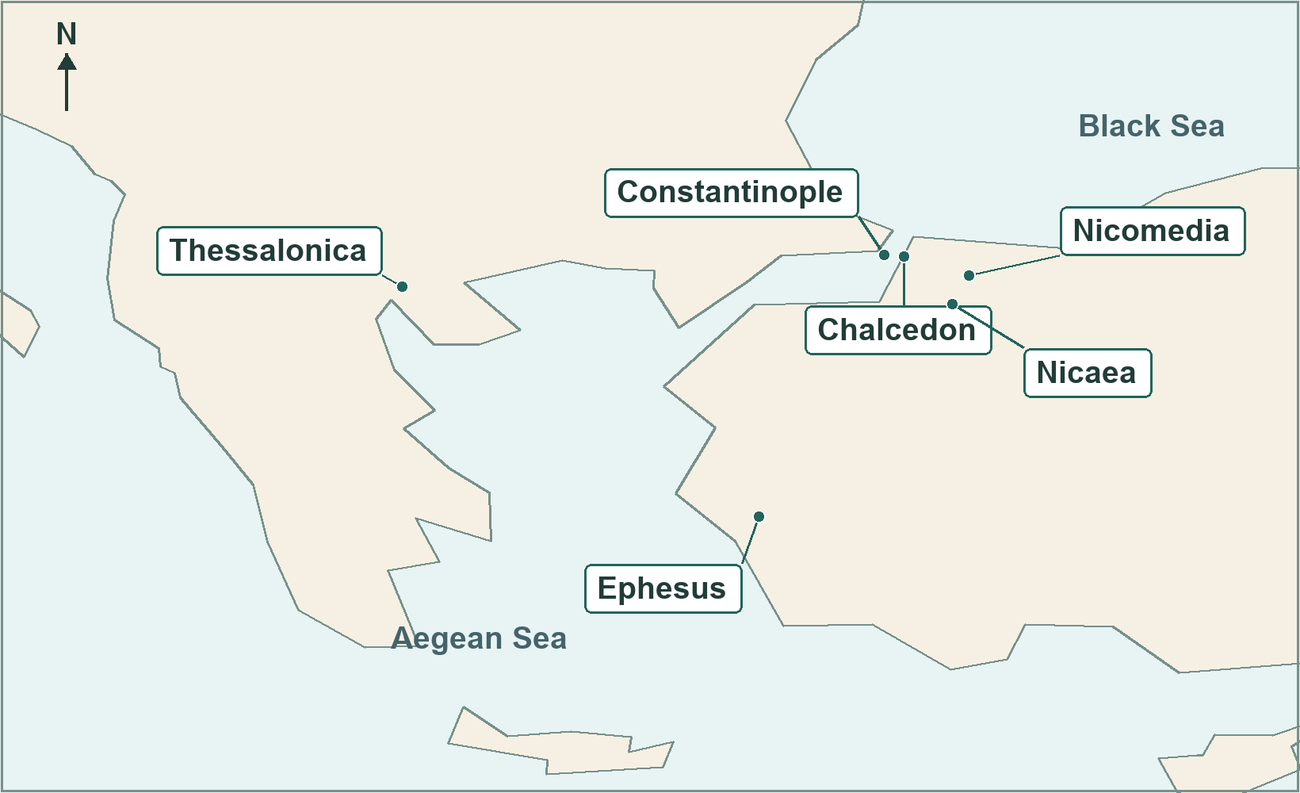
Place | Event to locate |
|---|---|
Nicomedia · 니코메디아 | Publication of the orders discussed for 311 and 313. The meeting referred to in 313 took place at Milan. |
Thessalonica · 데살로니가 | Place of issue for the 380 law addressed to people at Constantinople. |
Nicaea · 니케아 | Council of 325, at present-day İznik. |
Constantinople · 콘스탄티노폴리스 | Council of 381, in present-day Istanbul. |
Ephesus · 에베소 | Council of 431, near present-day Selçuk. |
Chalcedon · 칼케돈 | Council of 451, in present-day Kadıköy, across the Bosporus from old Constantinople. |
Chalcedon site record · Getty Thesaurus of Geographic Names
B3 Near and Beyond Rome’s Eastern Frontier
Read and Check
Find Dura-Europos and Aksum. What source from the lesson could you pair with each place?
Sample answer. Pair Dura with the excavated baptistery and Aksum with the inscription associated with King Ezana. The first is evidence from a building. The second gives a ruler’s public words.
Map data rights · Natural Earth
Appendix C People and Terms
People
Name | Why the person appears | Lesson |
|---|---|---|
Barnabas and Paul | Teachers at Antioch. Paul also recounts a dispute there over shared meals. | 2 |
Ignatius of Antioch | Wrote to Smyrna from Troas and urged unity in worship and teaching. | 3 |
Justin Martyr | Wrote a public defense that describes baptism, gatherings and help for people in need. | 4, 6–7 |
Pliny the Younger and Trajan | A governor and emperor whose letters discuss accusations and procedures. | 5, 8, 16 |
Polycarp | Bishop whose death the church of Smyrna remembers in a letter to other churches. | 5 |
Perpetua and Felicitas | Christians remembered in an account of imprisonment and death in Carthage. | 5 |
Irenaeus and Marcion | Irenaeus writes from the setting of Lyons and criticizes teachings he attributes to Marcion. | 6 |
Eusebius of Caesarea | A historian who reports how books were received and preserves quotations and public documents. | 7, 9, 13 |
Athanasius of Alexandria | Bishop whose Easter letter names the New Testament books. He also wrote the Life of Antony. | 7, 15 |
People continued
Name | Why the person appears | Lesson |
|---|---|---|
Phoebe and Lydia | Paul commends Phoebe’s service. Acts describes Lydia welcoming travelers into her home. | 8 |
Galerius, Constantine and Licinius | Rulers connected with the change in policy toward Christians in 311 and 313. Constantine convened the council in 325. | 9–10 |
Arius and Alexander of Alexandria | Arius and his supporters addressed Alexander in a dispute about the Son. | 10 |
Basil and Gregory of Nazianzus | Basil wrote about the Spirit and defended arrangements for care. Gregory later praised Basil’s work. | 11, 15–16 |
Cyril and Nestorius | Cyril’s second letter to Nestorius explains the identity of the Word made flesh. | 12 |
Gregory the Illuminator and Trdat | Named in the later Armenian account of the royal court’s conversion. | 13 |
Ezana of Aksum | A fourth-century ruler whose Greek inscription names Christ. | 13 |
Augustine and Pelagius | Augustine, bishop of Hippo, answers a work by Pelagius in On Nature and Grace. | 14 |
Antony and Pachomius | Antony’s life is presented as a model. Rules associated with Pachomius show shared community duties. | 15 |
Terms for Reading Sources
Term | Meaning | Lesson |
|---|---|---|
Textual witness | A manuscript, quotation or other record that preserves the wording of a text. | 1, 3 |
Critical edition | An edition whose editor compares textual witnesses and explains readings or important differences. | 1, 7, 10 |
Provenance | Where an object or record comes from. A place of use, a findspot and a present collection can differ. | 4–5, 13 |
Gentile | In Acts and Paul’s letters, a person from outside the Jewish people. | 2 |
Apology | An ancient written defense that answers charges or explains a belief. | 4, 6, 8 |
Libellus | In Lesson 5, a written statement and official attestation connected with required sacrifice. | 5 |
Canon and creed | A biblical canon identifies books received as Scripture. A creed states a confession of faith. | 7, 10–12 |
Restitution | Returning something that was taken, such as Christian communal property in the 313 instructions. | 9 |
Homoousios | Of the same being. The Nicene Creed uses the term for the Son in relation to the Father. | 10 |
Theotokos | A title meaning God-bearer. Cyril uses it to identify the one born of Mary as the Word made flesh. | 12 |
Syriac | A form of Aramaic used by writers and Christian communities in several regions. | 13 |
Hagiography | Writing that presents a holy person’s life as an example readers can follow. | 15 |
Appendix D Ancient Sources for Lessons 1–16
Read the passage, then look at its date, writer and purpose. Write your own answer to the question before checking the sample. Follow the links for the longer passage or the edition record.
Lesson 1 Reading Early Church History
Lesson 2 From Jerusalem to Many Peoples
Lesson 3 The Apostolic Fathers
Lesson 4 Worship, Baptism and Christian Life
Lesson 5 Persecution and Martyrdom
Lesson 6 Defending and Explaining the Gospel
Lesson 7 Scripture and the Rule of Faith
Lesson 8 Everyday Christians and Mission
Lesson 9 The Church and Imperial Power
Lesson 10 Nicaea and the Son of God
Lesson 11 The Holy Spirit and the Trinity
Lesson 12 One Christ in Two Natures
Lesson 13 Beyond the Roman Empire
Lesson 14 Augustine, Grace and Church Unity
Lesson 15 Formation, Learning and Care
Lesson 16 Learning from the Early Church
Lesson 1 Reading Early Church History
Codex Alexandrinus · the closing title of 1 Clement
Grade A · Greek closing title transcribed in the British Library’s official manuscript catalogue. The English gloss is a direct translation of that Greek line.
Passage British Library, Royal MS 1 D VIII, f. 143r, end of 1 Clement. The letter begins at f. 134r.
Κλήμεντος πρὸς Κορινθίους ἐπιστολὴ.
Grade B · direct gloss This means ‘Clement’s letter to the Corinthians.’ A closing title is a line at the end of a copied work that identifies it..
This fifth-century copy records the name under which the letter was transmitted. Read the greeting of 1 Clement to see how the letter itself identifies its sender.
British Library catalogue · 1 Clement, ff. 134r–143r
Metropolitan Museum · Fenton’s 1856 photographs of manuscript pages
1 Clement · the treatment of church leaders
Grade B · John Keith’s English translation, Ante-Nicene Fathers 9 (1896). The quotation is followed by a short reading aid.
Passage 1 Clement 44, paragraph beginning ‘We are of opinion’. Read chapter 1 for the greeting.
“cannot be justly dismissed from the ministry.” Rome points to the church’s consent in appointing leaders and to years of faithful service as reasons for its judgment.
The letter reports the removals and gives Rome’s evaluation. A reply or a record from Corinth would help explain how others understood the decision.
Keith translation · chapters 1 and 44
University of Fribourg · Greek text of the cited section
Michael W. Holmes · Greek and English edition (Baker Academic, 2007)
Read and Check
What different things can the manuscript title and chapter 44 establish?
Sample answer. The title shows a later copy’s attribution to Clement. Chapter 44 gives the Roman church’s judgment about the removal of leaders in Corinth.
Lesson 2 From Jerusalem to Many Peoples
Acts · grace at the Jerusalem meeting
Grade A · Greek text of the Nestle–Aland 28th edition, German Bible Society. The English gloss is translated directly from the Greek excerpt.
Passage Acts 15:11, phrase beginning διὰ. Read verses 7–11 and 22–29.
διὰ τῆς χάριτος τοῦ κυρίου Ἰησοῦ.
Grade B · direct gloss This means ‘through the grace of the Lord Jesus.’ Peter uses this phrase to describe how both groups are saved..
The speech gives Peter’s argument as Acts presents it. The letter in verses 22–29 gives the meeting’s instructions. Other sources would help show what particular churches did afterward.
German Bible Society · NA28 Greek text of Acts 15
New English Translation · Acts 15
Galatians · Peter’s shared meals in Antioch
Grade A · Greek text of the Nestle–Aland 28th edition, German Bible Society. The English gloss is translated directly from the Greek excerpt.
Passage Galatians 2:12, phrase beginning μετὰ. Read verses 11–14.
μετὰ τῶν ἐθνῶν συνήσθιεν.
Grade B · direct gloss This means ‘he used to eat with the Gentiles.’ Paul contrasts Peter’s earlier practice with his later withdrawal..
Paul gives his account of the dispute. The letter leaves open how Peter or the Gentile believers described the event and how to place it in relation to the meeting in Acts 15.
German Bible Society · NA28 Greek text of Galatians 2
New English Translation · Galatians 2
Read and Check
Which passage gives Peter’s reason at the meeting? Which gives Paul’s account of Peter’s actions at a meal?
Sample answer. Acts 15:11 gives Peter’s appeal to grace. Galatians 2:12 gives Paul’s account of the shared meals and Peter’s later withdrawal.
Lesson 3 The Apostolic Fathers
Didache · choosing and honoring local leaders
Grade B · M. B. Riddle’s English translation, Ante-Nicene Fathers 7 (1886). The Greek facsimile locates the passage in the surviving manuscript.
Passage Didache 15.1, first instruction. Greek witness Codex Hierosolymitanus 54, f. 80r, Harris facsimile plate IX.
“appoint for yourselves bishops and deacons worthy of the Lord.” The next words describe qualities to look for, including gentleness, truthfulness and tested character.
The guide asks a community to appoint people who meet these standards. To learn whom the readers chose and how they made the choice, we would need a record of their actions.
Riddle translation · chapter 15
University of Fribourg · Greek text of the cited section
Ignatius · worship and the bishop in Smyrna
Grade B · Alexander Roberts and James Donaldson’s English translation, Ante-Nicene Fathers 1 (1885). Lookadoo’s Cambridge Companion chapter identifies this letter among the seven commonly studied.
Passage Ignatius, Smyrnaeans 8.1, sentence about the Eucharist. Read 7–8 for the argument and 12 for the place of writing.
“either by the bishop, or by one to whom he has entrusted it.” Ignatius applies this instruction to the Eucharist, another name for the Lord’s Supper.
The letter records the author’s instruction to Smyrna. Other sources are needed to trace the community’s response or the practice of churches in other cities.
Roberts and Donaldson translation · chapter 8
University of Fribourg · Greek text of the cited section
Jonathon Lookadoo · The Letters of Ignatius, Cambridge University Press
Read and Check
What action does each source ask a church to take?
Sample answer. The Didache asks the community to choose worthy bishops and deacons. Ignatius asks the Smyrna church to celebrate the meal under the bishop’s oversight.
Lesson 4 Worship, Baptism and Christian Life
Justin · giving during the Sunday gathering
Grade B · Marcus Dods and George Reith’s English translation, Ante-Nicene Fathers 1 (1885). The Sources Chrétiennes catalogue identifies Charles Munier’s Greek critical edition.
Passage First Apology 67, paragraph about giving. Read 65–67 for the meeting and 61 for baptism.
“they who are well to do, and willing, give.” Justin describes giving from people who have the means and choose to help. The leader uses the gifts to care for people in need.
Justin writes a public defense and describes the worship he wishes his audience to understand. A record of another church’s meeting would help compare practices.
Dods and Reith translation · chapter 67
University of Fribourg · Greek text of the cited section
Éditions du Cerf · Munier’s critical edition, Sources Chrétiennes 507
Didache · water for baptism
Grade C · Teaching paraphrase based on M. B. Riddle’s English translation, Ante-Nicene Fathers 7 (1886).
Passage Didache 7.1–3. Read 7.4 and 8.1–3 for the directions on fasting and prayer.
The guide first recommends running water. It allows other water if needed, and cold water or warm water according to availability. When the other options are unavailable, it allows water to be poured three times on the head.
These are directions for the guide’s readers. Evidence from a particular place and time would help show how a baptism was carried out there.
Riddle translation · chapters 7–8
Read and Check
Which passage explains a gathering to outside readers? Which gives directions to the people who will carry them out?
Sample answer. Justin’s First Apology describes Christian worship for outside readers. The Didache gives a Christian community directions for baptism.
Lesson 5 Persecution and Martyrdom
Trajan · a reply to Pliny about accused Christians
Grade B · Direct translation for this appendix from the Latin as printed by Dickinson College Commentaries. Fordham’s posted English translation is provided for comparison.
Passage Pliny, Letters 10.97.2, opening clauses. Read 10.96.1–4 for the governor’s questions and procedures.
“They must not be sought out. If they are accused and proved guilty, they must be punished.” The reply also specifies how a person may receive pardon and excludes anonymous accusations.
Trajan gives guidance to Pliny about cases in his province. To know how officials elsewhere acted, look for evidence from those places.
Dickinson College Commentaries · Latin of 10.97 and editorial notes
Fordham University Sourcebook · letters 10.96–97 in English
Perseus Catalog · Mynors’s Oxford critical Latin edition
Martyrdom of Polycarp · why a church remembers
Grade B · J. B. Lightfoot’s English translation as reproduced by Fordham University’s Internet History Sourcebooks. The New Advent edition labels the commemoration as chapter 18.
Passage Martyrdom of Polycarp 18.2–3, Lightfoot’s paragraph beginning “And so we afterwards took up his bones”. Read 17.3 for the church’s distinction between worship of Christ and love for martyrs.
“for the commemoration of those that have already fought in the contest.” The writers use the image of a contest to describe faithful witness under pressure. They hope the gathering will also prepare others for what they may face.
This church letter gives a theological account of suffering and remembrance. Its purpose differs from that of a governor’s inquiry or a record of proceedings.
Lightfoot translation · Fordham University Sourcebook
University of Fribourg · Greek text of the cited section
Ante-Nicene Fathers translation · chapters 17–18
Michael W. Holmes · Greek and English edition (Baker Academic, 2007)
Read and Check
Which source addresses the handling of accusations, and which explains the value of remembrance to believers?
Sample answer. Trajan’s reply gives guidance to a governor. The Smyrna church’s account explains why it hopes to gather and remember Polycarp.
Lesson 6 Defending and Explaining the Gospel
Justin · judge what a person did
Grade B · Marcus Dods and George Reith’s English translation, Ante-Nicene Fathers 1 (1885). The Sources Chrétiennes catalogue identifies Charles Munier’s Greek critical edition.
Passage First Apology 4, opening paragraph. Read chapters 1–3 for the addressees and the request for a fair inquiry.
“For from a name neither praise nor punishment could reasonably spring”. Justin asks that an accusation be tested against a person’s conduct.
This appeal shows what Justin wanted Roman readers and rulers to consider. A reply or a court record would help show how officials responded.
Dods and Reith translation · chapters 1–4
University of Fribourg · Greek text of the cited section
Éditions du Cerf · Munier’s critical edition, Sources Chrétiennes 507
Irenaeus · a shared confession of the Creator
Grade B · Alexander Roberts and William Rambaut’s English translation, Ante-Nicene Fathers 1 (1885). The Sources Chrétiennes catalogue identifies Rousseau and Doutreleau’s critical edition of Book I.
Passage Against Heresies 1.10.1, opening confession. Compare 1.10.2 on churches in different regions and 1.27.2 on Marcion.
“one God, the Father Almighty, Maker of heaven, and earth, and the sea”. Irenaeus states the faith he understands the churches to have received. In 1.27.2 he describes views he attributes to Marcion and argues against them.
Chapter 10 gives Irenaeus’s own statement of faith. Chapter 27 is direct evidence of his argument and indirect evidence of Marcion’s position, which he describes as a critic.
Roberts and Rambaut translation · Book I, chapter 10
Harvey’s Greek critical text (1857), vol. I, p. 90 · UNC library scan
Roberts and Rambaut translation · Book I, chapter 27
Éditions du Cerf · Rousseau and Doutreleau’s critical edition, Sources Chrétiennes 264
Read and Check
What do Justin and Irenaeus ask their different readers to consider? How should you cite the information about Marcion?
Sample answer. Justin appeals for fair judgment based on conduct. Irenaeus explains the faith that he says the churches received. Attribute the claims about Marcion to Irenaeus in Against Heresies 1.27.2.
Lesson 7 Scripture and the Rule of Faith
Eusebius, Church History
Grade B · A. C. McGiffert’s direct English translation in Nicene and Post-Nicene Fathers, second series, vol. 1 (1890).
Passage 3.25.3–4, quotation from the sentence on James in §3
“Among the disputed writings, which are nevertheless recognized by many, are extant the so-called epistle of James.” In §4, Eusebius puts the Shepherd in a separate group.
Eusebius reports different judgments about writings. His account gives us his summary of those judgments, and a full picture of local practice would require evidence from individual churches.
McGiffert translation, chapter 25
Greek and English at the University of Fribourg, chapter 25
Schwartz’s Greek critical edition, GCS 9.1 (1903), digitized volume
Athanasius, Festal Letter 39
Grade B · Direct English translation by R. Payne-Smith in Nicene and Post-Nicene Fathers, second series, vol. 4 (1892).
Passage §§5 and 7 (AD 367), words from §7
Athanasius lists James among New Testament books. He places the Teaching of the Apostles and the Shepherd among books “appointed by the Fathers to be read by those who newly join us.”
The letter gives the bishop of Alexandria’s directions. To establish when another church received the same list, look for a witness from that church.
Payne-Smith translation, Letter 39
Greek fragment, Patrologia Graeca 26
Read and Check
Where do these two writers put James and the Shepherd? How does the purpose of each source help explain the categories?
Sample answer. Eusebius reports that James was disputed and widely known, and he puts the Shepherd in a separate group. Athanasius includes James in his New Testament list and recommends the Shepherd for instruction. The first source reports judgments, and the second gives directions for readers.
Lesson 8 Everyday Christians and Mission
Tertullian, Apology
Grade B · S. Thelwall’s direct English translation in Ante-Nicene Fathers, vol. 3 (1885), checked against Hoppe’s Latin text.
Passage 39.5–6, quotation from §5
About donations, Tertullian writes that “all is voluntary.” He says the money helps people in need, children who have lost their parents, and people in prison because of their faith.
Tertullian defends Christians before outsiders. To measure how often churches gave or how much they collected, we would need other evidence.
Thelwall translation, chapter 39
Hoppe’s Latin critical edition, CSEL 69, p. 92
Celsus and Origen, Against Celsus
Grade C · Textbook paraphrase of F. Crombie’s translation of Origen in Ante-Nicene Fathers, vol. 4 (1885). Origen quotes the accusation as part of his reply.
Passage 3.55–56
Celsus claims that workers who handle wool and leather teach children and women away from their fathers or teachers. Origen answers that Christian teachers direct people to the Creator. He asks what sound teaching the Christians took away.
Each writer is arguing a case, and Celsus’s words here survive inside the reply of his opponent. The passage shows a dispute about teaching in everyday settings. Its frequency would have to be established from other evidence.
Borret Greek critical edition, Sources Chrétiennes 136
Koetschau’s Greek critical edition, GCS 2 (1899), digitized volume
Read and Check
What practice does Tertullian defend? Who makes the accusation about everyday teachers, and whose work preserves it?
Sample answer. Tertullian defends voluntary giving for people in need. Celsus makes the accusation. Origen preserves it in his reply, so the source lets us hear both the accusation and the defense through Origen’s work.
Lesson 9 The Church and Imperial Power
The measures of AD 311 and 313 in Lactantius
Grade A · Two Latin extracts from the Brandt and Laubmann critical edition, CSEL 27.2 (1897). The English meanings are the textbook’s own renderings from Latin.
Passage Deaths of the Persecutors 34.4 and 48.2 (CSEL 27.2, pp. 213–214 and 228–229). For property, see 48.7–9.
AD 311 — ut denuo sint Christiani et conuenticula sua componant. AD 313 — liberam potestatem sequendi religionem quam quisque uoluisset.
Grade B · direct gloss They may be Christians again and restore their meeting places. People may follow the religion each chooses.
The 313 letter also directs that Christian property be returned without payment.
Lactantius transmits these measures in his history. The Latin records what officials permitted or ordered. Local records would help show what happened in particular places.
Brandt and Laubmann’s Latin edition · Scaife ATLAS
Brandt and Laubmann Latin edition, 34.4
Brandt and Laubmann Latin edition, 48.2
English translation · William Fletcher (ANF 7)
Imperial law of AD 380 in the Theodosian Code
Grade A · Latin from the Mommsen and Meyer critical edition (1905). The English meaning is the textbook’s own rendering from Latin.
Passage Theodosian Code 16.1.2, opening paragraph (Mommsen, vol. 1.2, p. 833)
unam deitatem sub parili maiestate et sub pia trinitate.
Grade B · direct gloss One deity in equal majesty and in a holy Trinity.
The law was issued in Thessalonica and addressed to the people of Constantinople. It calls followers of this faith Catholic Christians and threatens penalties for others. The fifth-century collection preserves what the authorities prescribed. Local records can show how the law was enforced.
Mommsen and Meyer Latin edition, 16.1.2
Ayer English translation, 16.1.2
Read and Check
What does each measure do in AD 311, 313, and 380? Which of the three orders the return of property?
Sample answer. The 311 measure allows Christians to gather again. The 313 letter allows religious choice and orders property returned. The 380 law prescribes a particular Christian confession and threatens penalties.
Lesson 10 Nicaea and the Son of God
Arius and his associates, Letter to Alexander
Grade A · Greek from H.-G. Opitz’s critical edition, Athanasius Werke 3.1, pp. 12–13. The English meaning is the textbook’s own rendering from Greek.
Passage Urkunde 6, §4, transmitted in Athanasius, On the Synods 16, and Epiphanius, Panarion 69.7–8
οὐδὲ γάρ ἐστιν ἀίδιος ἢ συναίδιος ἢ συναγέννητος τῷ πατρί.
Grade B · direct gloss For he is neither eternal, nor eternal together with the Father, nor unbegotten with him.
The letter gives the writers’ own position, preserved by later authors. Other people grouped with Arius in later debates could use different language.
Parallel Greek witnesses and Opitz text, document 1, p. 2
Opitz Greek text and translation, Urkunde 6
The Creed of Nicaea, AD 325
Grade B · Direct English translation by Aaron West, checked against the Greek text published alongside it.
Passage Confession about the Son, in the clause following “true God from true God”
The council calls the Son “begotten, not made, of the same being as the Father.”
The creed states what the council confessed. To trace agreement, debate, and later explanations, read the documents from the following decades.
Dossetti Greek text and West English translation, Urkunde 24
Eusebius’s letter to Caesarea, Urkunde 22
Read and Check
Which words in the creed make the disagreement with Arius clear? What relation do they confess between the Son and the Father?
Sample answer. The creed describes the Son as begotten and uncreated, and says he is of the same being as the Father. It confesses that the Son fully shares the Father’s divine being.
Lesson 11 The Holy Spirit and the Trinity
Two creeds on the Holy Spirit
Grade A · Greek extracts from G. L. Dossetti’s critical edition, Il Simbolo di Nicea e di Constantinopoli (1967), pp. 226–241 and 243–251. The English meanings are the textbook’s own renderings from Greek.
Passage Nicaea (AD 325), closing confession before the anathemas, and the creed associated with Constantinople (AD 381), confession of the Spirit
AD 325 — Καὶ εἰς τὸ ἅγιον πνεῦμα. Creed associated with AD 381 — τὸ κύριον καὶ ζωοποιόν.
Grade B · direct gloss And in the Holy Spirit. The Lord and giver of life.
The longer creed also says the Spirit receives worship and glory with the Father and the Son.
We can compare the wording. The surviving evidence for the setting and reception of the longer text includes later records, such as the acts of Chalcedon.
Greek text of the Creed of Nicaea (325)
Greek text of the creed associated with Constantinople (381)
The creed read at Chalcedon, AD 451
Grade C · Textbook paraphrase of the English excerpts edited by H. R. Percival. The underlying witness is the record of the council’s meeting.
Passage Chalcedon, second session in chronological order, reading of the two creeds. Greek critical edition ACO II.1.2, pp. 77–79.
The officials asked for the creed attributed to the 150 fathers. Aëtius, a deacon of Constantinople, read it, and the bishops present voiced their agreement.
This record shows how the creed was presented and received in 451. Questions about when each phrase entered the creed require additional witnesses.
Percival edition, second session excerpts
Price and Gaddis translation, vol. 2, pp. 1–28
Critical-edition locator for the reading of the creeds
Read and Check
What does the longer creed say about the Spirit? What can you establish from the meeting record of AD 451?
Sample answer. The longer creed calls the Spirit Lord and giver of life and places the Spirit with the Father and the Son in worship and glory. The minutes show that in 451 the council heard the creed attributed to the 150 fathers and voiced agreement with it.
Lesson 12 One Christ in Two Natures
Cyril’s Second Letter to Nestorius
Grade B · Brief excerpt from the English rendering in H. R. Percival’s Acts of Ephesus, NPNF II.14 (1900). The Greek critical edition is identified by the ACO index.
Passage Acts of Ephesus, Session I, Second Letter to Nestorius, paragraph beginning ‘For we do not say’. Schwartz, ACO I.1.1 (1927), doc. 4, pp. 25–28.
“one Christ and one Son”
The letter explains Cyril’s understanding of the union. The council’s response follows the letter in Session I. Other documents are needed to trace how Christians elsewhere received that judgment.
Percival’s English council record
Migne PG 77, Greek text of Cyril’s letter
ACO Greek critical edition index, doc. 4
The Definition of Chalcedon, AD 451
Grade B · Brief excerpt from the English rendering in H. R. Percival’s Acts of Chalcedon, NPNF II.14 (1900). ACO identifies the Greek critical edition.
Passage Acts of Chalcedon, Session V, Definition of Faith, paragraph beginning ‘This one and the same Jesus Christ’. Schwartz, ACO II.1.2 (1933), Act V, pp. 123–130.
“unconfusedly, immutably, indivisibly, inseparably”
The four expressions describe the union of two natures in one Christ. The Definition records the council’s confession. The joint statement of 1990 records a modern dialogue and has its own historical setting.
Percival’s English Definition and session record
Bindley’s Greek text of the Definition
ACO Greek critical edition index, Act V
Joint Commission, 1990 statement, §§2, 7–8
Read and Check
Which words explain who Jesus is, and which terms protect the union and distinction of his two natures?
Sample answer. Cyril identifies one Christ and one Son. The first two Chalcedonian terms keep the natures distinct. The last two protect their union in the one person.
Lesson 13 Beyond the Roman Empire
The Bardaisan Dialogue as Quoted by Eusebius
Grade C · A paraphrase of E. H. Gifford’s English translation (1903). Gifford translates Eusebius’s Greek, which transmits an earlier dialogue attributed to Bardaisan.
Passage Eusebius, Preparation for the Gospel 6.10, Bardaisan dialogue, closing discussion of Christian communities. Greek critical edition for comparison, K. Mras, GCS 43.1, book VI, ch. 10.
The speaker points to Christians in places including Parthia and Persia. Shared practices in different places serve his argument against astrological fate.
The dialogue makes an argument with examples. It names communities, while their sizes and the routes by which the gospel reached them need other evidence. The excavated building at Dura supplies evidence of a different kind.
Gifford’s English translation, book VI
Mras Greek critical edition, university library record
Yale University Art Gallery, Christian Building at Dura
Ezana’s Royal Inscription and Armenia’s Later Narrative
Grade B · Brief excerpt from Aaron Michael Butts’s direct English translation of the Greek inscription, Aethiopica 28 (2025), p. 9. The published Greek text and an independent French translation are linked separately.
Passage Ezana’s inscription RIÉ 271, opening, fourth century. Greek edition by F. Anfray, A. Caquot and P. Nautin, Journal des savants (1970), pp. 260–274. For Armenian tradition, compare Agathangelos, History of the Armenians, 4.6 in the Livius adaptation.
“in the faith of his Son Jesus Christ”
The inscription shows the king’s public Christian language in a particular setting. Agathangelos’s Armenian version took shape in the later fifth century and relates an earlier royal conversion tradition. The inscription cannot date the conversion of every Aksumite community, and the narrative’s detailed claims about Armenia require corroboration.
Butts, English translation of RIÉ 271, p. 9
Hatke, Greek inscription excerpt from Bernand, p. 69 n. 176
Anfray, Caquot and Nautin, Greek edition of the inscription
French Ministry of Culture, RIÉ 271 translated by Caquot
Pan-Armenian Digital Library, Armenian edition of Agathangelos, 1909
Livius adaptation, section 4.6
R. W. Thomson on Agathangelos’s dating and transmission
Read and Check
Which source supports a claim about Ezana’s public confession? Why would you need other evidence to date the conversion of a population?
Sample answer. RIÉ 271 uses the king’s own public language. Local writings, inscriptions or archaeological evidence could help trace Christian practice in particular communities over time.
Lesson 14 Augustine, Grace and Church Unity
Two Letters on the Donatist Conflict
Grade B · Short excerpts from J. G. Cunningham’s English translation, NPNF I.1 (1887). Goldbacher’s Latin editions are listed in the CSEL institutional catalogue.
Passage Letter 93 to Vincentius, 5.17, on Augustine’s change of view. Letter 133 to Marcellinus, §1, on sentences for accused men. Goldbacher, CSEL 34/2 (1898) and 44 (1904), respectively.
93.5.17 “originally my opinion was, that no one should be coerced into the unity of Christ.” 133.1 “without the taking of their lives or the maiming of their bodies”
In the first letter Augustine explains why his earlier position changed and refers to examples he considered persuasive. In the second he asks a Roman official to spare life and limb in a particular case. Each letter presents Augustine’s perspective and purpose.
Augustine, Letter 133 in Latin
CSEL official catalogue for Latin volumes 34/2 and 44
Augustine, On Nature and Grace
Grade B · Short excerpt from the English translation by Peter Holmes and Robert Ernest Wallis, revised by B. B. Warfield, NPNF I.5 (1887). The Latin critical edition is listed in the CSEL institutional catalogue.
Passage On Nature and Grace 3, opening discussion of creation and the need for healing. De natura et gratia 3, CSEL 60 (1913).
“now wants the Physician, because it is not sound”
In this older English translation, wants means needs. Augustine uses the image of a physician to explain why human nature, created good and harmed by sin, needs healing. The work records his reply to Pelagius’s book.
Holmes and Wallis, English translation
Augustine, On Nature and Grace in Latin
CSEL official catalogue for Latin volume 60
Read and Check
What kinds of change does Augustine describe in these two readings, and whose perspective do they preserve?
Sample answer. The letters show changes or limits in his practical judgment about coercion. On Nature and Grace describes the healing grace human beings need. All three passages give Augustine’s position.
Lesson 15 Formation, Learning and Care
Athanasius, Life of Antony
Grade B · Short excerpt from H. Ellershaw’s English translation, NPNF II.4 (1892). Bartelink’s Greek critical edition is identified by the publisher.
Passage Life of Antony, Preface, paragraph beginning ‘And I know that you’. Bartelink, Vie d’Antoine, Sources Chrétiennes 400 (1994), Prologue.
“a sufficient pattern of discipline”
Athanasius offers Antony’s life as a model for monks. His purpose helps explain why he selects some details and emphasizes imitation. Evidence about what different monastic communities actually did requires other sources.
Ellershaw, English translation and Preface
Dysinger’s parallel Greek and English text, prologue
Cerf catalogue, Bartelink’s Greek critical edition
Basil’s Letter 94 to Governor Elias
Grade B · Short excerpt from Blomfield Jackson’s English translation, NPNF II.8 (1895). Courtonne’s Greek critical edition is identified by the publisher.
Passage Letter 94, paragraph beginning ‘But to whom do we do any harm’. Courtonne, Correspondance I (1957), letter 94. Compare Gregory of Nazianzus, Oration 43.63, the ‘new city’ passage.
“for those who are on a journey and for those who require medical treatment”
Basil defends proposed provision for travelers and sick people. His letter gives the purpose and names resources such as transport and medical care. Gregory later honors Basil in a funeral speech. Daily use and the experiences of those receiving care require other evidence.
Cassia, Greek excerpt from Courtonne, Letter 94 and n. 22
Les Belles Lettres catalogue, Courtonne’s Greek edition
Browne and Swallow, Oration 43.63
Cerf catalogue, Bernardi’s Greek critical edition of Orations 42–43
Read and Check
What could you learn about the intended readers from each passage? What source would help you check whether Basil’s plans reached people in need?
Sample answer. Athanasius addresses people who can imitate Antony’s discipline. Basil answers a governor and explains how an institution would serve travelers and sick people. An account from a recipient or a record of services could show how the plans worked.
Lesson 16 Learning from the Early Church
Pliny and Trajan on Cases in Bithynia-Pontus
Grade B · Brief translation for this appendix directly from the Latin text in Dickinson College Commentaries, edited by Ashley Roman Francese. Mynors’s Oxford critical edition is a separate reference.
Passage Pliny, Letters 10.96–97, around AD 112. Excerpt from Trajan’s reply 10.97.2, beginning Conquirendi non sunt.
“They are to be punished if they are formally accused and the charge is proved.”
Trajan also limits how cases can begin. His letter rules out a search for Christians and the use of anonymous accusations. This exchange helps us study the governor’s procedure in one province.
Dickinson College, Latin text of 10.97
Dickinson College, Latin text of 10.96
Oxford Classical Texts, Mynors’s critical edition
The Nicene Creed, AD 325
Grade A · Greek excerpt from G. L. Dossetti’s critical edition (1967), as reproduced by Fourth Century Christianity. The English gloss is translated for this appendix directly from the Greek.
Passage Nicene Creed of AD 325, Son clause. Dossetti, Il Simbolo di Nicea e di Constantinopoli, pp. 226–241, via Fourth Century Christianity, Urkunde 24.
γεννηθέντα οὐ ποιηθέντα, ὁμοούσιον τῷ πατρὶ.
Grade B · direct gloss Begotten, uncreated, of one essence with the Father.
The creed records what the bishops confessed about the Son. How people in a particular congregation learned, used or contested its words calls for evidence from that congregation.
Dossetti’s critical Greek text, reproduced with West’s translation
Read and Check
How would you use a letter, a creed and a plan for care differently? Compare Trajan’s reply, the Nicene Creed and Basil’s Letter 94 from Lesson 15.
Sample answer. Trajan tells one official how to handle cases. Nicaea states a confession. Basil describes arrangements intended to meet practical needs. For each source, first ask what the author or council is doing, then look for evidence of how others responded.
Appendix E Greek Texts and Material Evidence
E1 A Dated Egyptian Papyrus
Grade A · Greek transcription Berlin P. 13430, SB I 5943, lines 7–12. Words split by a line break are joined here. Two readings follow the corrections listed under the text.
ἐπὶ παρόντων ὑμῶν κατὰ τὰ προσταχθέντα ἔσπεισα καὶ ἔθυσα καὶ τῶν ἱερείων ἐγευσάμην, καὶ ἀξιῶ ὑμᾶς ὑποσημειώσασθαί μοι.
Grade B · direct translation “In your presence, in keeping with the orders, I poured out an offering, sacrificed and tasted the offerings. I ask you to certify this for me.”
The Berlin catalogue dates this document to 16 June AD 250 and identifies Theadelpheia as its place of origin. The place where it was found is uncertain. The two witnesses give an attestation in lines 14–16. The record says what Aurelia Charis reported and what the witnesses affirmed. Her motives or religious identity would require more evidence.
Berlin Papyrus Database · Greek text and apparatus from DDbDP · CC BY
E2 The Son Clause at Nicaea
Grade A · Greek critical text Creed of Nicaea, AD 325, Son clause. G. L. Dossetti’s edition as reproduced by Fourth Century Christianity.
γεννηθέντα οὐ ποιηθέντα, ὁμοούσιον τῷ πατρὶ
Grade B · direct translation “Begotten, uncreated, sharing the Father’s very being.”
This clause belongs to the creed adopted in AD 325. Compare it with the longer creed and its reception in Lesson 11. To ask how a given church taught the creed, look for a letter, sermon or catechetical text from that setting.
Fourth Century Christianity · Greek and English text · CC BY-NC-SA 4.0
E3 A Manuscript Seen through a Photograph
Use this as an A-grade witness to the photographed pages. The letter was written earlier than the fifth-century manuscript, and the photograph was made much later. Name one feature you can see in the copy. The photograph alone cannot fix the date of the letter’s composition.
Fenton facsimile · Metropolitan Museum of Art
Codex Alexandrinus · British Library collection record
E4 Archaeological Photograph from Dura
This photograph documents a part of the excavated building. Its 1932 date is the date of the photograph. To date the building’s Christian use, compare the excavation records and archaeological studies. The A–C text grades apply to a textual witness or a translation. This image has its own archaeological reference.
Appendix F Source Comparison Worksheet
Choose two sources that bear on a question from your lesson. Try the comparison below first. Then use the blank spaces for another pair.
Worked example from Lesson 5
Prompt | Trajan’s reply, Letters 10.97.2 | Sacrifice certificate, Berlin P. 13430 |
|---|---|---|
Who, where, when? | The emperor writes to Pliny in Bithynia-Pontus, about AD 112. | Aurelia Charis and two witnesses are named at Theadelpheia, AD 250. |
What is its purpose? | To tell a governor how to handle accusations. | To record a claim and certify that a sacrifice took place. |
What can you show? | The reply gives instructions for reported cases and sets conditions for punishment. | The certificate shows which acts one person reported and which act the witnesses confirmed. |
Comparison. Roman officials used written records in both settings. The reply gives a rule for hearing accusations. The certificate records actions in a particular village. A larger claim about Roman practice would need records from more places and dates.
Compare two sources
My question
Prompt | Source 1 | Source 2 |
|---|---|---|
Title and passage | ||
Who, where, when? | ||
What is its purpose? | ||
What can you show? |
Write one sentence that the two sources together support. Name one other source that could help answer your question.
Back cover
Remember the Past. Confess Christ. Serve with Hope.
A History of the Early Church: From Jerusalem to Chalcedon invites students, pastors, church leaders, and teachers to explore the first centuries of Christian history. From the first believers in Jerusalem to the Council of Chalcedon in AD 451, readers follow the gospel across languages and cultures, meet Christians who faced persecution, and discover how churches worshiped, cared for their neighbors, and confessed Jesus Christ. The story also takes readers beyond the Roman Empire to Christian communities in Armenia and Aksum.
Written in clear English for readers who use English as an additional language, this textbook brings together historical narrative, Reformed theological reflection, and practical ministry. Readers examine letters, creeds, inscriptions, and photographs of ancient sites. They learn to ask what each source can tell us, how Scripture guides our judgment, and what churches today can put into practice.
This book is designed for
- Seminary and Bible college courses in early church history
- Pastors, elders, deacons, teachers, and church workers
- Reformed and Presbyterian theological education
- Four-day intensives, local church training, small groups, and independent study
Inside, readers will find
- Sixteen lessons on the people, places, and events that shaped the early church
- Key terms, maps, timelines, and comparison tables
- Guided readings from ancient sources and clear explanations of the early councils
- Ministry cases set in Cagayan and Lagum, with discussion questions, reflection prompts, and prayer points
- A final activity that helps readers turn one lesson from history into a 30-day ministry plan
About the Author
Steve Jun is a missionary-theologian and educator. His teaching and writing connect Scripture, Reformed theology, church history, and mission, with particular attention to equipping Filipino and Asian church leaders for local ministry. He also wrote A History of Christianity in the Philippines.
May this book help churches remember their history truthfully, confess Christ faithfully, and serve their neighbors with hope.